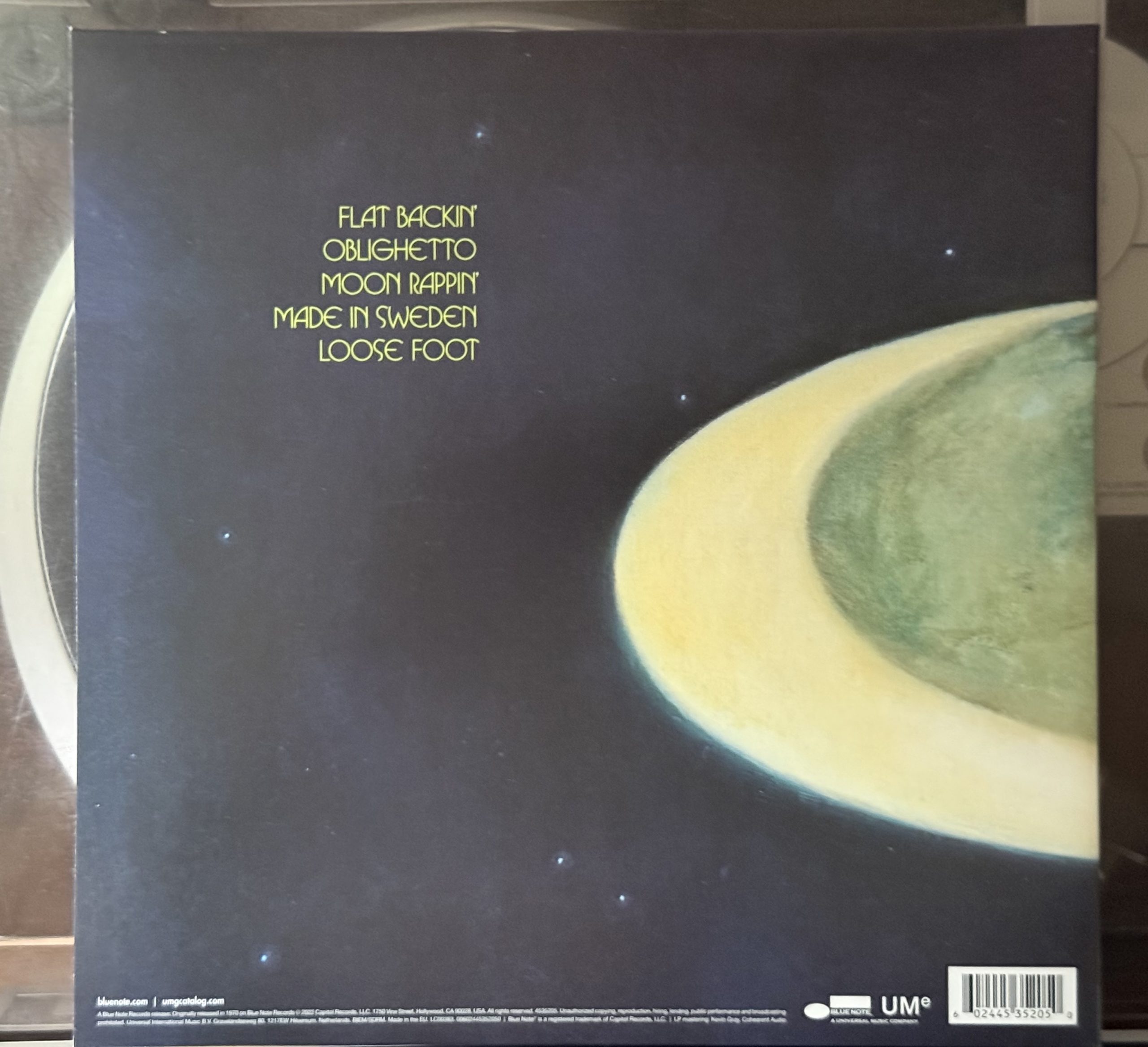
Brother Jack McDuff, Moon Rappin’

Brother Jack gives us an album that’s alternately spacey and bluesy, and hints at where jazz organ was about to go.

Album of the Week, September 27, 2025

By 1969 a few things had changed in the jazz world. Some of the old formulas for how jazz worked on albums like Brother Jack McDuff’s Hot Barbeque had started to morph, influenced by what was happening in rock and roll (and responding to the shift of youth attention from jazz to rock music). In particular, Miles Davis was listening to Jimi Hendrix, and the music he made in response on records like Filles de Kilimanjaro and Bitches Brew brought a different conception of the role of guitar in improvised music. But other genres were colliding with jazz, particularly funk.

We’ve talked about jazz-funk before in the context of CTI Records and of Herbie Hancock’s glorious Fat Albert Rotunda. By 1969, Blue Note Records had started to embrace this sound in a significant way. Jack McDuff had signed to Blue Note after a brief stint with Atlantic Records, and for this, his second album, he brought together a small army of younger musicians, including Joe Dukes on drums (and a guest appearance from Richard Davis on bass for two tracks) and dove into some truly strange, but truly glorious, jazz-funk explorations.

Flat Backin’” starts us off in fine form, with the melody stated by Richard Davis’ funky, funky bass and a flourish on the drums from Spider Bryce, and a spiraling guitar line from Melvin Sparks that pans right to left. When McDuff enters on the Hammond, he’s right in the middle of everything, including a horn section that appear for a moment and then back away as the cymbal and bass restate the groove. And then—zowie!—it’s as though the track travels back in time at least ten years as the bass groove falls back into a swinging fast four and the band gives us a scampering improvisation, only to fall back to that groovy bass and an echo-laden guitar freak out, followed by a Hammond solo. Structurally the track keeps returning to that bass groove. It’s undeniably cool—not as out there as Bitches Brew but still fun to listen to.

Oblighetto” is a more straightforward blues, given juice by Sparks’ guitar, right up until we get four measures of unexpected chords from McDuff and a spacey vocal in a minor mode, à la Star Trek. And then we shift gears again into a fast four as McDuff and drummer Vince DiLeonardi give us a little boogaloo, only to return to the minor mode and vocals once more. The band finishes with a return to the boogaloo, and one more minor chord.

Moon Rappin’” is another jazz-funk workout, with a Richard Davis bass line and a winding chord progression that exercises both McDuff and the horns. After the lead, the band settles into a groove around a fifth, on which the horns unfortunately blow a little out of tune. But the reverby McDuff piano solo makes it all worthwhile. We then get a tasty minor blues that adjusts the bass line melody from “Flat Backin’” into something anticipatory and deeply funky, especially as Melvin Sparks’ guitar seems to reverb into outer space.

Made in Sweden” threatens to invade “Take Five” territory, but it’s in six rather than five, and the melody goes in a slightly different direction, staying more closely wedded to the groove. Ron Park’s flute is a great addition to the theme, but the real star is McDuff’s Hammond, which threatens to levitate into outer space throughout his solo. A drum break separates the second half of the tune, in which a two-note riff moves from the organ to the horns and back “Loose Foot” picks up where “Made in Sweden” left off, but it’s a more straightahead tune and a showcase for Ron Park’s tenor sax. McDuff gives us a blues-forward solo in which he displays his virtuosic touch on the organ. The band closes out the outer-space album in a most grounded way, with the blues.
McDuff was a survivor; he kept on recording through the ’70s, even as commercial interest in jazz collapsed, and enjoyed a career renaissance in the late 1980s and 1990s, recording albums for Muse and Concord Jazz. He died in January 2001, less than a year after touring Japan at age 73. While he certainly picked up influences from the jazz-funk movement, he never tipped over into the sound wholesale. But other jazz organists did, and in a few weeks we’ll hear one of the most famous examples of the genre. Before we get there, though, there are a few other interesting corners of the jazz organ world to explore; we’ll hear one next week.

You can listen to this week’s album here:

BONUS: I included “Flat Backin’” in my “Cooking with Fat” episode of Exfiltration Radio, an hour-long exploration of jazz-funk. You can listen to that radio show below:

New mix: Exfiltration Radio, Cooking With Fat

It’s a Veracode Hackathon, so it must be time for an Exfiltration Radio playlist! This time, naturally, the musical choices were influenced by all the Miles-related jazz I’ve been writing about over the last few months, as well as an unlikely source: my Apple Music library maintenance.

So, when you source your library from iTunes Store purchases, third-party high-res music providers like HDTracks and Bandcamp, and CD and vinyl rips, you end up with pretty big music files and a lot of music. Too much music to fit on the internal hard drive of most Macs. I’ve been using an external drive for my media for many years now. Mostly it works fine. When it doesn’t, though, it’s disastrous. There is some kind of error condition in Apple Music that causes it to freak out when the external drive is temporarily unavailable and re-download all the music in the iCloud library. Which is OK, I guess, except when the external drive comes back online, you now have two copies of all the music in your library. Or, if it happens again, three.

I’ve figured out a rubric for cleaning this up, which will be the subject of another post. But I’ve been going through all the music in my library album by album, and in the process creating new genres to make it easier to find some types of music. In particular, the genres that inspired this mix were Jazz Funk and Fusion. The latter needs no explanation due to our journey with Miles; jazz funk is just the hybrid of a bunch of different strains of African American music with a heavy focus on improvisation over a funky beat. The end mix combines some tracks I’ve already written about with some more modern jazz from my collection; I’ll provide notes for each track below.

“Wiggle-Waggle,” from Fat Albert Rotunda: the track that got the most comments from my write-up of Herbie Hancock’s TV show soundtrack, with friends noting how it sounds like this track dropped in from another dimension.

“Chunky,” from Live: Cookin’ with Blue Note at the Montreux Jazz Festival, by Ronnie Foster. I’ve programmed Foster’s great “Mystic Brew” in past Exfiltration Radio segments, including the Hammond special. This is a live version of the opening track from the same album, Foster’s great Blue Note debut Two Headed Freap. There’s a lot that’s different about his approach to the Hammond organ compared to earlier artists, but all I can say is: he funky.

“Flat Backin’,” from Moon Rappin’ by Brother Jack McDuff. Speaking of earlier artists, a lot of McDuff’s early work was squarely in the “soul jazz” category (like his great Hot Barbecue), but by the time of this 1969 album McDuff was on another planet, and the electric guitar and bass land the music in Funklandia.

“Funky Finger,” from The Essence of Mystery by Alphonse Mouzon. We have seen Mouzon on the first Weather Report album, but his solo debut for Blue Note is another thing entirely. Despite the name, it’s got less of the mystery of Weather Report and more of the funk, and this track is a great example.

“Sugar Ray,” from Champions by Miles Davis. “That’s some raunchy sh*t, y’all.” Listen to how the chord changes are so wrong, the way they just walk over to an adjacent major key and then settle back into the original as though nothing happened. Also note the remarkable Wayne Shorter solo.

“Superfluous,” from Instant Death by Eddie Harris. Sampled on “What Cool Breezes Do” from Digable Planets’ Reachin’, this is an instant classic.

“The Griot,” from Henry Franklin: JID014 by Henry Franklin, Adrian Younge and Ali Shaheed Muhammad. Composer Younge and former Tribe Called Quest member Shaheed Muhammad have been having a blast recording albums with their jazz idols in the Jazz is Dead series, and this newer release with bassist Franklin, who played with Freddie Hubbard, Bobbi Humphrey, Archie Shepp, Willie Bobo, Stevie Wonder and others, is a tasty slice of funk anchored by his acoustic double bass.

“Tell Me a Bedtime Story,” from Fly Moon Die Soon by Takuya Kuroda. This funky cover of Herbie Hancock’s original from Fat Albert Rotunda is a great example of latter-day jazz-funk, with the arrangement draped (or smothered, depending on your taste) in layers of Fender Rhodes, synths, and electric bass. Kuroda’s incisive trumpet anchors the arrangement and lifts the funk to another level.

“Timelord,” from Inflection in the Sentence by Sarah Tandy. A great 21st century London jazz album, featuring Tandy on both acoustic piano and electric keys, the latter notably apparent in this moody track.

“Where to Find It,” from SuperBlue by Kurt Elling. I’ll write more about this track another time, but it’s worth noting that Elling is one of the few vocalists to brave the task of putting lyrics to modern jazz tracks like this one, Wayne Shorter’s Grammy award winning “Aung San Suu Kyi.”

Enough words. “We have taken control as to bring you this special show, and we will return it to you as soon as you are exfiltrated.”