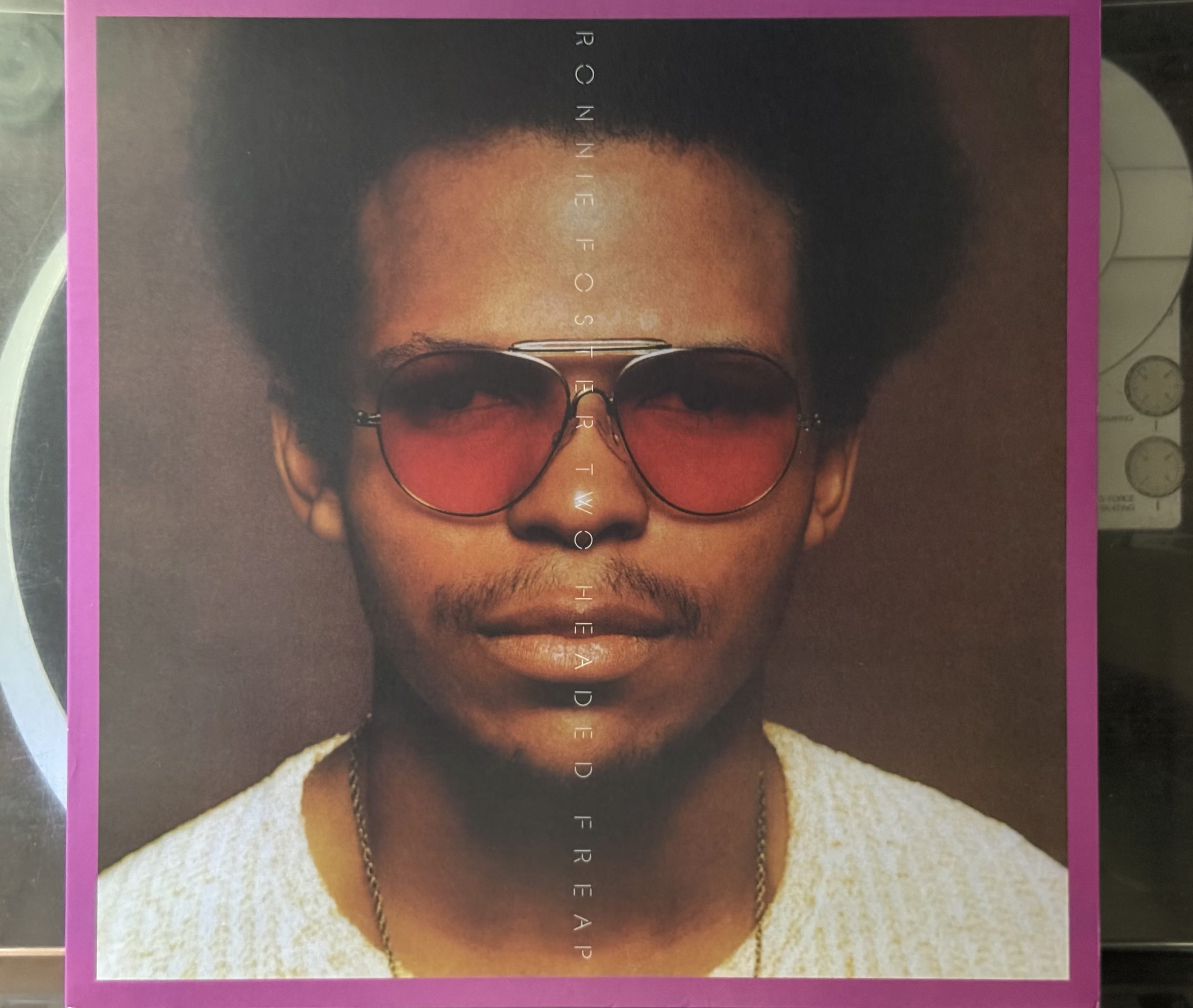
Album of the Week, October 11, 2025
Blue Note Records in 1972 was not the same label that it had been in , or even in 1963. Duke Pearson’s run as head of A&R had shifted the label from the straight-ahead jazz favored by his predecessor Ike Quebec to something a little more au courant. But even Duke was gone, leaving the label in 1971, the same year that label co-founder and famed album cover photographer Francis Wolff died. The label’s corporate parent, Liberty Records, was absorbed by United Artist Records the same year. And A&R executive George Butler took over the label, coming from United Artists, and sponsoring a number of projects aimed at crossing over between the jazz and soul audiences to build more market momentum for the label. Among the artists crossing over in this way were flautist Bobbi Humphrey, guitarist Earl Klugh, trumpeter Donald Byrd, and today’s artist, Ronnie Foster.
Foster grew up in Buffalo, New York and was interested in music from an early age, playing his first show (in a strip club) at age 15. He was not formally educated in jazz, receiving only a month of musical instruction—on the accordion. For this, his first record, he assembled an assortment of musicians that included George Duvivier on bass, Gene Bertoncini on guitar, Gordon Edwards on bass guitar, Jimmy Johnson on drums, Eugene Bianco on harp, George Devens on percussion and vibes, and Arthur Jenkins on congas. Motown producer Wade Marcus, who also had arranged Blue Note sessions for Bobbi Humphrey, Grant Green, Horace Silver, and Marlena Shaw, did the arrangements.
“Chunky” starts out hard with distorted guitar over a four-four beat from Johnson, followed by a syncopated figure from Foster on the Hammond, a long vamp over a four-chord sequence. A sudden shift to a different minor chord provides a quick four-measure bridge and we’re off to the races. Foster’s improvisation is primarily in the right hand, playing runs, venturing out into different tonalities, even quoting the “Love Supreme” progression at one point. His solo goes into runs, chromatic up and down figures that are played so that they smear together, and sustained notes that transition into out-of-tempo arpeggios. The track fades out, leaving us with just a hint of Foster’s rhythmic and improvisational imagination.
“Drowning in the Sea of Love,” a hit written for Joe Simon by Kenny Gamble and Leon Huff, is played as a straight cover of the bluesy soul hit, with lots of color from Bertoncini and George Devens’ vibes. Foster’s playing shows off his harmonic ear, as he harmonizes with the melody and then gives a couple blasts on the organ to introduce the solo proper. He has a pattern here and in “Chunky” of playing with time and meter in a way that seemingly breaks his improvisation free of the groove, right up until the fade-out.
The introduction to “The Two-Headed Freap” could have been titled “Chunky Pt. 2,” with the same pattern of blasting chords almost to the same rhythm. But the chords are a different progression, almost discordant, and things change quickly into a bluesy salsa-inflected solo with a nine-beat turnaround. Foster’s solo gives us a nasty (in a good way) breakdown in the last minute that calls to mind some of Jimmy Smith’s work.
“Summer Song” is an original with melody played by Bertoncini and Devens, over a growling bass line, before Foster’s solo. Here his technique is very different as he works with sustained suspended notes and chords as well as a right hand solo line that stays in the upper octave. The basic materials are fairly static, with vamps over chords that rock back and forth, but George Duvivier’s bass part (not quite a solo) is worth the price of admission.
“Let’s Stay Together” is a cover of Al Green’s hit, which again benefits from Duvivier’s bass as Foster tosses riff after riff off in his solo. The organ seems to have irrepressible energy, riffing at double speed over the groove, right up to the fade-out. “Don’t Knock My Love” is another cover, this one of Wilson Pickett’s last number one hit. Where the original benefited from a measured funky groove, Foster’s cover seems to lack some of the funk of the original even as it speeds up the tempo by a click or two. The fuzz distortion on the guitar doesn’t help matters here as the band threatens to come unglued during the endless wind out.
The fade-out takes us into “Mystic Brew.” Easily the most memorable track on the album, certainly the most sampled, the track opens with a double bass line from both Duvivier and Gordon Edwards, forming a bedrock for the entire song. Bertoncini and Devens’s vibes repeat the tonic together with Eugene Bianco’s harp. Bertoncini doubles Foster as he plays the relaxed main theme, which seems content to hang out on the tonic as Devens and Bertoncini elaborate around the edges. Foster’s solo is more disciplined here, with the first iteration playing with multi-measure suspensions, the second with syncopated eighths, the third evolving into triplets and then rolling sixteenth and even 32nd notes. The performance, in addition to being a complete pleasure, illustrates the ingenuity and athleticism that Foster brings to the table.
“Kentucky Fried Chicken” closes out with a slightly funky riff on a minor third over a funky bass, then shifts gears over a series of odd suspended chords for a moment. Bertoncini gets a brief solo before Foster plays his games with meter and time, at one point chattering like a hen, changing keys, and ripping through a set of arpeggios. So we end as we began, with Foster improvising straight into the fade-out.

Foster cut a series of albums for Blue Note as a leader, including a pretty great Live at Montreux in 1973. He was less successful after leaving the label for Columbia, recording two albums there and one for Pro Jazz between 1978 and 1986. But he produced almost 100 records and had hundreds of sideman credits, including a collaboration with George Benson that began on 1975’s Good King Bad. We’ll hear from him once more, from later in his career. But next week we’ll hear a famous record from an artist who went through a remarkable shift of his own in the early 1970s.
You can listen to this week’s album here:
BONUS: Foster’s live performances of material from this and other albums are spectacular. You can find some on the officially-released Ronnie Foster Live: Cookin’ with Blue Note at Montreux. Here’s “Chunky”:
BONUS BONUS: “Mystic Brew” became an unlikely standard of sorts through sampling and latter-day covers. Notably, A Tribe Called Quest sampled it for “Electric Relaxation” from their 1993 album Midnight Mauraders:
BONUS BONUS BONUS: Maybe the most unlikely cover of all is the way I first heard “Mystic Brew,” in a version by Vijay Iyer’s trio on his 2009 album Historicity: