Album of the Week, October 25, 2025
The way I have structured this series is inherently unfair to some of the artists I write about. Basically, unless I have the album on vinyl, I don’t write about it. This means that I’ll never write about some artists, and others will be represented by albums that don’t represent their most significant work.
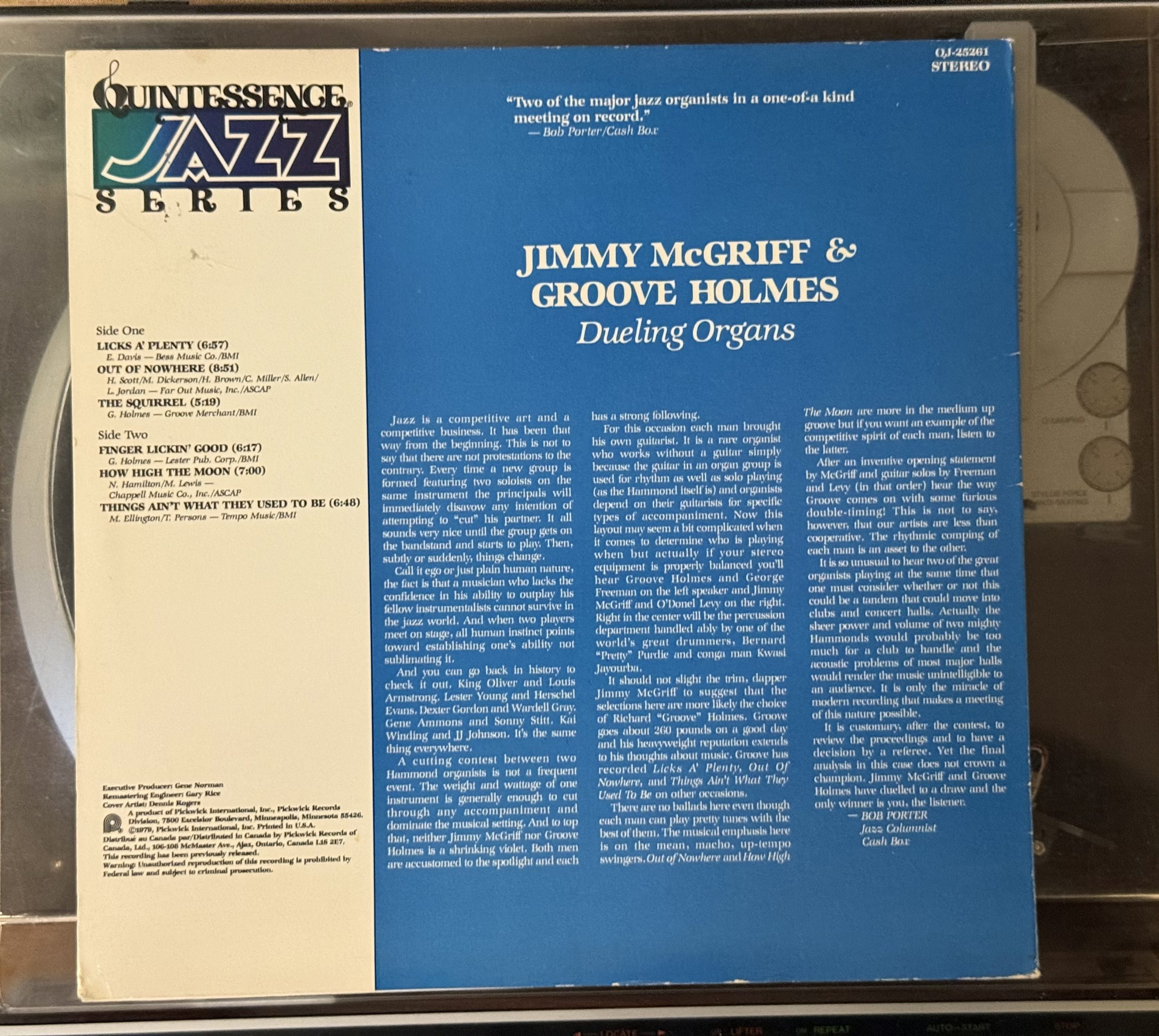
Such is the case with this week’s album. Originally released in 1973 on the famed Groove Merchant label as Giants of the Organ Come Together, it was gifted with a bizarre cover illustration and a much shorter (and inadvertently suggestive…) title when Pickwick’s subsidiary label Quintessence re-released it as part of their Quintessence Jazz Series. Both organists featured on the record had long careers of their own. Jimmy McGriff cut over sixty records on a variety of labels from the early 1960s to the early 2000s, including Blues for Mister Jimmy and Groove Grease. He got his start with the Hammond B-3 organ when he heard one played at his sister’s wedding by a man who turned out to be Richard “Groove” Holmes. Holmes had about forty records to his own credit, from 1961 to 1991 when he passed away from a heart attack; his most famous was a 1965 version of “Misty” that hit the Hot 100.
The liner notes correctly point out that recording two Hammond organs at the same time is challenging; the instrument isn’t subtle (or light), and a two-organ setup would have been challenging to mike in the studio—but still easier than getting two organs into the average nightclub or concert hall. But the producer, Sonny Lester, persevered. He placed Groove Holmes and his guitarist, George Freeman, in the left channel, and Jimmy McGriff and his guitarist, O’Donel Levy, in the right. Straight down the middle were conga player Kwasi Jayourba and redoubtable funky drummer Bernard Purdie.
“Licks A’Plenty” is what it says on the package, a battle of dueling voices. Here we hear both organists start out, followed by the mellow tones of Jimmy McGriff’s instrument and O’Donel Levy. It’s interesting to compare their approach to Jimmy Smith with Kenny Burrell; where Burrell answered Smith’s licks, Levy plays alongside McGriff, playing runs and chords as a kind of counter-solo and showing why the organist brought his own guitarist. Groove Holmes plays a series of chords and then lets George Freeman take a solo, while McGriff supports with rhythm from the other channel. Holmes returns the favor for Levy’s solo as well. There’s lots of back and forth here, with some supportive work as well as spotlights for Purdie and Jayourba, and even an Acme siren whistle at one point. Everyone appears to be simultaneously having a great time and trying to outdo his neighbor, which is what the best cutting contests are all about.
“Out of Nowhere” starts with a Jimmy McGriff solo and rolls from there, with Holmes supporting him with chord stabs at the turns of each phrase. Freeman takes a laid-back solo with repeated notes on the dominant that builds through the repetition; Levy’s no-nonsense solo is more rapid but similarly relaxed. Groove Holmes takes a solo in a higher octave that builds tension through sustained notes; McGriff does a blast of rapid vibrato that eggs him on.
“The Squirrel” is one of two tunes credited to Holmes and McGriff. It’s a tune that features the band with McGriff playing what almost amounts to commentary after each phrase. Again, Freeman builds a minimalist solo with repeated licks; Levy is positively extroverted by comparison, with notes scampering over the fretboard.
“Finger Lickin’ Good,” the other original on the album, is sadly not the song sampled by the Beastie Boys in their song of the same name, though they clearly had this album in the studio given that Check Your Head also features a song called “Groove Holmes.” But this one is an instantly recognizable classic, with chord stabs from Holmes answered by running notes from McGriff and the guitars. The band takes this cheery blues around the world, with each organist and guitarist taking a solo as the other players support them. There’s a moment at the end of the song where Holmes’s organ makes a sound as though it’s being run through a wah-wah pedal, and the whole band shifts into a hemiola as things fade out.
“How High the Moon” is as close as this record gets to a ballad, with both organists playing swoony turns on the classic melody. Holmes in particular shines here with a solo that swoops up into the high corners of the tune. The record concludes with a briskly virtuosic take on “Things Ain’t What They Used to Be,” replete with stabs on the organ from Holmes, laid back licks from McGriff and Levy, and a bluesy guitar solo from Freeman. Groove Holmes takes a full twelve bars of tremolo that builds to a screaming climax, then trades licks with McGriff all the way to the end.
Under whatever name you refer to this collaboration, it’s an oddly fun one, hearing the two masters of the organ trade ideas and licks back and forth, and as a bonus has one genuine classic in the form of “Finger Lickin’ Good” that sits alongside “The Cat” in the ranks of organ combo standards. It’s definitely worth seeking out the records that each organist made under his own name, but this session is a lot of fun to listen to as well.
There were some dry years for organ combos over the next little bit, but younger players have come along to claim the mantle of these greats. We’ll spend a bit of time with one of them over the next few weeks as we draw nearer to the end of this series.
You can hear this week’s album here (under its original title):
BONUS: The duo of McGriff and Holmes also cut a live album with this set-up. Here’s “The Preacher’s Tune” from Giants of the Organ in Concert: