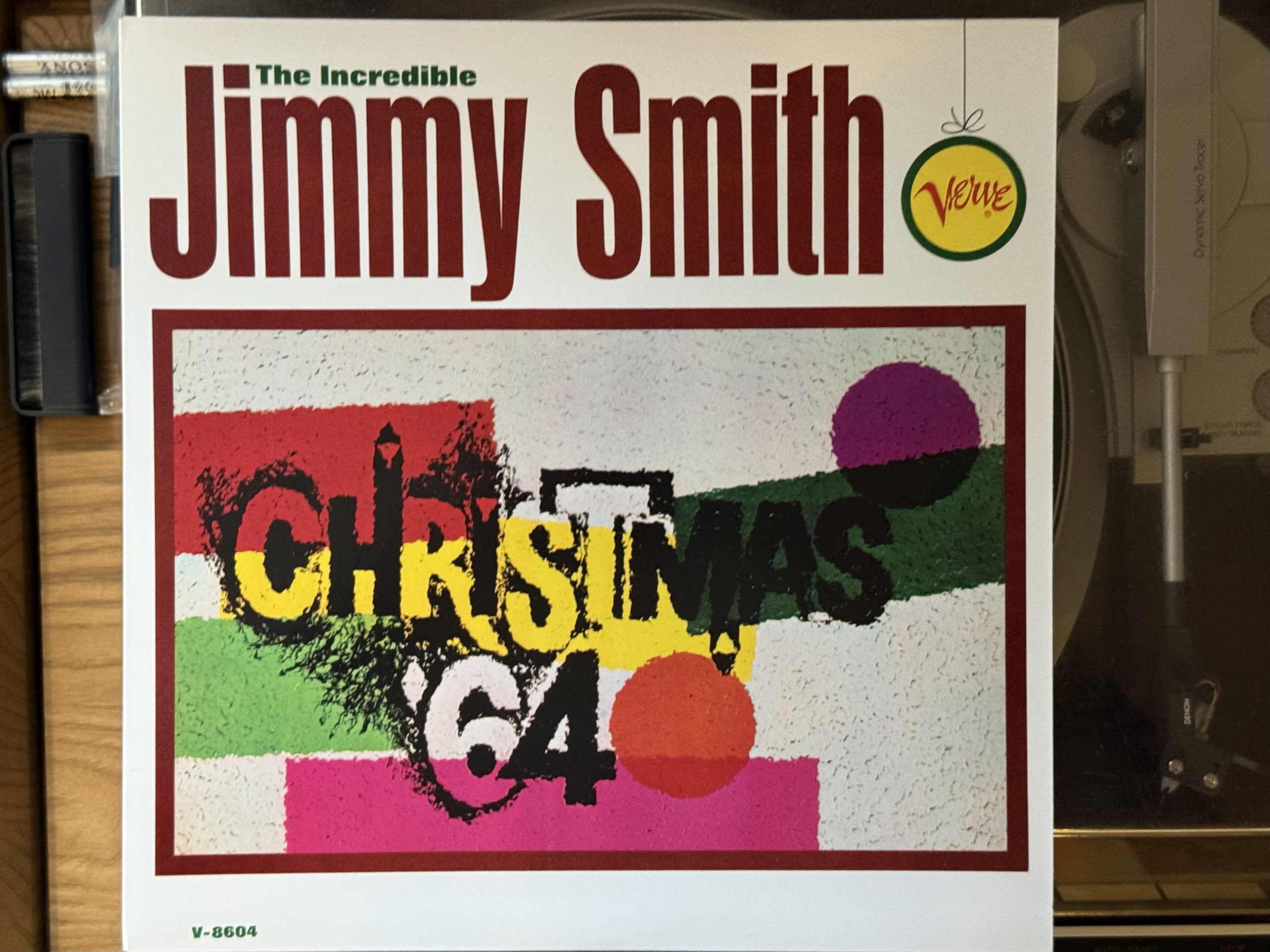
Jimmy Smith, Christmas ’64

One more organ record—maybe the best known of them all—brings us into this year’s holiday season.

November 29, 2025

Remember how I signed off last week saying we were going to “take a break for some seasonal music,” bringing this run of articles on the jazz organ to a close? Wanna know who our first purveyor of seasonal music is? (Squints) Oh yeah, Jimmy Smith. Had I planned better I could have set this up as a great segue from the organ combo articles into the holidays, but as it is you’ll have to settle for an absolutely spectacular album of both jazz organ and holiday music.

Jimmy Smith in 1964, on Verve, was at the height of both his musical powers and his bankability, and Creed Taylor was not the sort of producer who was above stretching the popularity of his artist for some additional revenue via the time-honored tradition of the Christmas album. Coming off his one-two punch of The Cat and Who’s Afraid of Virginia Woolf?, you’d be forgiven for expecting that Smith would take things easier on this holiday album. But with a band consisting of many of the musicians who made those great recordings, including Kenny Burrell (and Quentin Warren) on guitar, Art Davis on bass, Grady Tate (and Billy Hart) on drums—plus a whole orchestra that included Jimmy Cleveland on trombone and the elusive Margaret Ross on harp, among others—and charts by Billy Byers and Al Cohn, there was no room for slacking here. This is a seriously hot record, and a fantastic Christmas album to boot.

God Rest Ye Merry Gentlemen (Big Band version)” begins in big band fashion indeed, with a low-brass processional full of pomp and accompanied by the timpani, right up until “tidings of comfort and joy.” At which point the trumpets call a blue fanfare and Jimmy rolls in. The band continues with a “Slaughter on 10th Avenue” style take on the tune for one more verse, but then Jimmy takes the reins and plays a clean organ trio verse with Kenny Burrell and Grady Tate that is telepathically tight and funky. The horns rise up behind the trio like an incipient ambush until they take one more verse, but Jimmy gets the last word.

Jingle Bells” is a fine and mellow tune for the trio. Check Grady Tate’s subtle explosions behind the band as well as Jimmy’s understated organ part. The slow crescendos on the two held arpeggios are the only loud part of the arrangement, which fades out just as it gets going. It’s cool—something that can’t be said for the opening of “We Three Kings of Orient Are,” which sports a full symphonic brass arrangement that’s well-nigh Mahlerian, courtesy of saxophonist/arranger Al Cohn. But then it turns the corner into a gospel shouter and we’re really off and running. I would have been pleased to hear a side-long take on the middle bit of the arrangement, but here it’s bookended by an outro version of that opening.

The Christmas Song” is more swinging, with both Jimmy and the band in a laid back mood. The horns are swinging so hard they’re practically a beat behind, and Jimmy happily burbles bits of mood before playing a doggedly on-model melodic solo as the horns provide chromatically oracular pronouncements. A high chorus of trumpets brings us into a double-time solo wherein Jimmy stretches out over a frantic bit of Grady Tate drumming, then back to the chorus which slowly builds to a massive climax, punctuated by a chime before the final chorus.

The trumpets give us a “White Christmas” opening that could be played by the Boston Pops, key change and all, before Grady Tate takes us into bossa nova land. Jimmy’s solo is low key, in the baritone range, at least until the horns take it up a notch, at which point we get a little happy double time arpeggio, a final chorus, and a little “Jingle Bells” quote to wrap it up.

Santa Claus Is Coming to Town” is a trio number with Quentin Wells and Billy Hart, featuring Jimmy and Quentin trading off licks. The stereo separation (guitar in the left channel, organ in the right) is the only thing that helps to piece apart the players at the beginning, so close is the harmony, especially since Jimmy is soloing without much vibrato. Quentin Wells is a bluesier player than Kenny Burrell and he leans into that here, both in his solo and in the stabs of chords he plays under Jimmy’s solo. Jimmy starts out mellow but builds intensity through his usual tricks, particularly leaning on the tonic and playing bursts of arpeggios around the edges of his solo, all the way into the fade-out.

It’s another Pops-style arrangement for “Silent Night,” complete with bells and flugelhorn, then a handoff to Jimmy and the trio who do what they do best, a brisk, unsentimental swing through the tune. The horns make like “The Cat,” briefly, in the climax of their accompaniment to Jimmy’s solo—indeed, the only thing to criticize here is that they actually overwhelm the organ for the only time on record.

God Rest Ye Merry Gentlemen (Trio Version)” starts right in, sounding a bit like Jimmy’s version of “Greensleeves.” The trio with Quentin Warren and Billy Hart swings convincingly, with Billy’s snare work so powerful that it causes a secondary rattle somewhere between the snares and the ride cymbal. Jimmy spools off riff after riff in his solo, as Quentin Warren walks around the chords, keeping the rhythm going strong. At several points, it sounds as though the group will fade out, but the producers wisely keep rolling tape as the trio lands the hottest number on the whole record at the very end. Finally as the trio returns to the opening vamp, the engineers bring down the sliders and fade it out into the dark.
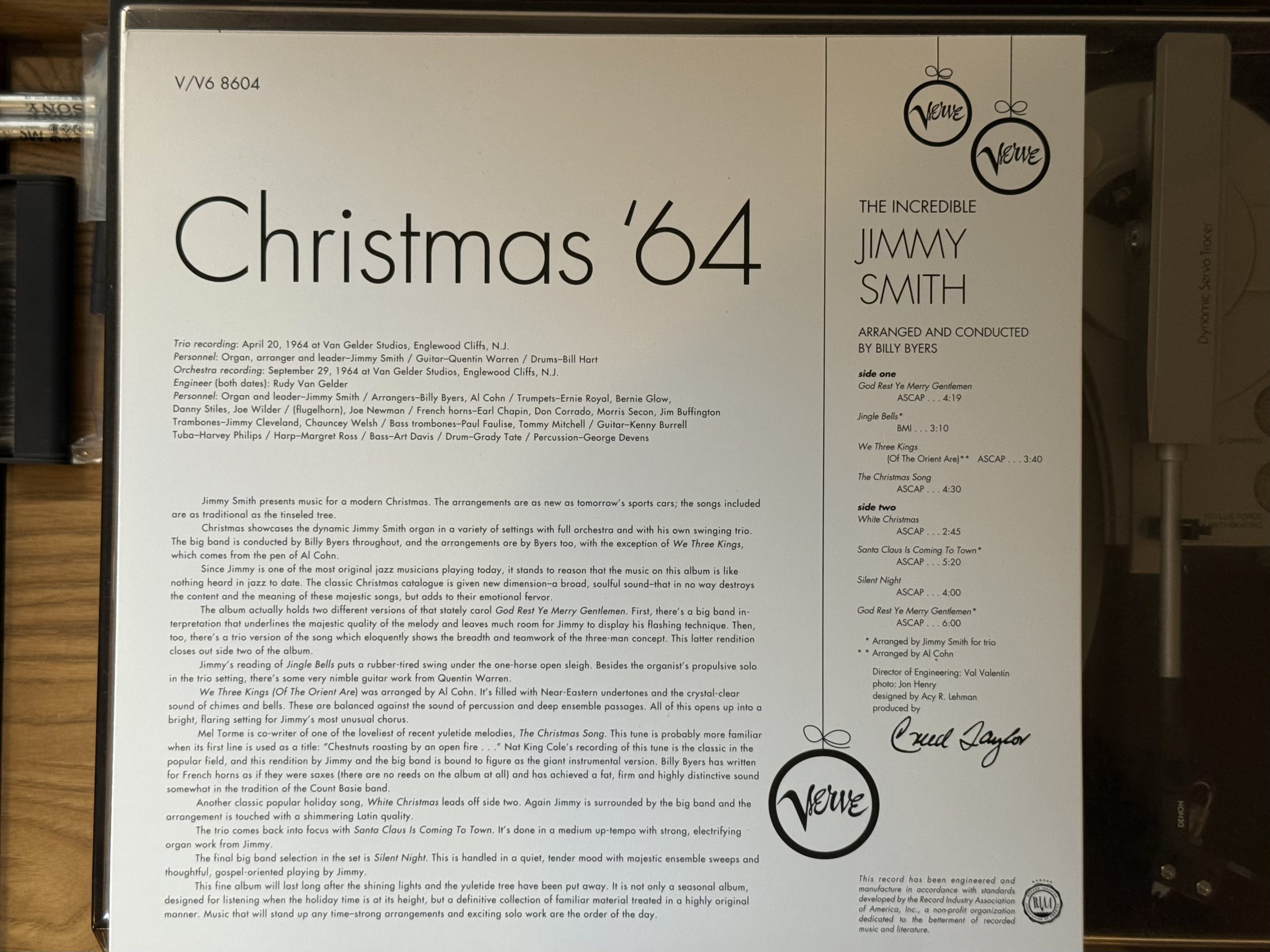
About the only thing wrong with Christmas ‘64 is the title; though it wasn’t the only Verve album to include the year in the title, it was clearly not a good choice for a title for a holiday album, which tend to sell between Thanksgiving and Christmas but can continue to rack up sales for many years. Retitled and with a new cover, the album had a long life under its new name, Christmas Cookin’, including in its CD reissue which included two other tracks, “Greensleeves” from Organ Grinder Swing and “Baby It’s Cold Outside” from Jimmy and Wes: The Dynamic Duo.

The better known cover and title for this week’s album as reissued in 1966, courtesy Discogs.

Next week we’ll stay in the jazz lane, with a holiday album by one of the players on this week’s set. You can listen to this week’s album here:

BONUS: This album and its related tracks cast a long shadow over holiday jazz records. The late great Joey DeFrancesco included a rearrangement of Jimmy’s “Greensleeves,” as “What Child is This,” on his superb 2014 album Home for the Holidays:
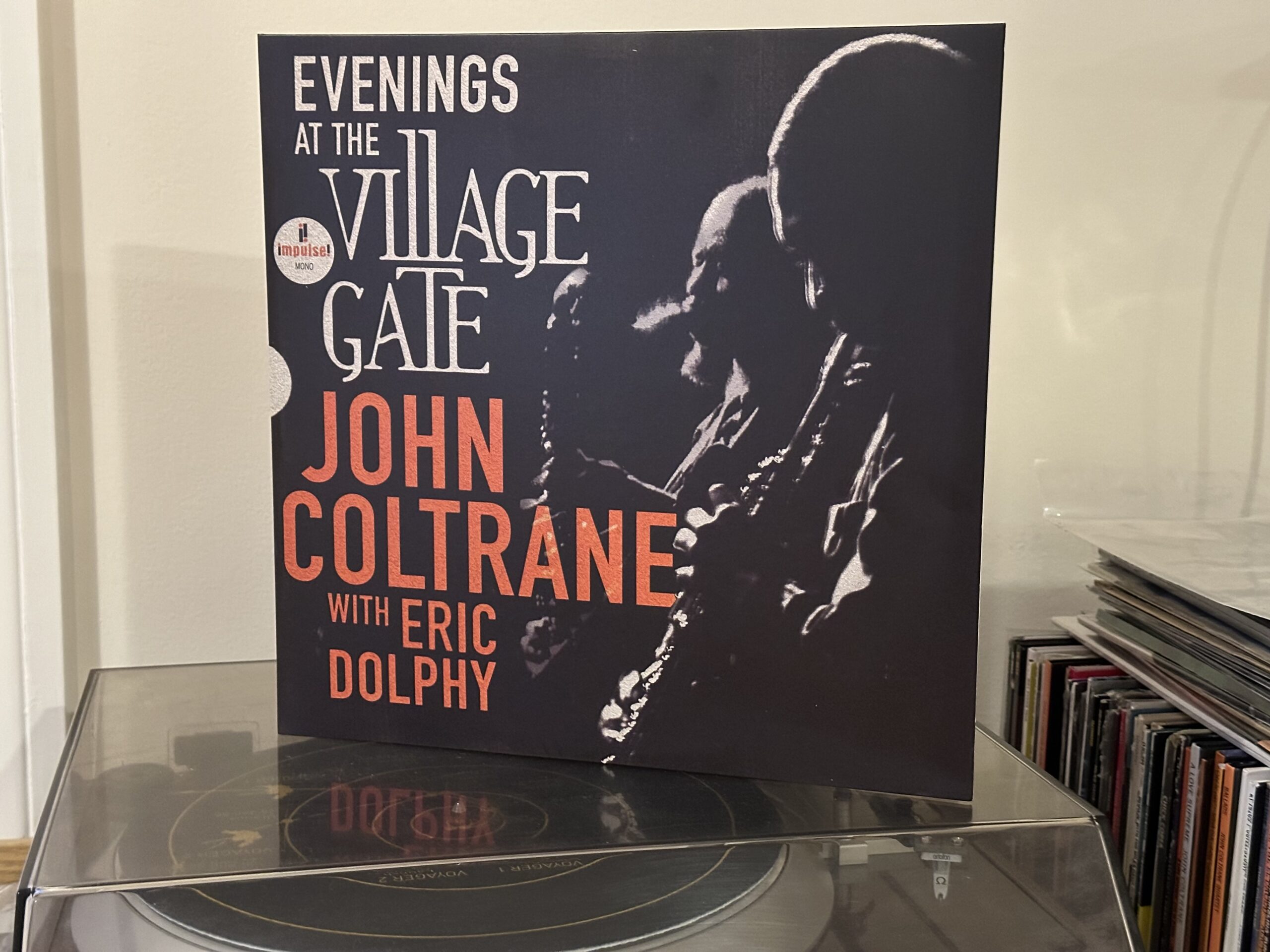
John Coltrane with Eric Dolphy, Evenings at the Village Gate

Album of the Week, January 20, 2024

In the early 1960s, John Coltrane’s studio recordings were expressive and harmonically innovative, but still followed a recognizable jazz form: statement of the melody, or head; solos that were structured around the chords of the melody; a recapitulation of the head. But other musicians were starting to innovate on that form, moving away from the structure of playing over the chord changes. Miles moved to improvisation over modal scales, as we’ve seen. And other musicians went even further, rejecting consistent chords in favor of more unlimited explorations. Ornette Coleman’s 1960 album Free Jazz gave the movement a name, and others explored its ideas. One of the most promising of them was saxophonist and flautist Eric Dolphy. And when Dolphy met Trane, it changed the older composer’s trajectory.

Trane and Dolphy had met years previously in Los Angeles, and when Trane began performing in New York in the summer of 1961, he invited Dolphy to join his group. Additionally, his group included two bassists; Trane liked the freedom the second bass offered to have both a constant “ground” or repeated fundamental note in the chord, while the other bassist was free to be a more melodic voice. So the group included Dolphy, Reggie Workman (who had replaced Steve Davis), Art Davis, and Elvin Jones and McCoy Tyner from Trane’s quartet, last heard on Coltrane’s Sound.

Until recently, the main documentation for Trane’s New York sessions with Dolphy consisted of recordings from his residencies at the Village Vanguard in the fall of 1961, including 1962’s Live! At the Village Vanguard and half the tracks on 1963’s Impressions; both recordings have Jimmy Garrison replacing Art Davis. But last year a recording was found at the New York Public Library of an earlier residency, from July 1961, at the Village Gate. The recording shows off Trane’s emerging free concept at a transitional moment. Much of the repertoire is familiar from his 1961 releases, but the performances are very different.

Where the studio version of “My Favorite Things” begins with a modal progression and a clear statement of the theme, this live version jumps right in with an extended Eric Dolphy flute solo. It’s actually not clear from the recording whether the song begins here or if the recording started after the statement of the theme, but he improvises for an extended period over the minor chords of theme, eventually coming into a statement of the second eight bars of the melody (ending in “these are a few of my favorite things”) before entering another extended improvisation. He finally brings this solo to a close some six minutes in, and Trane steps up on soprano sax, stating the theme before signalling the beginning of his improvisation with a sustained blast on the tonic. His solo hugs the high end of the range, stretching out the ideas in his solos on the studio version. A phrase that might have occupied a measure or two on My Favorite Things here gets extended to 16 or 32 bars, with Trane continually extending and searching forward. Beneath the solos, Elvin Jones continually propels the beat forward. On this archival recording live recording, the bass is less audible than if Rudy Van Gelder were taping, but you can hear both the constant ground and the melodic improvisation of the two players.

When Lights are Low” has both a straight version of the melody and a keening dervish-like improvisation from Trane’s soprano sax. Dolphy anchors the low end of the line with his bass clarinet, underpinning the dizzying improvisation of Trane’s soprano sax with an earthier tone. Tyner gets a solo that sounds more conventionally structural than anything else in the 80 minute long set, but which is almost as equally searching within the limits of chromatic tonality as some of Trane’s Pentecostal honks. Throughout, Jones continues to drop explosions. I once saw the Elvin Jones Jazz Machine in Old Cabell Hall at the University of Virginia, in 1993; at the age of 66, he was easily the most muscular and dramatic player I saw that weekend, and you can hear his work throughout this set.

Impressions” is a track that Trane never released on a studio album; the only two studio recordings extant weren’t released until 2018—but the many live performances he did often featured the track, including its appearance on the 1963 half-live album that is its namesake. Here the track has all its hallmark features—the use of the “So What” chords, especially the uptempo live version that Miles preferred and that features on the Live in Copenhagen recording. Trane takes a shorter solo here and lets Dolphy and Tyner explore the sounds before stepping back up to close out the tune. It feels more formal and less wild than the version from Impressions, recorded just four months later, but the seeds of the approach were clearly already planted.

Trane finished the set with “Greensleeves” and “Africa,” both of which featured on his Africa/Brass album, which was still about six weeks from release at the time of these sessions. “Greensleeves” feels a lot like the “My Favorite Things” arrangement, anchored in a modal two-chord pivot that Tyner keeps going throughout the arrangement, but made wild and new by Trane’s explorations. Dolphy is mostly in the background on bass clarinet for these cuts as Trane explores the sound being created by the group. When the horns drop away, leaving a Tyner-anchored piano trio, it’s almost a shock, even as Tyner’s powerful clustered chords keep the momentum of the full band track going. “Africa” is a wilder, looser tune, less anchored in chords and more a free modal exploration. It also features the one part of the set where you can clearly hear what Reggie Workman and Art Davis were up to, in an eight minute long duet. Workman’s melodic playing explored the upper end of the instrument’s register before finding a rhythmic dance against percussive string slaps and a grounding thrum from Davis. Jones takes center stage as well, dislodging the pulse in space and time, before Dolphy and Trane return for a final hurrah—and applause from what sounds like a small audience in the club.

Trane’s group with Dolphy would last almost through the end of the year. Ultimately Dolphy moved on to play with Charles Mingus, where he could play a more central role in the sound of the group; Reggie Workman would move on as well following a European tour. Ultimately Trane found a mixed reception for his experiments with Dolphy, with some critics calling the sound “anti-jazz.” He would regroup in the following year and take his sound in another very different direction. Before we check in on the outcomes of those explorations, though, we’ll listen a little more closely to what some of his sidemen were bringing to the table.

You can listen to this week’s album here: