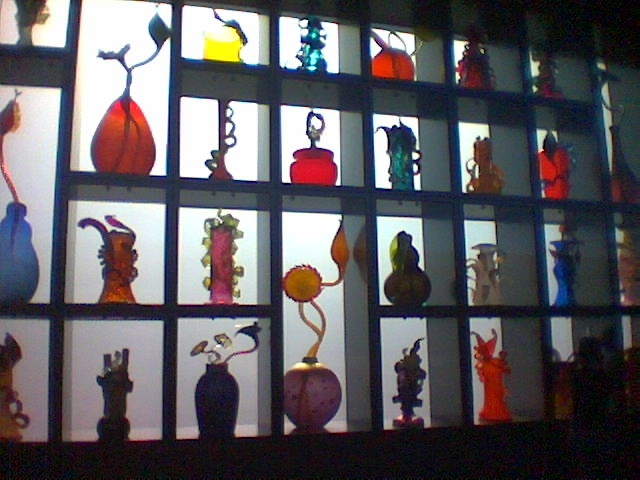
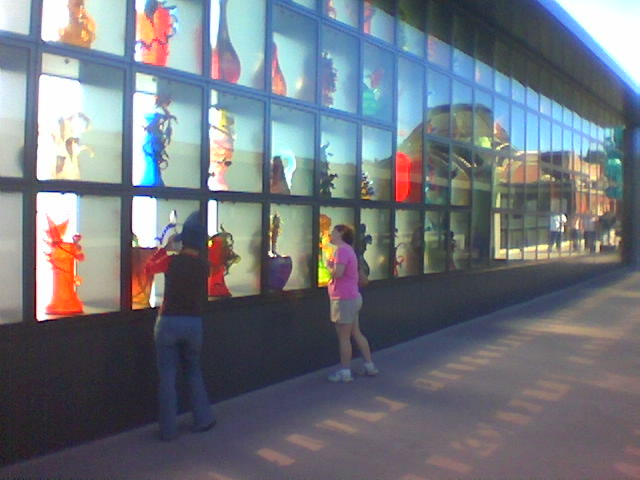
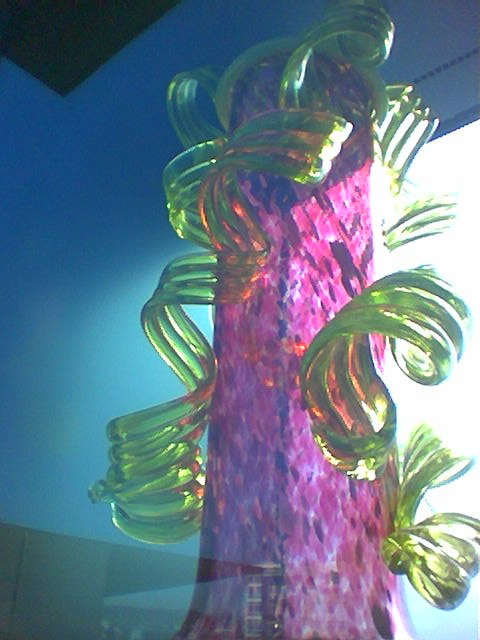
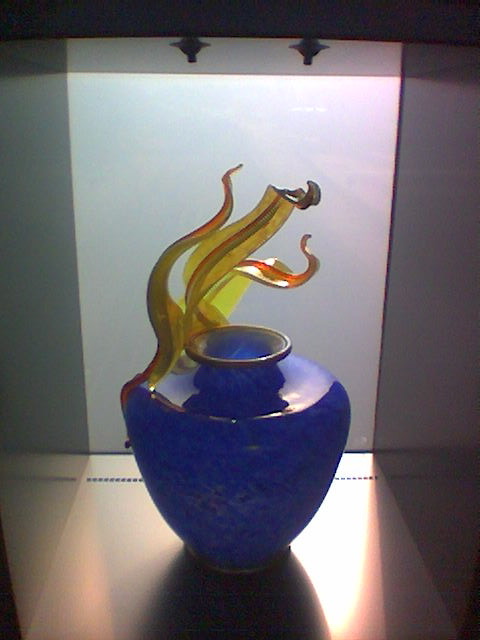
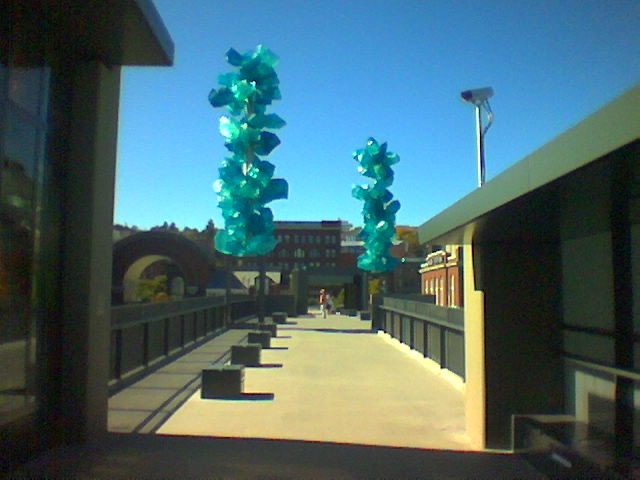
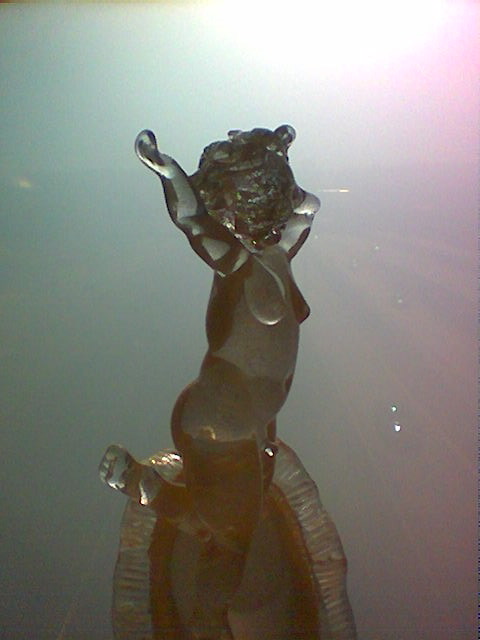
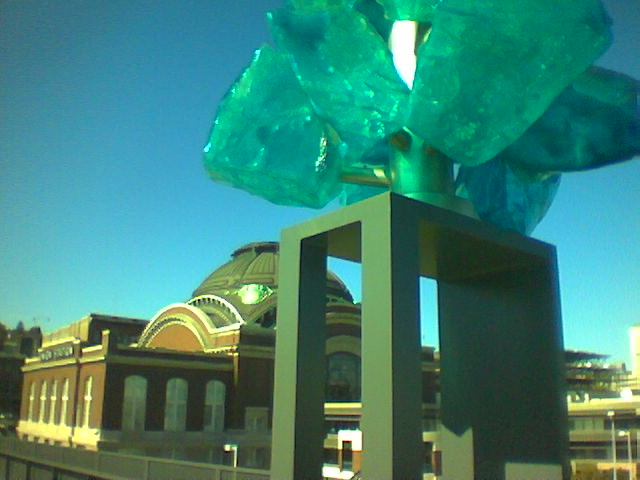
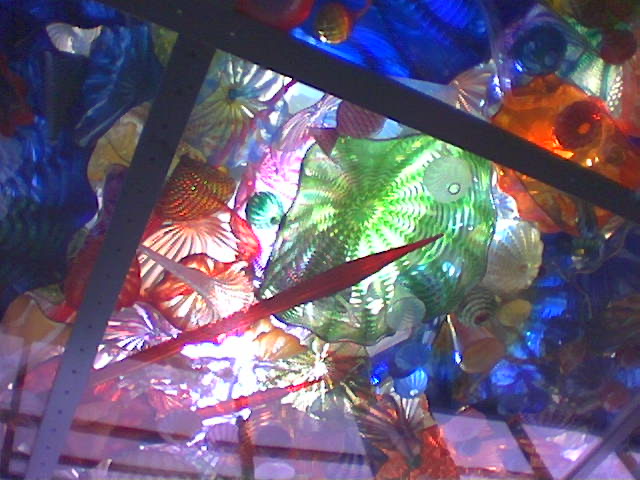
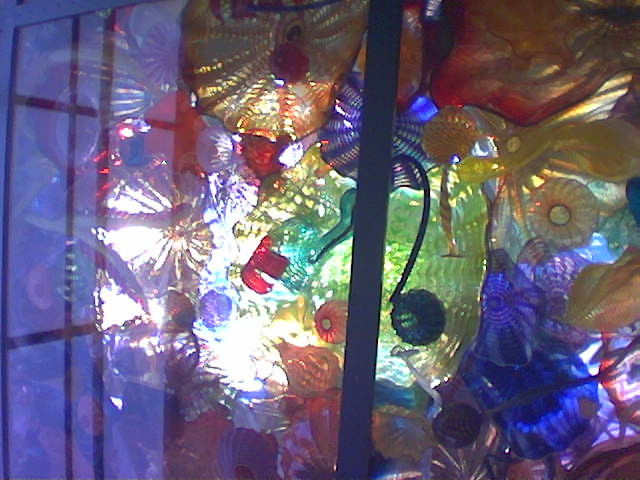
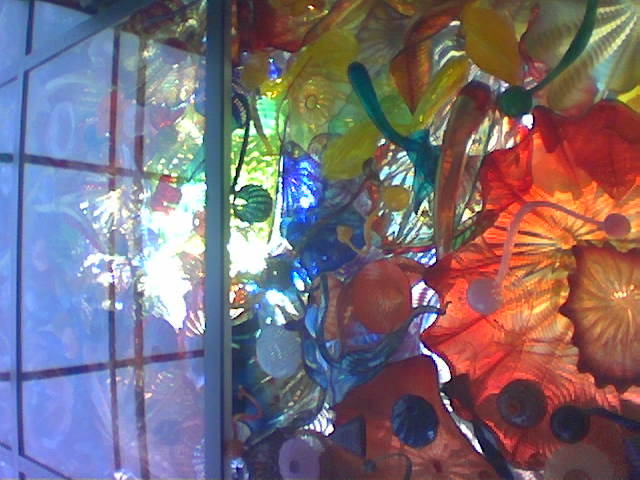
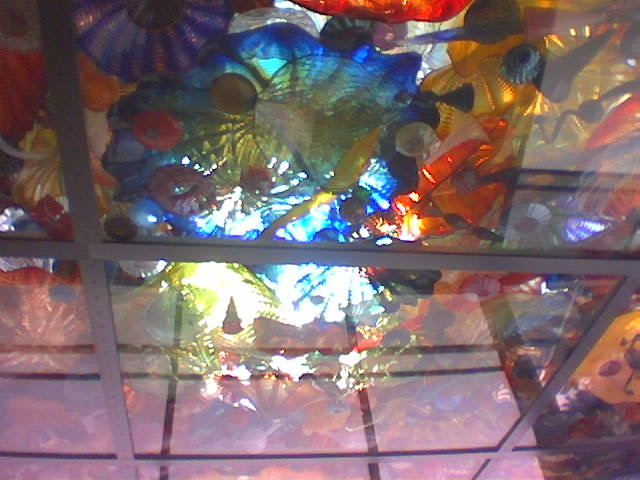
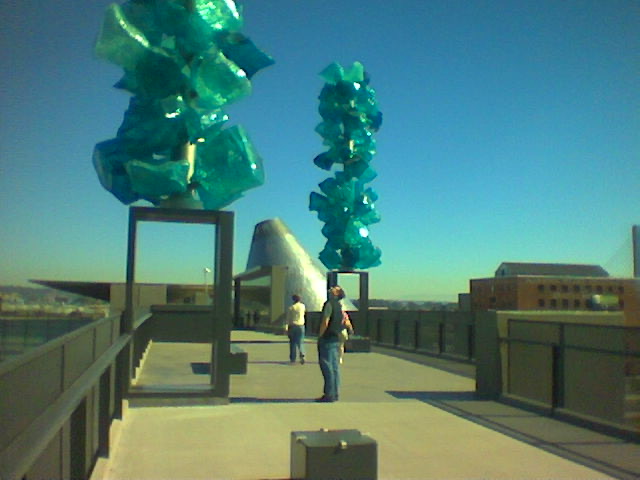
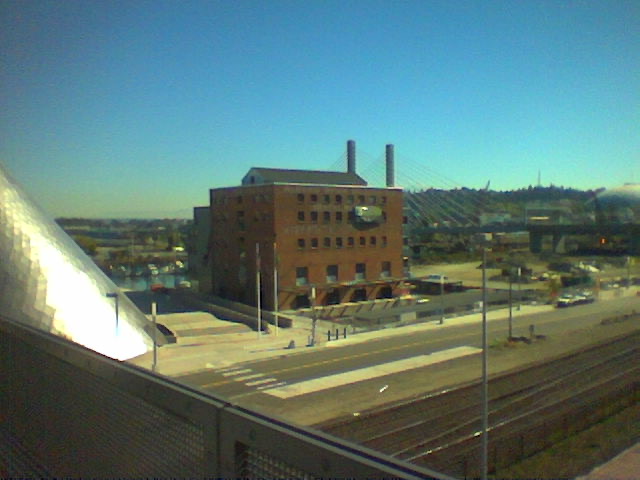
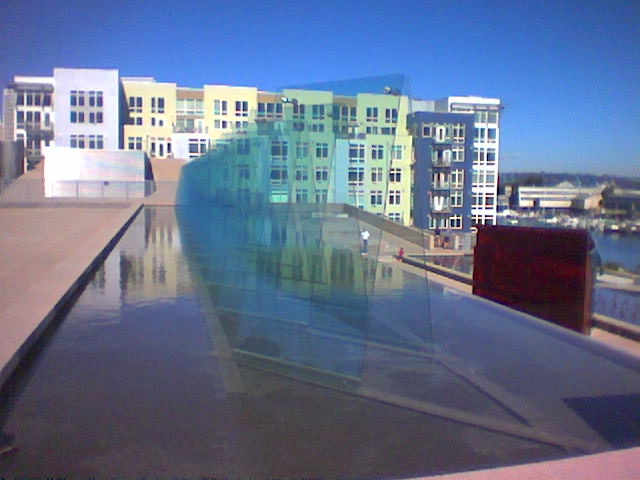
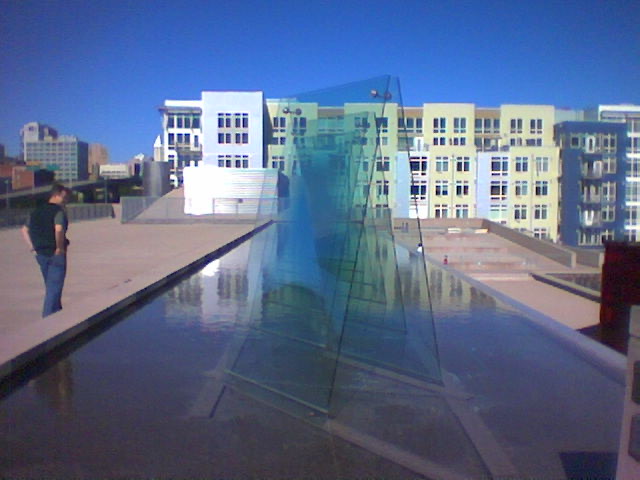
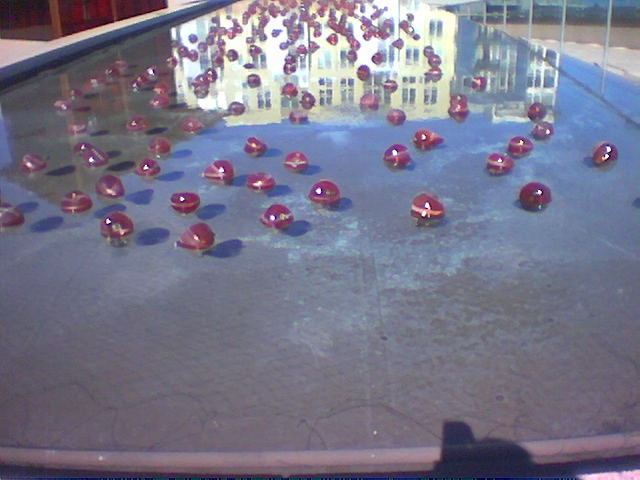
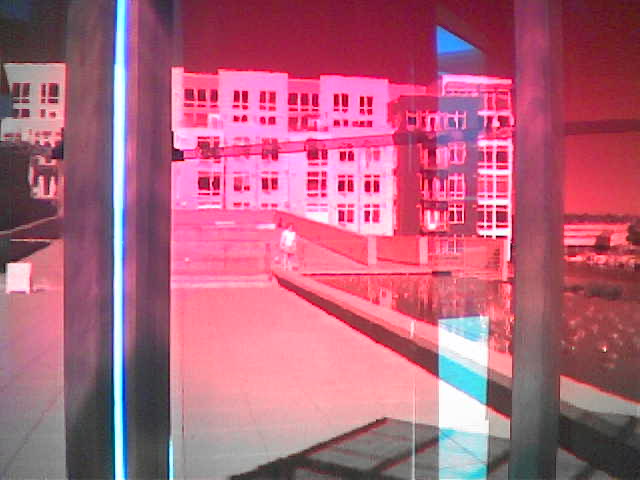
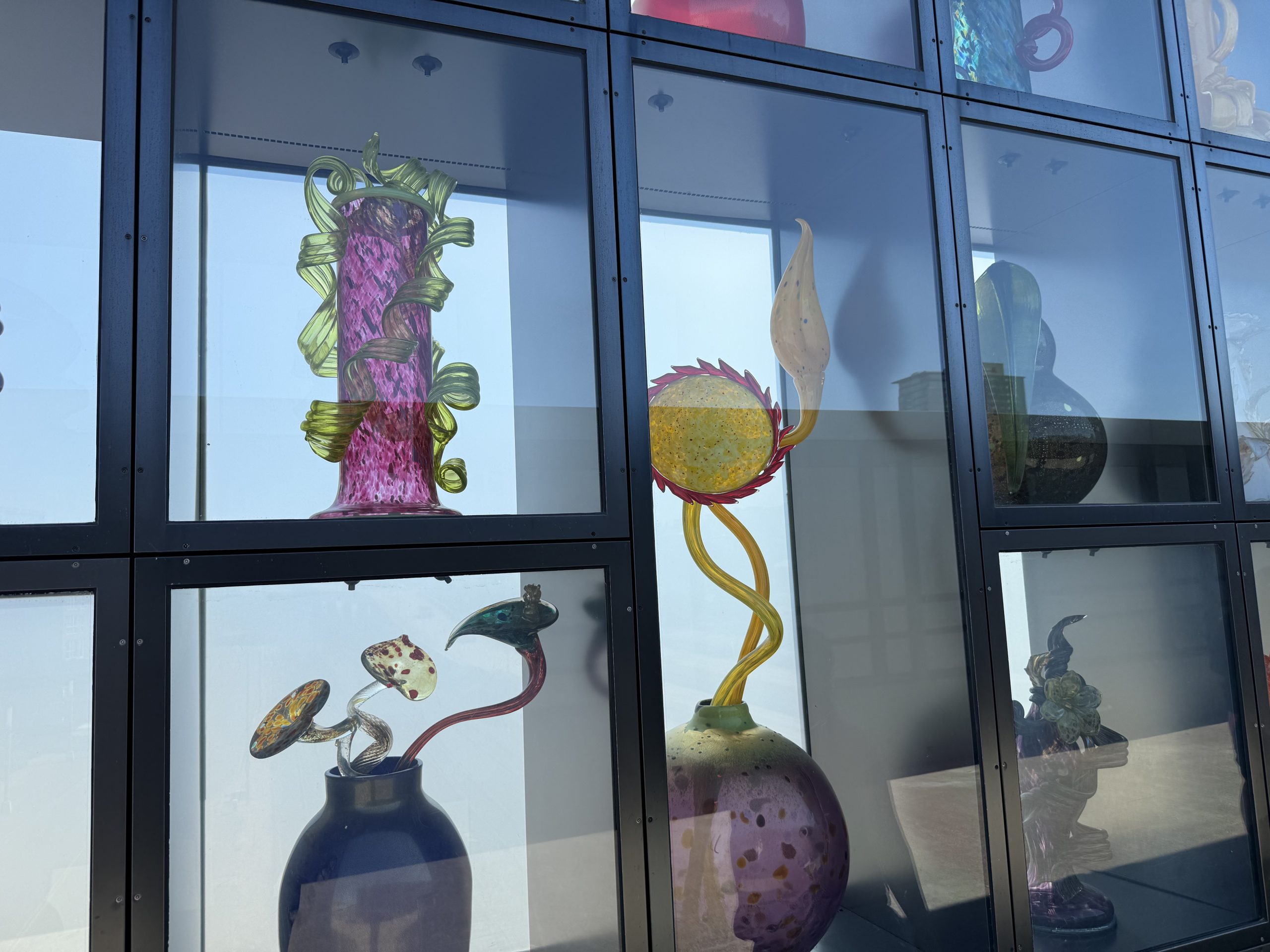
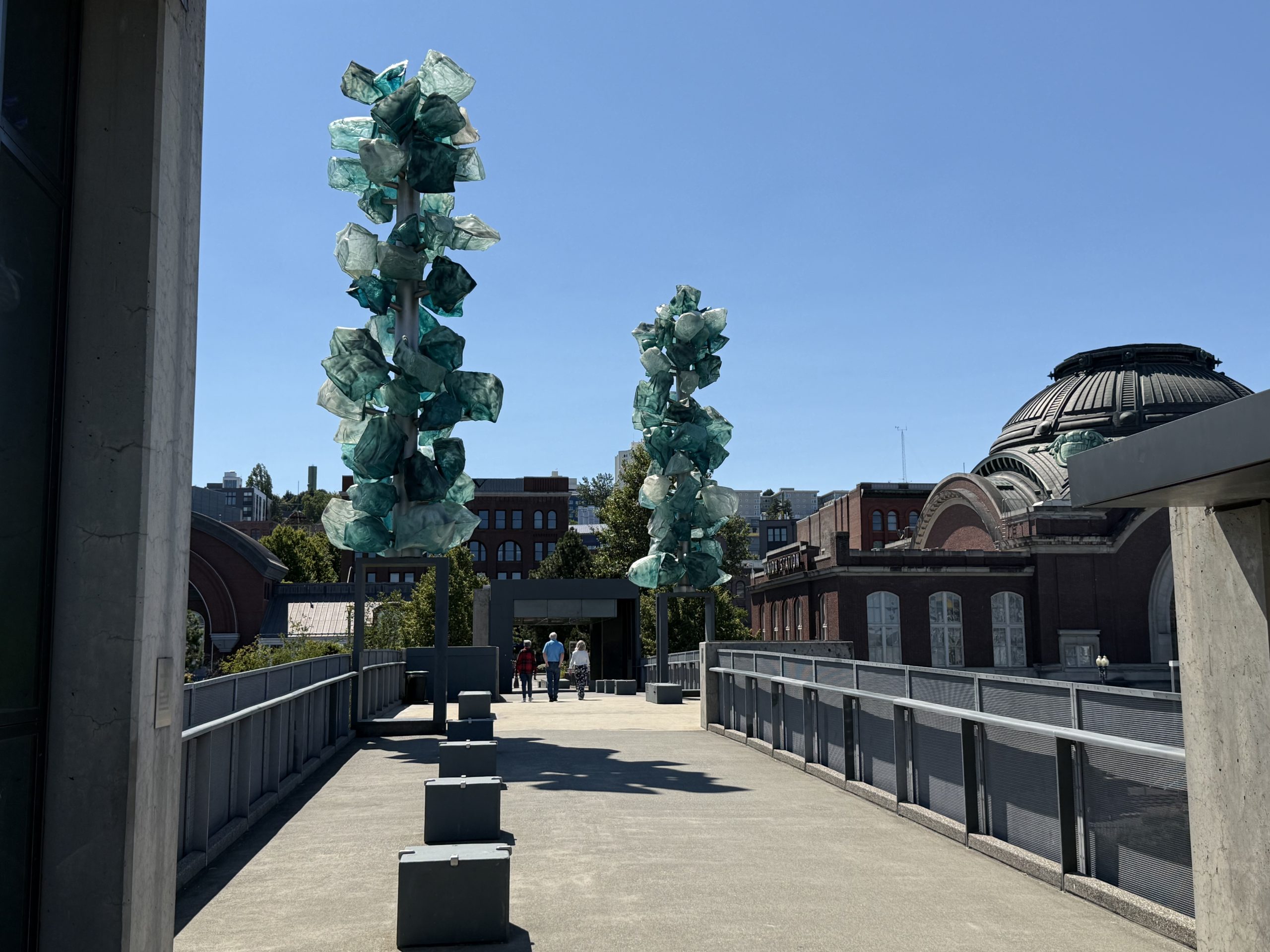
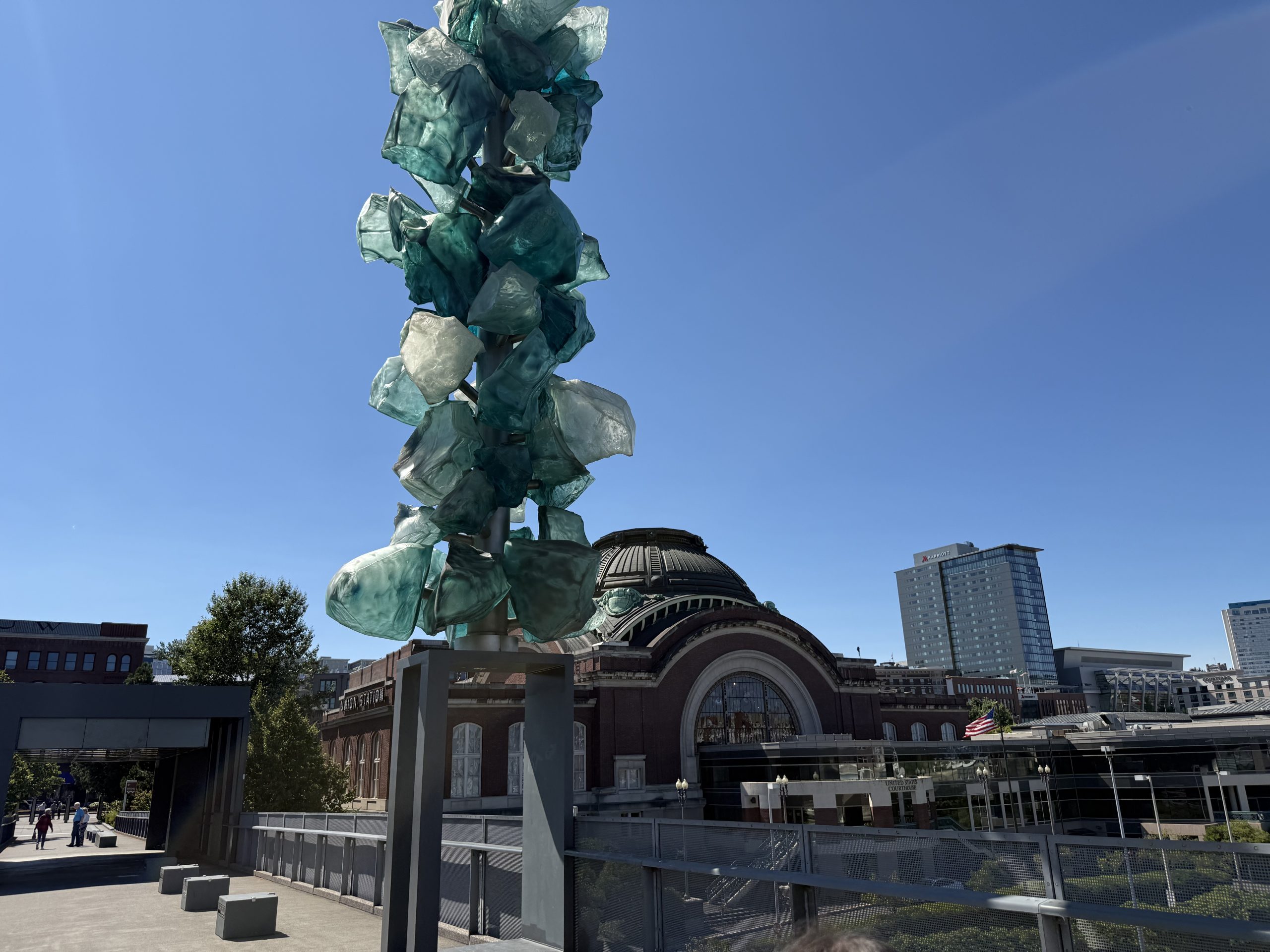
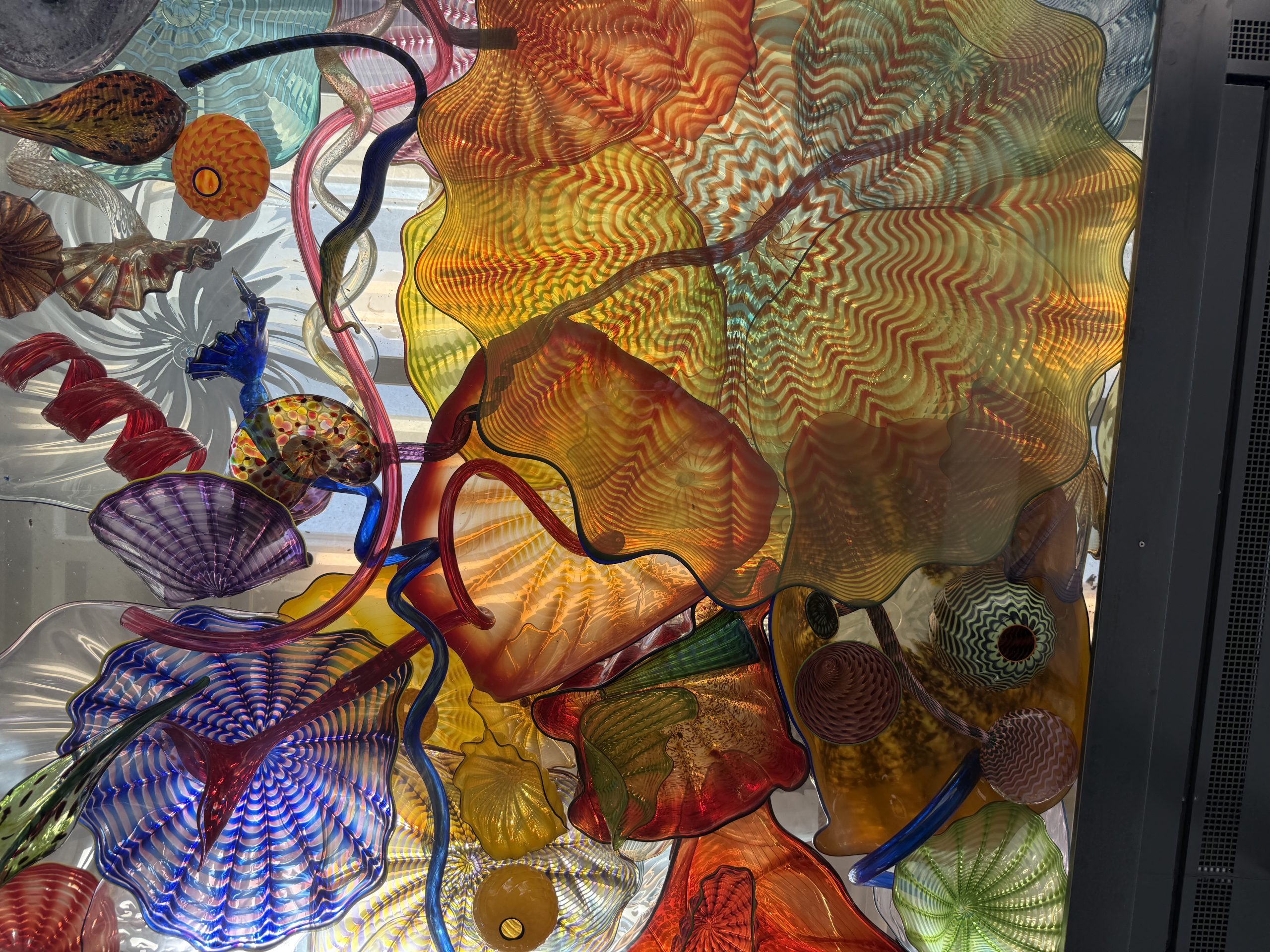
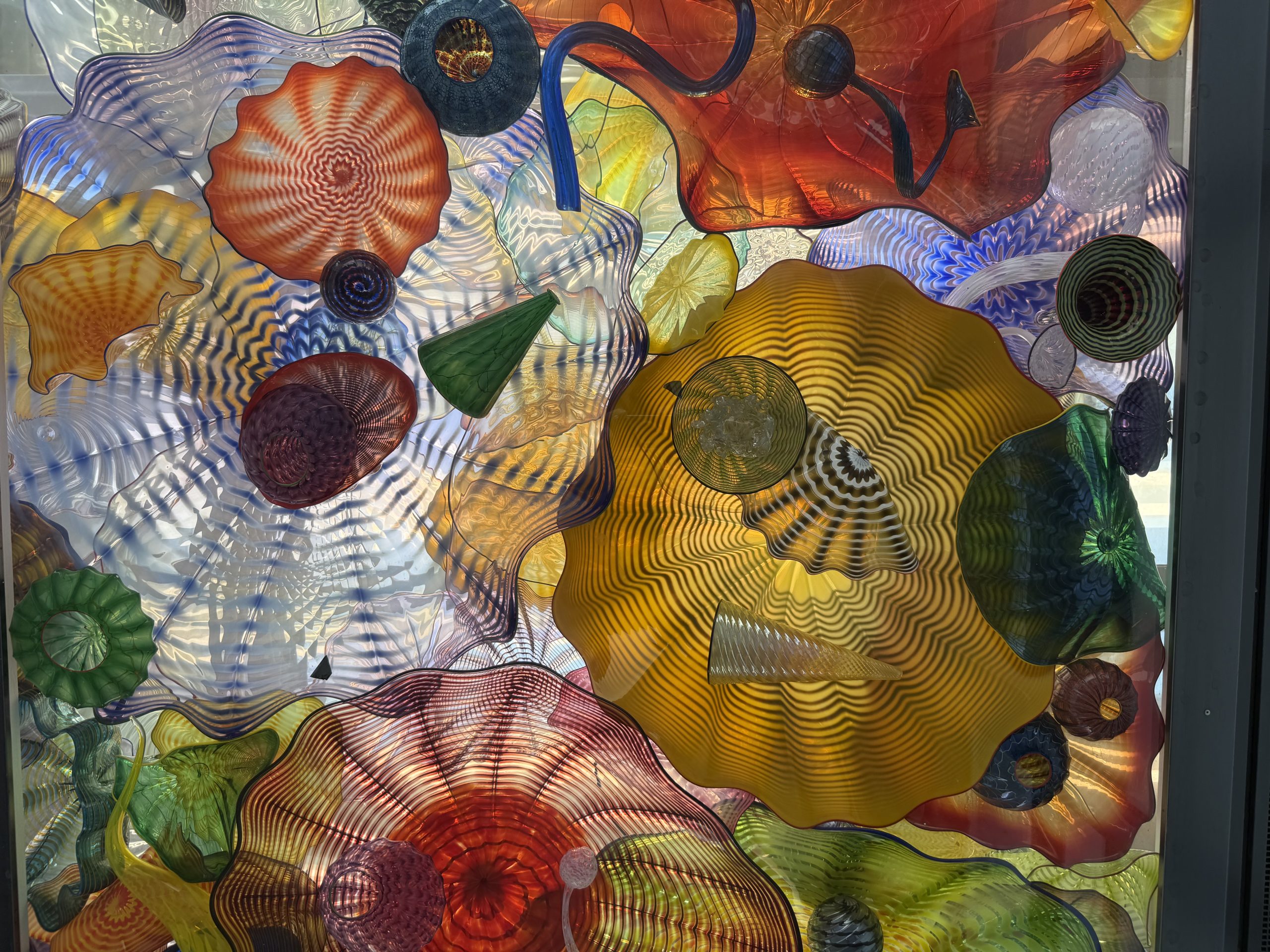
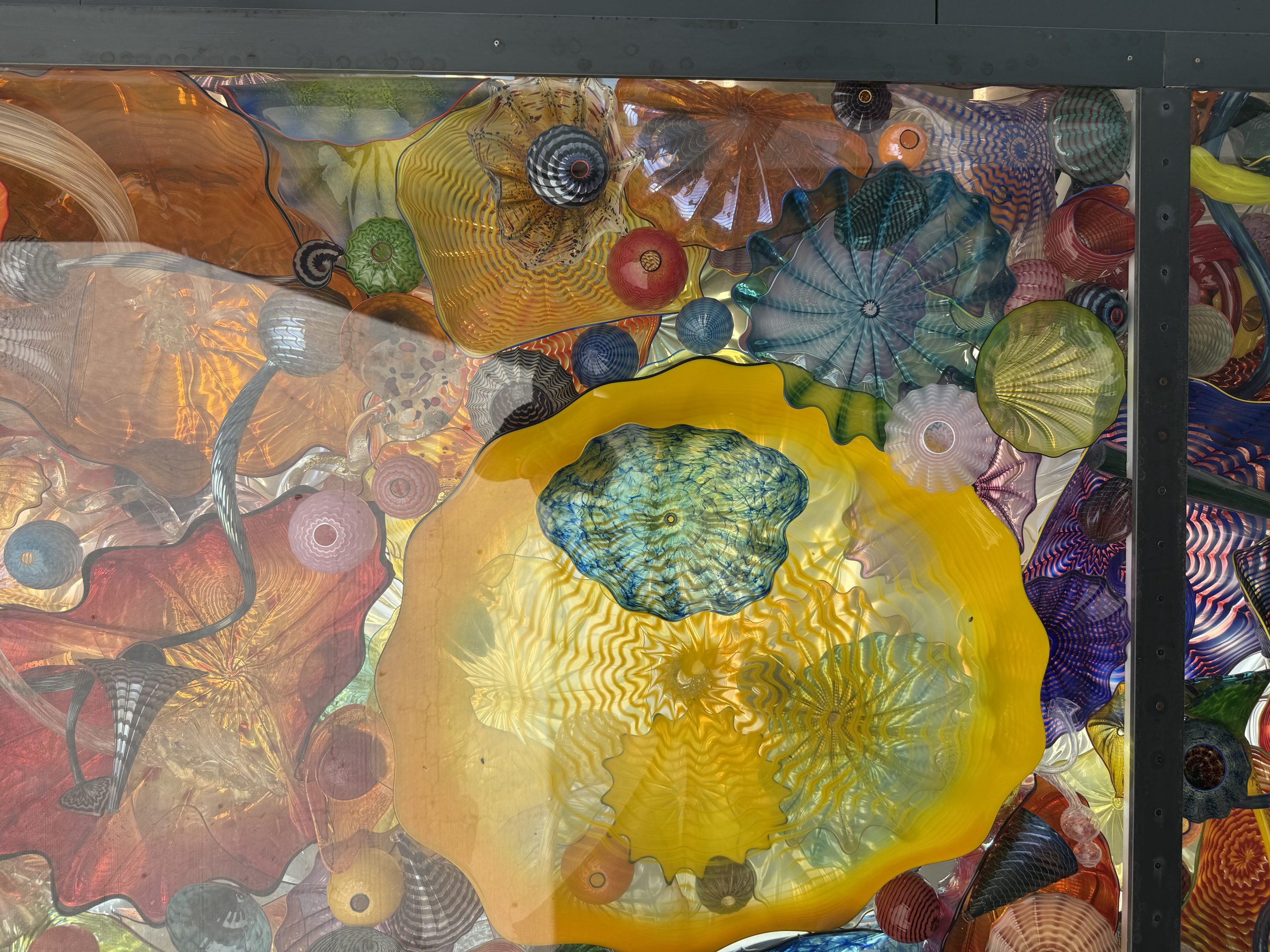
Most of that is offline now, but with a little careful archaeology I was able to pull some of the pieces back together and also get some updated photos from our trip yesterday. Here are some of the bits and pieces.
First, the photos from that day. I used to use Mac.com to serve my photo albums before switching to Flickr. Unfortunately you can’t access any of the Mac.com content any more; fortunately it’s all in the photo albums in my Photos app, to this day. So here’s the gallery of the photos that were there.
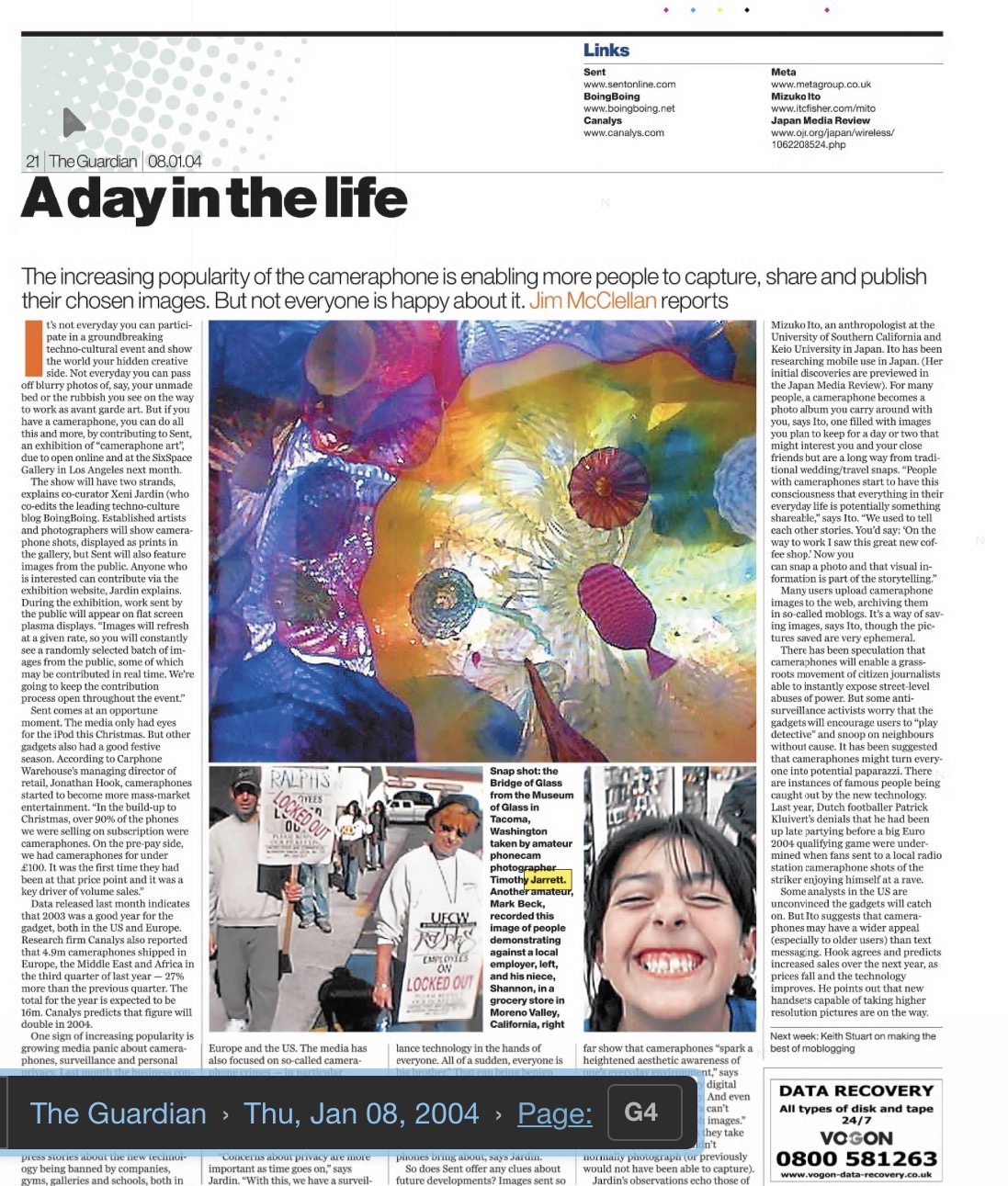
In the middle of all of this, the Guardian wrote their article. My photo was never in the online version but Newspapers.com now has the actual print article online; see below.
My photo in the print edition of The Guardian, January 8, 2004.
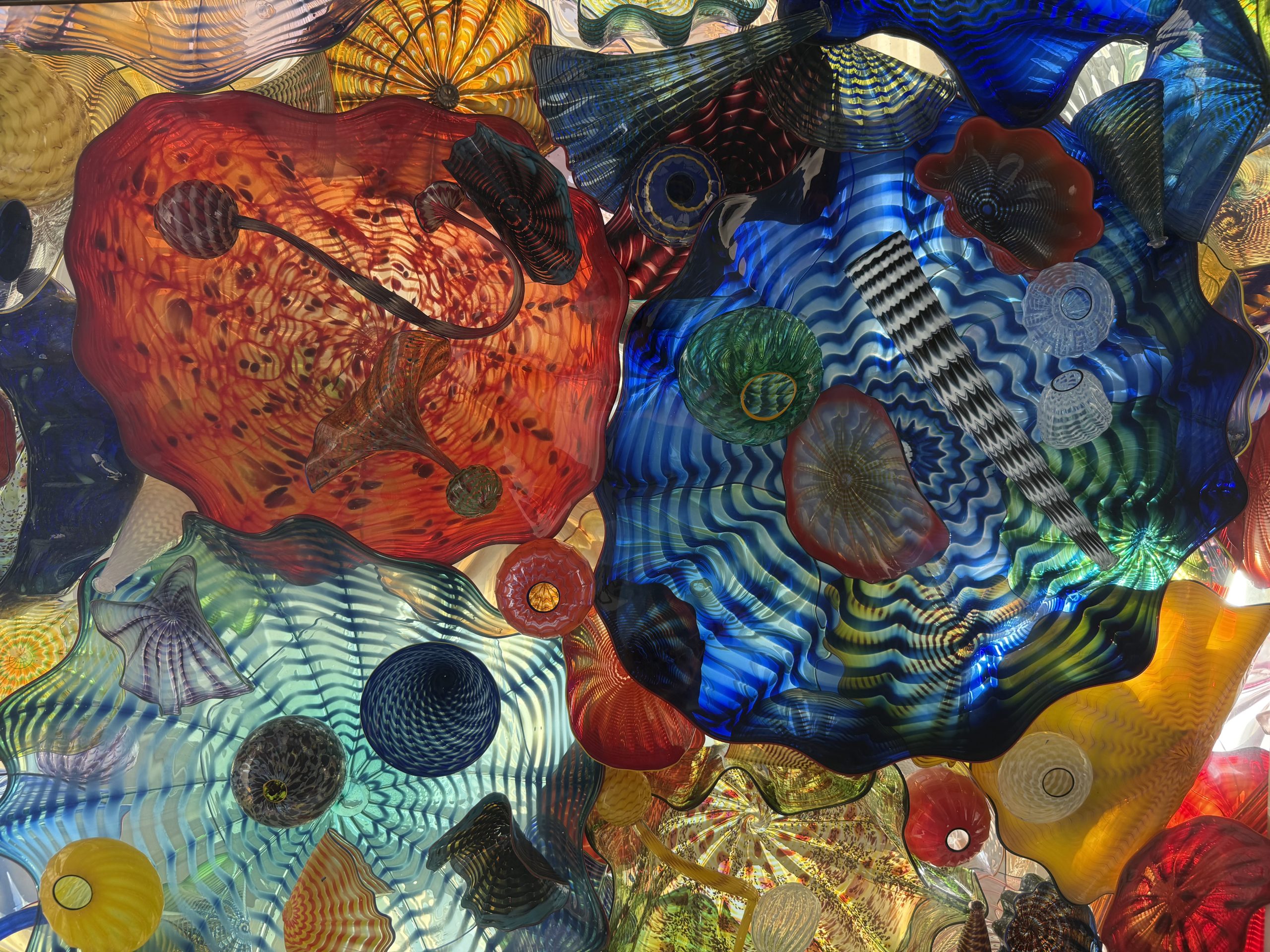
Last but not least, I retook some of the photos from that day when we visited the museum again last month. Amazing to me how the exhibit still has the same impact though the landscape around it has changed.
In which a performance artist leans into the musical side of her art and finds emotional resonance.
Album of the Week, July 11, 2026
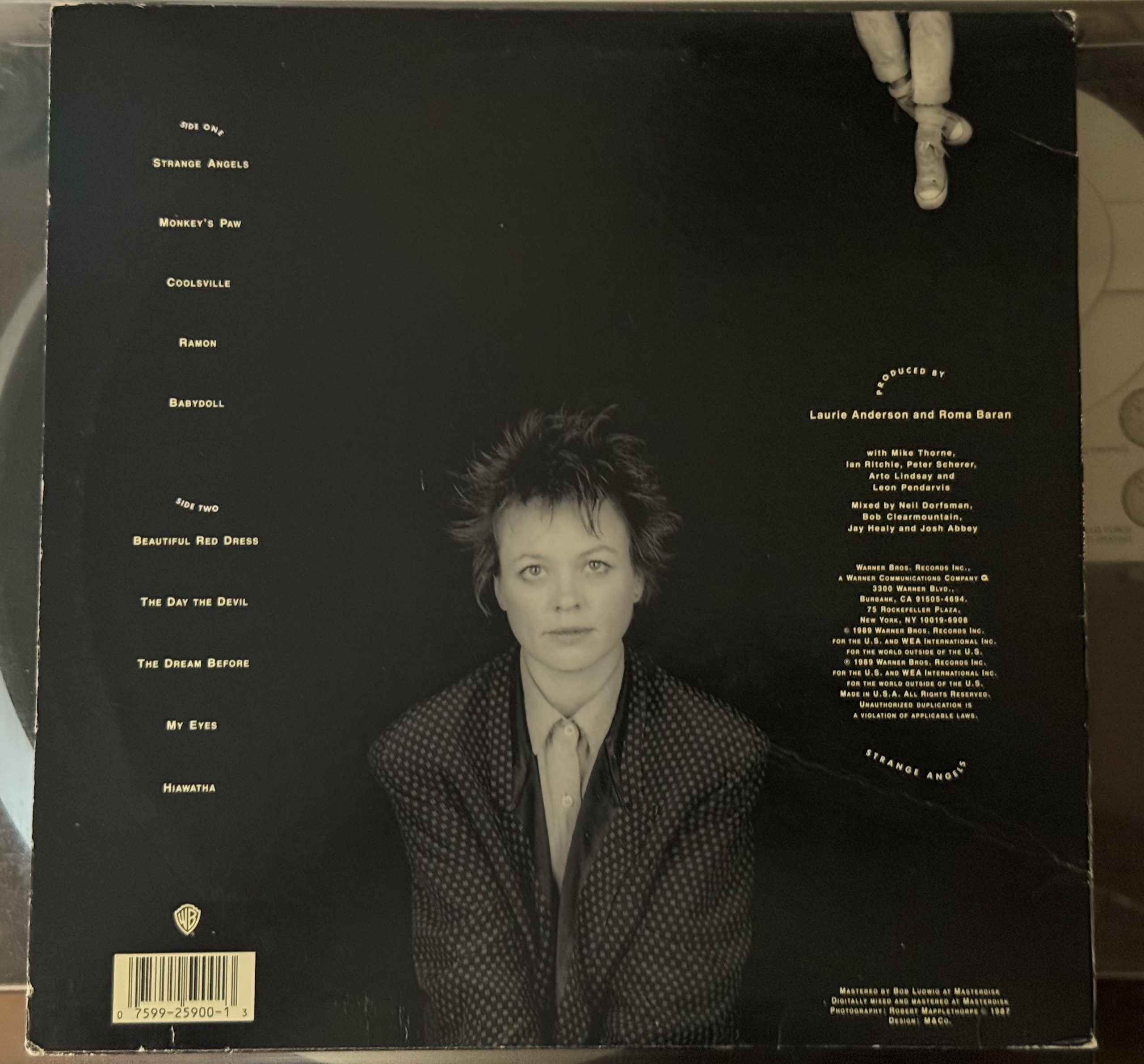
Laurie Anderson might have started the 1980s as the definitive performance artist who also happened to sing, but her last album of the decade posited her as a singer who also happened to be a performance artist. Like Kate Bush’s The Sensual World, released just a week before Strange Angels, the album centered Laurie the person in an emotional space that she had never really occupied, showing her with fewer electronic tricks and more heartfelt songwriting in an album adorned by a stunningly intimate cover portrait.
That cover was taken by famed photographer Robert Mapplethorpe, who near the beginning of his career had captured the great Patti Smith for her first album Horses. In the earlier photo he portrayed someone both confrontational and delicate in a way that played with gender conventions. Here, near the end of his life (Mapplethorpe died several months before the album’s release, of AIDS), he imbued Anderson, previously careful to present herself through a sort of hip androgyny, with a sort of uncanny beauty, presenting her in a way that was still undeniably artistic and avant-garde but somehow unavoidably feminine.
The cover photo was a good metaphor for the music contained inside, as an artist who had previously relied on an electronic pitch-shifter to give her “The Voice of Authority” now leveraged a new voice, an unexpectedly clear and beautiful soprano. She has told a story about realizing that a song needed to be actually sung instead of talked, going to take voice lessons, and discovering that voice had been waiting for her the whole time. And while there are certainly familiar collaborators, including producer Roma Baran and percussionist David Van Tieghem, most of the musicians on the record are most familiar for having collaborated with someone else: the Golden Palominos’ Anton Fier; trumpeter Earl Gardner, trombonist Steve Turre, drum programmer Leon Pendarvis (Janice’s husband) and accordionist Tom “T-Bone” Wolk from the Saturday Night Live band; session drummer Steve Gadd (“50 Ways to Leave Your Lover”); Tony Levin; guitarist Ray Phiri and bassist Bakithi Kumalo (Graceland); minimalist tape loop composer Scott Johnson; bassist Mark Dresser (Anthony Braxton); drummer Joey Baron and percussionist Cyro Baptista (John Zorn); and a host of well-known voices lending backing vocals including Meat Loaf, Bobby McFerrin, outsider artists The Roches, and Lisa Fischer (Rolling Stones, Luther Vandross).
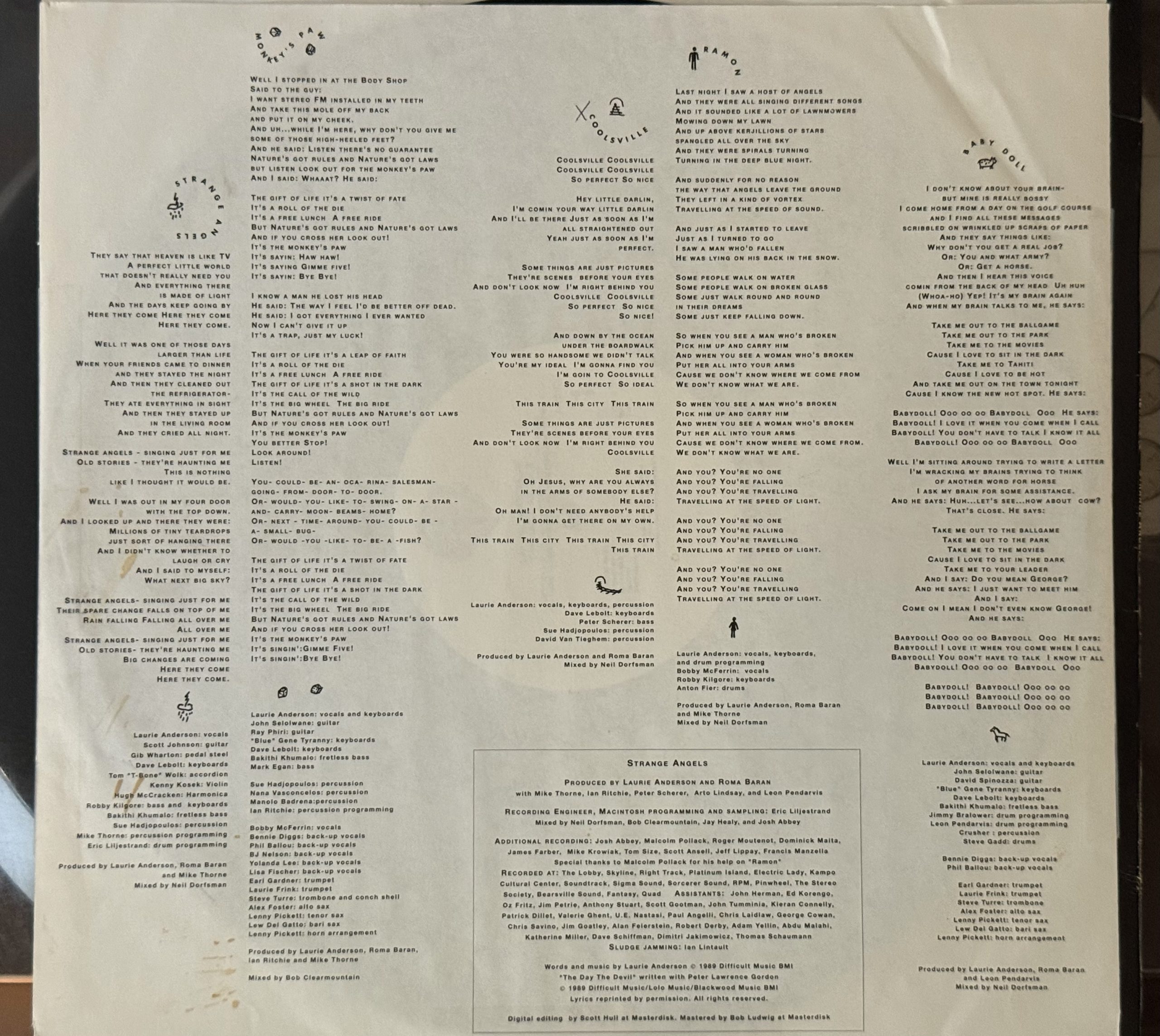
“Strange Angels” begins as a classic Laurie Anderson lyric: “They say that heaven is like TV,/A perfect little world/That doesn’t really need you.” But it’s sung, not wryly spoken, and the combination of instruments that joins as she intones “here they come” – guitar, accordion, bass, crisp percussion – tells us we are in for a different sort of experience. I always loved the lyric that leads off the second verse: “Well it was one of those days / Larger than life / When your friends came to dinner /And they stayed they night/ And then they cleaned out the refrigerator / They ate everything in sight / And then they stayed up in the living room / And they cried all night.” Possibly I feel this way because the first time I heard the album was in the living room of a Mount Holyoke choir member, where I was crashing overnight on the floor while we were on tour. I don’t make friends easily but that night we stayed up until two, and would have cleaned out the refrigerator had there been one. (Some of these reviews are not impartial.) Perhaps, though, I like the tune so much because, as the chords swing from major to minor, the band creates an undercurrent of melancholy underneath the main story, and we understand that we’re looking backwards at a visitation from the angels that can never occur again.
“The Monkey’s Paw” is a different thing, a fable about not messing with Mother Nature in the form of a song. The setup—Laurie going to a retail establishment and requesting modifications—is not particularly novel, but the salesman pushing back on her warning of the unintended consequences is: “Please. There’s no guarantee. Cause nature’s got rules, and nature’s got laws, and if you cross her look out — it’s the monkey’s paw.” The musical track is light, thanks to Ray Phiri and Bakithi Kumalo, and the gorgeous falsetto vocalise of Bobby McFerrin.
“Coolsville” is a song built over an effect, a delayed reverb circuit providing a sort of call and response effect behind Laurie’s vocals. That’s the gimmick, and on the initial listen when she intones “Coolsville” into this thing it can be overwhelming. But the song itself, with its longing for perfection that doesn’t exist, is somehow deeply moving nevertheless.
That brings us to “Ramon,” which for me is the emotional center of the album. Opening with a deceptive drum pattern that always makes me think the beat is dislocated by half a measure, Laurie is back to clouds of angels: “Last night I saw a host of angels, and they were all singing different songs/And they sounded like a lot of lawnmowers/Mowing down my lawn/And up above kerjillions of stars spangled all over the sky…” But the visitation of angels leaves us and there’s a man fallen on his back in the snow. Laurie’s verse centers this man in the broader cosmos: “some people walk on water/some people walk on broken glass/some just walk round and round in their dreams/some just keep falling down.” There’s something deeply human, almost a humanist form of Christian ethics, in these lyrics: regardless of which kind of person you’re dealing with, when you see a man who’s broken, pick him up and carry him! To put this into context, this was coming at the end of an eight year period where the culture had encouraged a kind of spiritual self-centeredness, amid the rise of televangelism and the rapid removal of societal support for the homeless, as well as at the end of a period where the Reagan administration’s refusal to do anything about the AIDS crisis had meant the loss of tens of thousands of people, with the population of artists in New York with whom Anderson collaborated (including Mapplethorpe) hit especially hard. So for me, hearing these lyrics against this context, it came as a sort of moral call to arms. For Anderson, this isn’t an explicitly Christian moment, more a humanist one, since we are all in this together: “We don’t know where we come from/We don’t know what we are.”
The first side closes out with “Babydoll,” which is for me one of the songs on the album that would have done better as spoken word. The concept, about a brain that stops functioning on behalf of its owner because it wants to have fun, is pretty good, and the music is rich, but they somehow don’t seem to reinforce each other. Still the song is worth it for its extremely 1989 moment, in which the brain says, “Take me to your leader/And I say: do you mean … George?”
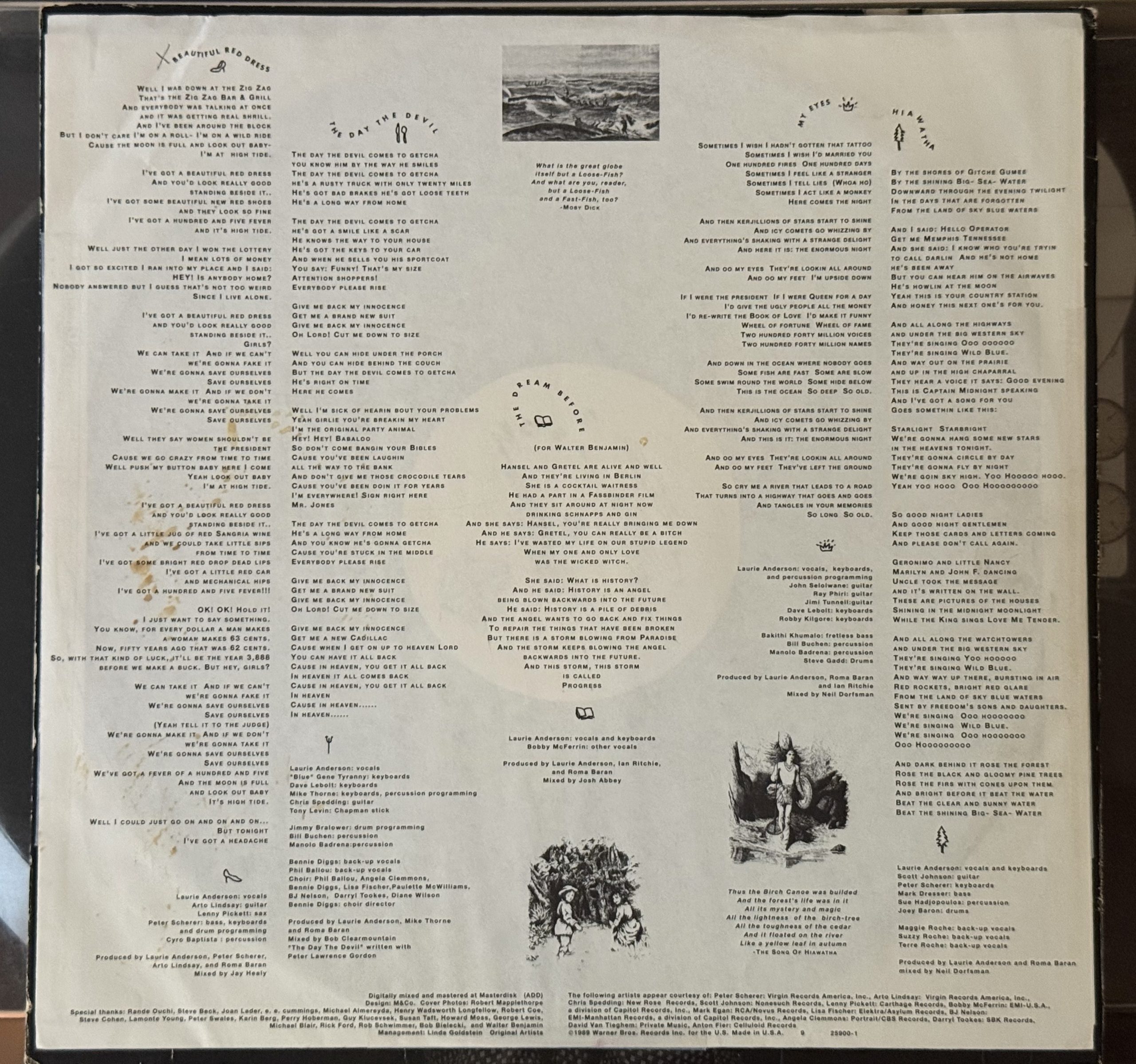
“Beautiful Red Dress” flips the tropes of women’s roles (shrill, decorative, emotionally unstable, dependence) on their heads, starting from the first chorus: “I’ve got a beautiful red dress/And you’d look really good/Standing beside it…” Lenny Pickett gets to play some spectacular 1980s saxophone all over the track, and there’s a great moment in which Laurie quiets the track down with the observation, “You know, for every dollar a man makes, a woman makes 63 cents. Now, fifty years ago, that was 62 cents. So, with that kind of luck, it’ll be the year 3,888 before we make — a buck.”
“The Day the Devil” flips the script on blaming external forces for your problems, with the devil being blamed for knowing you inside out before sneering, “Don’t come banging your Bibles/Cause you’ve been laughing all the way to the bank.” It’s not, to my hearing, entirely coherent, but the gospel chorus covers a multitude of sins in this song for me: “Give me back my innocence… ‘Cause when I get on up to heaven Lord/You can have it all back.”
The other emotional center for me comes next. “The Dream Before” is an unvarnished story of dashed hopes and unhappy outcomes. Hansel says, “I’ve wasted my life on our stupid legend/When my one and only love was the wicked witch.” The second half of the brief functions as sort of an ultimate Zen koan, with Anderson and Bobby McFerrin laying down some high-grade philosophy: “History is an angel being blown backwards into the future… and the angel wants to go back and fix things, to repair the things that have been broken, but there is a storm blowing from Paradise … and this storm, this storm, is called Progress.” Really listening to this as an about-to-graduate college student did something to the wiring of my brain. (I centered this song on a mix tape in 1993.)
“My Eyes” is somehow the perfect blend of Laurie’s tart observations and her new musical fluency, all the more so because there’s no pat moral or punchline. She confronts the enormous night, the kerjillions of stars, the “ocean, so deep, so old,” and simply exists in it: “Everything’s shaking in strange delight.” The track is underpinned by that spectacular one-two combo of Bakithi Khumalo’s fretless bass and Ray Phiri’s guitar.
The album ends with a valediction for the departed in “Hiawatha,” as Laurie invokes the spirits of Elvis, JFK, and Marilyn Monroe to welcome newly departed souls: “Well, starlight, starbright, we’re going to hang some new stars in the sky tonight.” The combination of Scott Johnson’s guitar and the understated backing vocals of the Roches turns the overall effect into a simultaneous groove and valediction.
Laurie’s experiment with leaning more fully into the musical side of her art was well received by the critics, with Robert Christgau giving the album an A. After the album it took a while for her to find her next voice, but find it she did after about five years, and we’ll hear that sound another time. Next week, though, we’ll swerve back over into what was being called “world music” to hear the next album from one of Peter Gabriel’s other collaborators.
You can listen to this week’s album here:
BONUS: Here’s Laurie performing “Strange Angels” live in San Remo in 2001, during an award ceremony in which she was awarded the Premio Tenco for songwriting:
BONUS BONUS: “Strange Angels” soundtracks a moving moment in the William Hurt/Elizabeth Perkins 1991 film The Doctor, in which the characters, playing cancer patients, embrace a moment of grace:
BONUS BONUS BONUS: Laurie originally didn’t pursue the traditional music video route to promote the album, instead opting to produce a series of short videos, called “Personal Service Announcements,” in which she did her version of stand-up comedy. A few of these have surfaced over the years, including these:
For me, the American Bicentennial celebrations in 1776 came and went without leaving much of an impact. I was not yet four years old, so am unsure of what I do remember, though certain impressions (crowds, heat, loud sounds) persist. I do remember the atmosphere of the year: lots of red, white, and blue kitsch. A resurgence in Holly Hobbyized “Colonial” fashion. Wrought iron plaques on garage doors and the siding of split level ranches, indicating the inhabitants’ connection to the Colonial era.
What I remember happened five years later, during the celebration of the Yorktown Bicentennial, celebrating the final battle of the Revolutionary War and the surrender by General Cornwallis to the American forces. We visited during that four day period when the crowds of adults weren’t there, as part of a crowd of schoolchildren bussed in on massive field trips. In early October in Tidewater it was still hot; the grass of the field was scratchy; and the event struck the right balance between celebration and sober reflection—the latter mostly at how big the battlefield was and how far we had to walk.
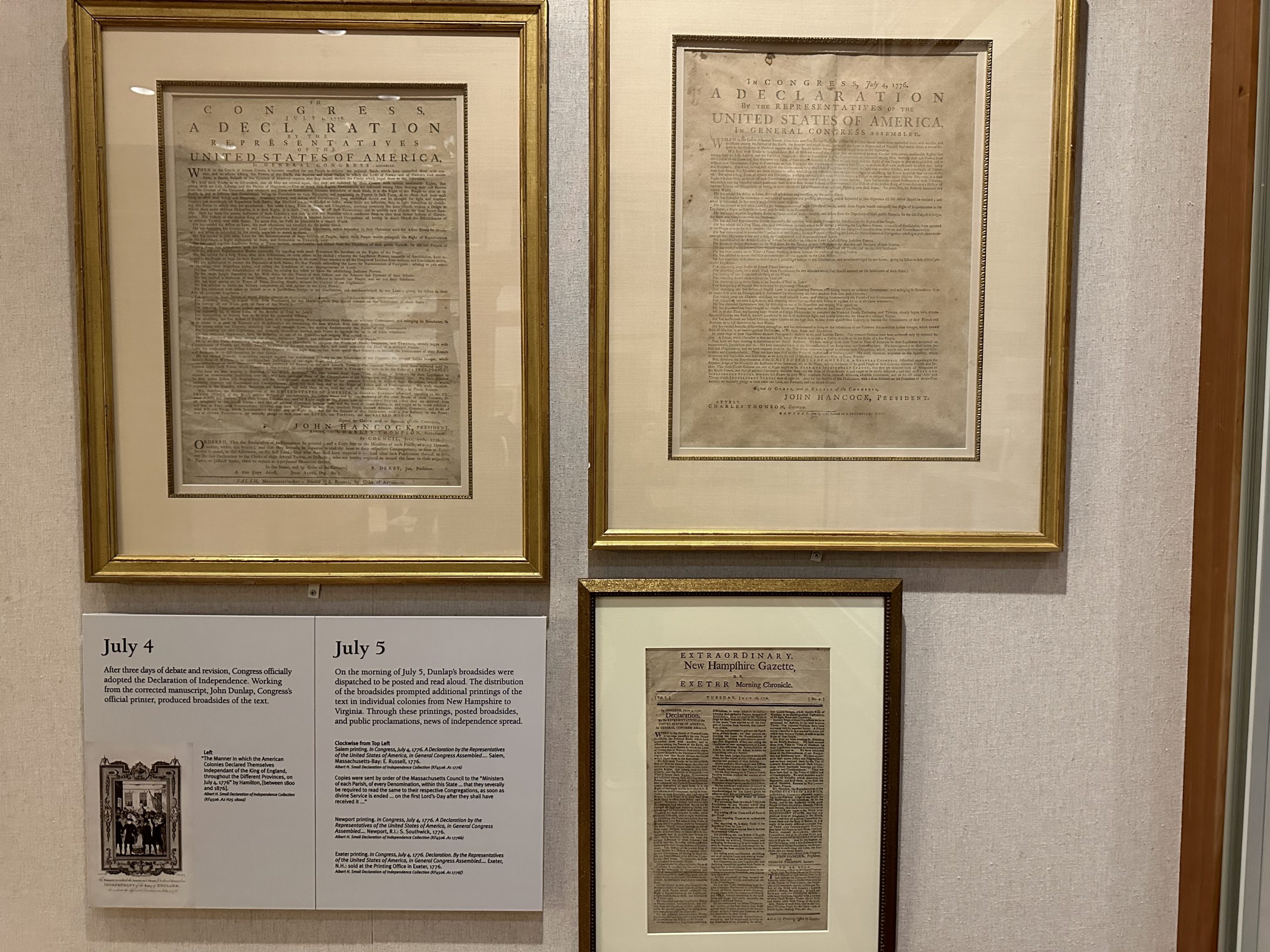
I feel the same about the Declaration of Independence that was announced on July 4. We all remember the engrossed copy, but the one we remember is an 1820s facsimile of an original that was then already fading, now almost completely illegible. But the versions the country first saw were like the ones in the photo above: printed hastily by John Dunlap in Philadelphia and distributed throughout the 13 colonies, who then went on to print their own versions to spread the news far and wide. (Albert Small collected these and other copies of the Declaration; the photo above is from the Small Special Collections Library at the University of Virginia.) Our country’s birth was announced by mass media and by word of mouth, and we remember the fancy souvenirs rather than the original announcement.
Thomas Jefferson to John Adams, September 12, 1821
We seek consolation in these moments from the past, and also inspiration. Last year I quoted Jefferson’s letters: “The flames kindled on the Fourth of July…” and “The spirit of 1776 is not dead.” This year I think of another quote (coincidentally also used in the Testament of Freedom): “I shall not die without a hope that light and liberty are on a steady advance.” Of a potential eclipse of reason in Europe, he also wrote, “even should the clouds of barbarism and despotism again obscure the science & liberties of Europe, this country remains to preserve and restore light and liberty to them.” Here’s hoping it goes both ways.
Kate reaches a deeper emotional resonance on the sequel to Hounds of Love, with help from an unlikely cast of collaborators.
Album of the Week, July 4, 2026
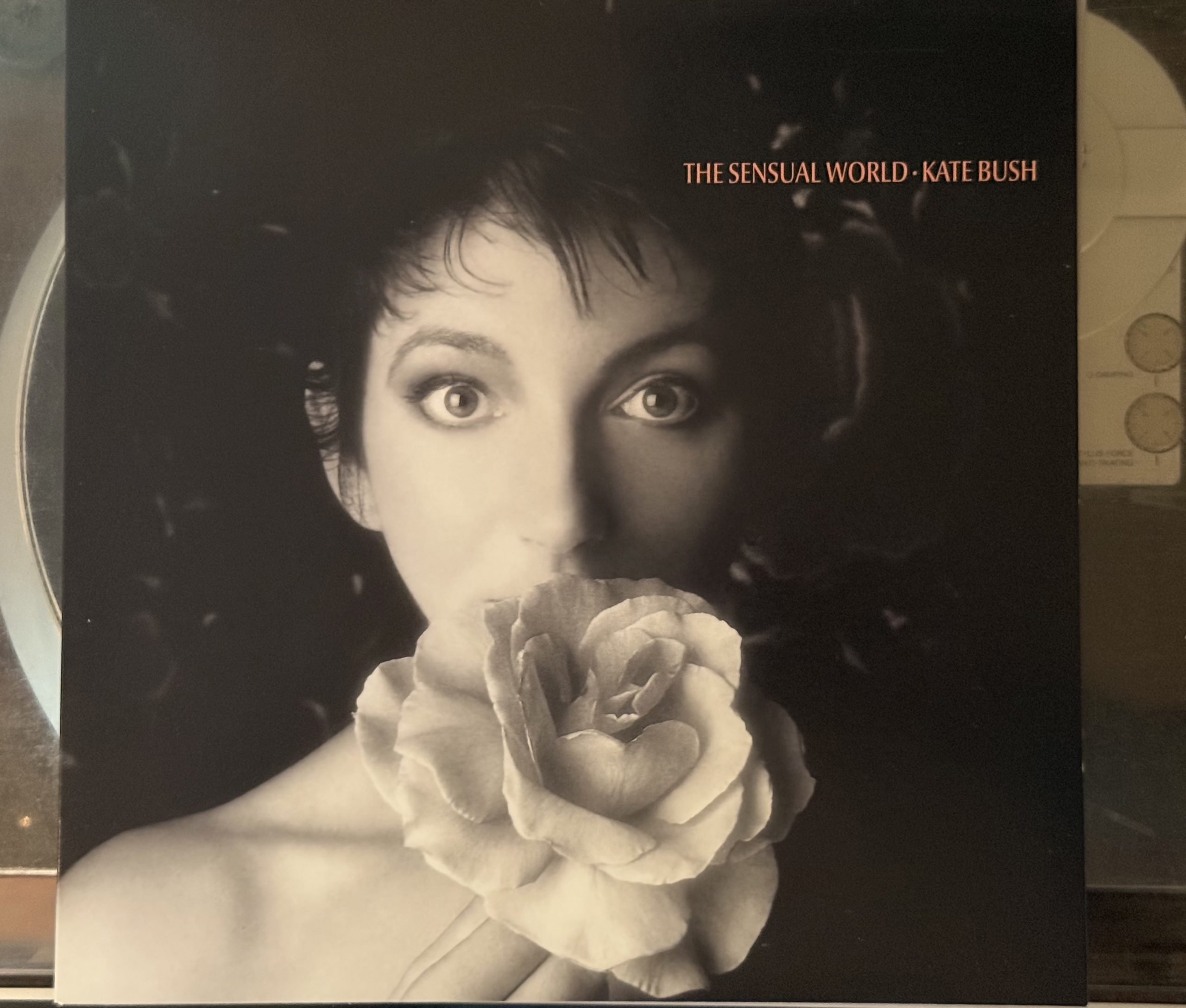
Though Kate Bush wasn’t touring (she legendarily eschewed live performances aside from the occasional TV appearance from the conclusion of her 1979 “Tour of Life” for the next 35 years), she was keeping busy following the one-two hit of Hounds of Love and her appearance on Peter Gabriel’s So. She released her first greatest hits collection, The Whole Story, in 1986, featuring a re-recorded version of “Wuthering Heights” and a new single, “Experiment IV.” Though she was quiet in her official releases, she recorded the original version of “This Woman’s Work” for the 1988 John Hughes romantic comedy She’s Having a Baby while in the studio, off and on, working on her next album. It was finally released on October 16, 1989, having gestated in studio session stretching from September 1987 to July 1989.
In addition to some of her stalwart musicians like Del Palmer, her brother Paddy Bush, Alan Murphy (who died three days after the album’s release), bassist Eberhard Weber, and Pink Floyd guitarist David Gilmore, there were some notable additional musicians who lent the album a unique color. These included Uilleann pipes from Irish musician Davy Spillane (Moving Hearts), bassist Mick Karn (Japan), orchestral arrangements from Michael Kamen, the Balanescu Quartet performing string quartet arrangements by Michael Nyman, and most of all the Bulgarian vocal ensemble Trio Bulgarka.
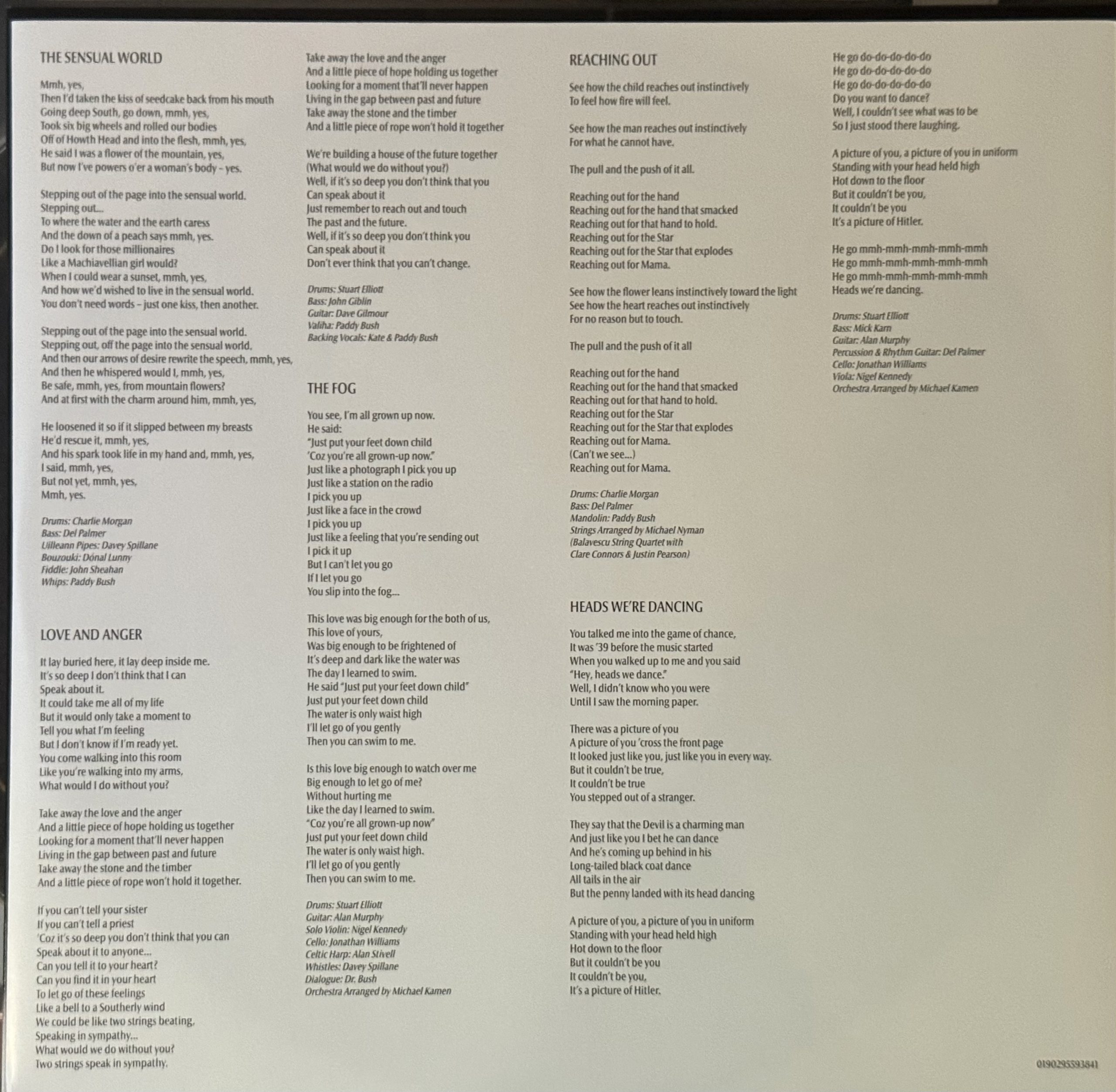
We begin with the title track, which is a song that almost didn’t happen. “The Sensual World” was originally Kate’s take on Molly Bloom’s famous interior monologue from James Joyce’s Ulysses, and actually set text from the novel, until the estate complained and she was forced to write new words to the track. (In 2011 on her album Director’s Cut, on which she re-recorded many of the tracks from this album and her follow-up, she was able with permission from the estate to present the original version of the track, now titled “Flower of the Mountain.”) The song itself leans into its title, with Bush using both her broadening lower range and a breathily erotic tone over a rich sonic tapestry that includes church bells, fiddle, bouzouki, whips(!), and Spillane’s brilliant Uilleann pipes. Through it all she presents a vision of a heroine experiencing the sensations of being in the physical world for the first time, stepping off the page to experience sensations and, especially, pleasure. The setting is typically brilliant for Kate; this character, formerly trapped in the two dimensional world of the book, expresses herself almost entirely on a single tone throughout the verse, only varying in pitch when rising to an earthy blues note on the repeated blue note of “ooh, yes” and in the chorus. It’s a bewitching, nearly hypnotic effect. I’ve been known to listen to it on repeat from time to time.
“Love and Anger” is another magnificent Kate uptempo song, with high energy courtesy the tight rhythm section of Stuart Elliott on drums and John Giblin on bass, a soulful piano line, backing vocals from the Trio Bulgarka (a Bulgarian folk group who had performed on the pivotal 1970s albums Les Mystère des Voix Bulgares, Volume Two and on Balkana: the Music of Bulgaria) and a wicked guitar line from Pink Floyd’s David Gilmour.1 It’s all in service of a movingly mature lyric about a relationship on the rocks due to the inability of the participants to communicate about where their emotional millstones lie. The track also features one of my all-time favorite hummed parts in any song. Again, Track 2 on Kate albums is where she puts the bangers.
“The Fog,” by contrast, is a return to the world of The Ninth Wave, in which the narrator fears dissolution and loss of identity as she contemplates stepping away from her family (Kate’s father Dr. Robert Bush speaks on this track) into the water, which seems life threatening but is only waist deep. In the song, there is a deep ambivalence about the water: is it the unknown? Is it the deep and somehow threatening love of another, one who threatens to disappear, to slip into the fog? The lyrics are vulnerable and beautiful, and are given an exquisite string instrumental with enfant terrible violinist Nigel Kennedy and a taut guitar solo from Alan Murphy.
“Reaching Out” is a tenderly maternal ballad, with added emotional heft from the choral accompaniment by the Trio Bulgarka and strings arranged by composer Michael Nyman and performed by the Balanescu Quartet. (In my symphonic performance experience, we call that “luxury casting.”) Kate’s vocals on the soaring chorus are magnificent, though the verses are a bit wooly —“See how the child reaches out instinctively/to feel how fire will feel” invokes a different reaction in me than what she presumably intended.
“Heads We’re Dancing” is something entirely different. Driven by a propulsive synth line, and a shaggy dog story about a woman in 1939 who is asked by a stranger to dance, and who realizes in the morning that she was dancing with Adolf Hitler. The whole thing is a brilliant excuse for more Alan Murphy, some brilliant bass from Japan’s Mick Karn, and one of the all-time great “doo doo doo” choruses. Indeed, with each song on the first side, Kate seems to lean further into a sexily minimalist groove. (The darkly chromatic string parts, by the way, are arranged by Michael Kamen, who was by now almost a decade into his film-score career.)
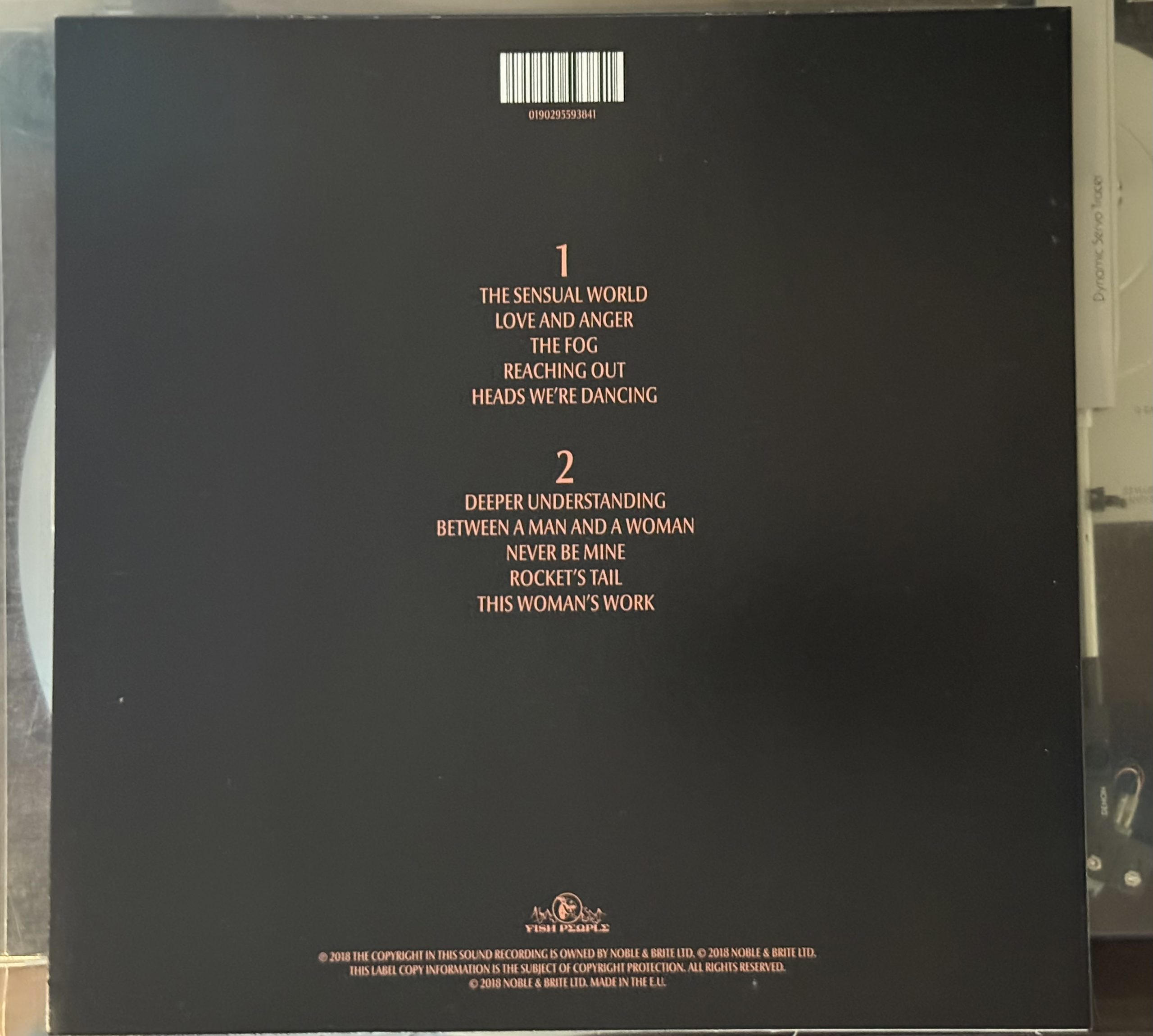
Opening Side 2, “Deeper Understanding” tells the story of a narrator who disappears further and further into a rapport with a computer, until they forget to eat or sleep. Supposedly inspired by a documentary about Stephen Hawking, it’s been noted that there may be an autobiographical element here as well, as the Fairlight CMI also loads programs and has a button marked “Execute,” and Kate spent many months in front of it producing the album… Trio Bulgarka put flesh and blood on the digital heartbeat of the track with a hair-raising solo line and a resonant chorale at the end.
“Between a Man and a Woman” returns to the theme of a difficult relationship, with a twist: here Bush’s narrator warns the listener not to intervene in the “pendulum swing/between a man and a woman.” The track feels to have grown from the same roots as “Heads We’re Dancing”, as though there was one long jam session that birthed them both. By contrast, “Never Be Mine” is something new, driven by Eberhard Weber’s slinky bass and a vision of the narrator confronting the smoke from the burning stubble in a cornfield and stating “This is where I want to be,” as she burns off the last bits of her connection to an ex-lover so that she can plant the seeds of something new. Trio Bulgarka provide a moment out of time here as well, singing in ringing harmony to the departing lover as Davy Spillane provides a sympathetic tone in the pipes.
Trio Bulgarka get their ultimate shot at brilliance, going full out on “Rocket’s Tail” as the narrator calls the listener’s wistful desire to be a rocket in space “the saddest thing I’d ever seen,” then herself seizes the moment and flies into space. Bush, the Bulgarians, Stuart Elliott, John Giblin and David Gilmour are all going full out, seizing the electric moment, and then contentedly burning out into silence. It’s breathtaking.
Into the sudden silence steps “This Woman’s Work,” performed by Bush accompanying herself on piano with Michael Kamen’s orchestral arrangement. The lyric is Bush’s most deeply heartwrenching, as she sings from the point of view of a man forced to watch his wife fight for her life in childbirth as he confronts his regrets for things left unsaid and undone. It’s an astonishing, bravura performance, all the more amazing for its made-to-order origins in “She’s Having a Baby.”
I think there’s something about the records that come out when you’re in high school that have a special glow about them. While objectively Hounds of Love is an album of high brilliance, somehow it’s the emotional center of The Sensual World that keeps drawing me back; even if I only found it at the very end of my senior year, it’s still dug deep into that primal memory. And who is to say that the high concept of Hounds of Love is really superior to the personal depths of The Sensual World? It’s ultimately a triumph either way, an album that laughs, sobs, and takes steps out into a multidimensional landscape of heart and mind.
Kate wasn’t ready to burn out like a rocket just yet, and we’ll hear more from her. But first we’ll hear from another Peter Gabriel collaborator’s 1989 release and its own unexpectedly emotional moments.
You can listen to this week’s album here:
BONUS: Following the release of The Sensual World, Kate gave a rare long-form interview that was aired as The Sensual World of Kate Bush:
BONUS BONUS: An even rarer live performance by Kate from this late period, this version of “This Woman’s Work” from the Wogan television program is moving:
BONUS BONUS BONUS: While there are fewer covers of the songs from this album than of some of Kate’s other songs, the version of “Love and Anger” by Nada Surf on their covers album If I Had a Hi-Fi gets me every time. Though the audio is imperfect, this live cover from the Bowery Ballroom in 2010 is somehow even better than their studio version:
Footnotes
One of several session appearances in 1989 for Gilmour; the others were Warren Zevon’s Transverse City and “We Got Married” on Paul McCartney’s great Flowers in the Dirt. ↩︎
A musical journey around the world with the collaborators and inspirations for the sounds of Peter Gabriel’s groundbreaking soundtrack.
Album of the Week, June 27, 2026
In the late 1980s, there was an upwelling of interest in world music. We had Paul Simon working with South African musicians on Graceland, Sting incorporating Latin sounds on …Nothing Like the Sun, Talking Heads incorporating Brazilian rhythms and sounds on Naked (followed by an even more direct partnership by frontman David Byrne on his first solo album, Rei Momo), and of course Peter Gabriel working with the likes of Youssou N’Dour and others on Soand Passion. For some onlookers it started to have the whiff of exploitation; I distinctly remember a 1990 article in one of the college papers I wrote for that called out the musicians above as “carpetbaggers,” stealing world sounds for pop.
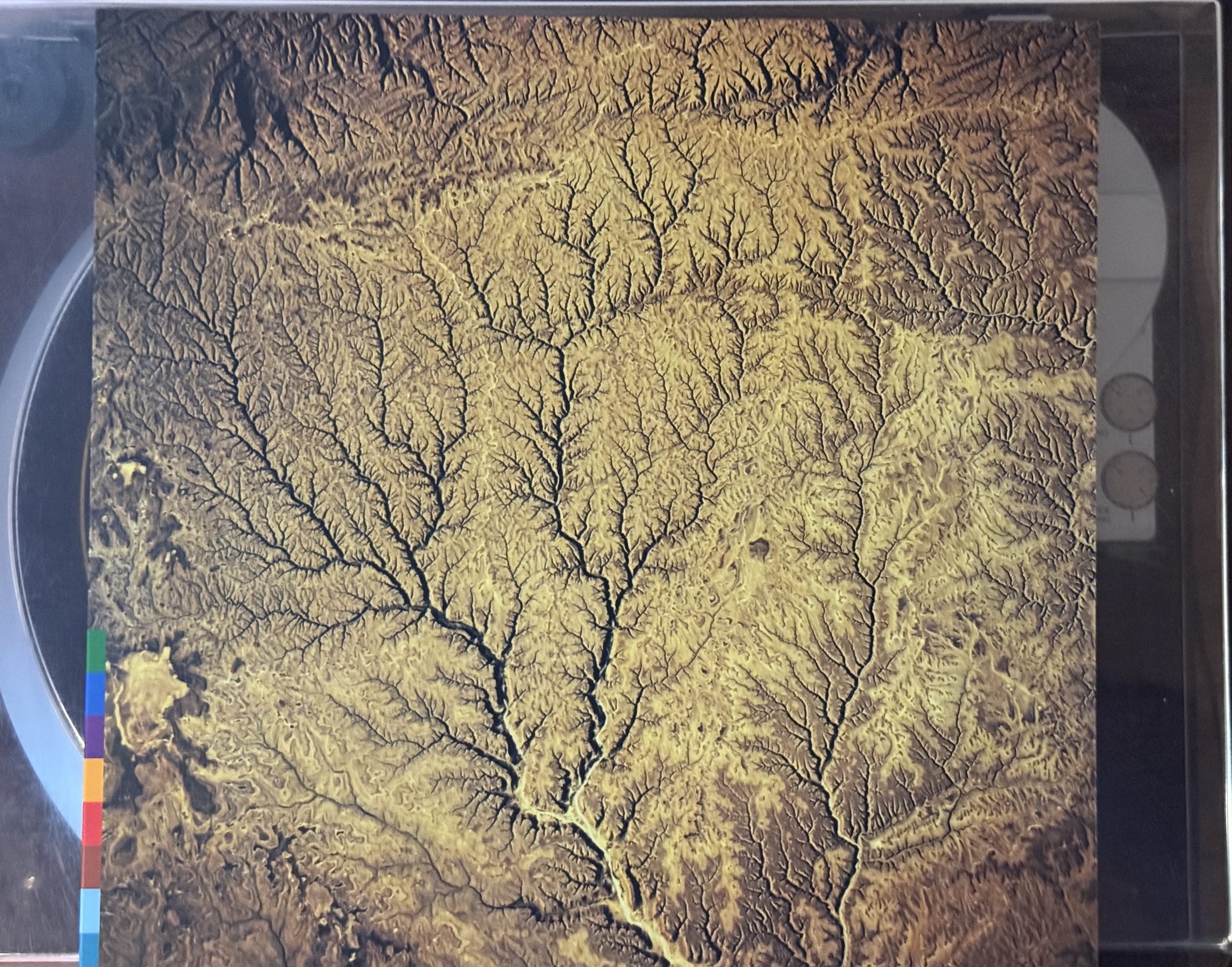
But as we’ve seen, for Peter Gabriel at least the connection to world rhythms and sounds went back further—as far back as 1982, at least, where on the strength of his song “Biko” he started the WOMAD festival to bring these artists to the public, and featured musicians like the Ekome Dance Company, L. Shankar, Manu Katché, and of course Youssou and Nusrat Fateh Ali Khan. He also, notably, launched Passion as the first record on his Real World label and gave many of these musicians record deals that allowed them to get their music in front of Western audiences. And he put out a label sampler, of a sort, in the form of Passion – Sources, a compilation album that gave space for both the musicians who had collaborated live in the studio on the making of Passion, and for some of the archival tracks that served as the foundation for the sonic explorations on the soundtrack.
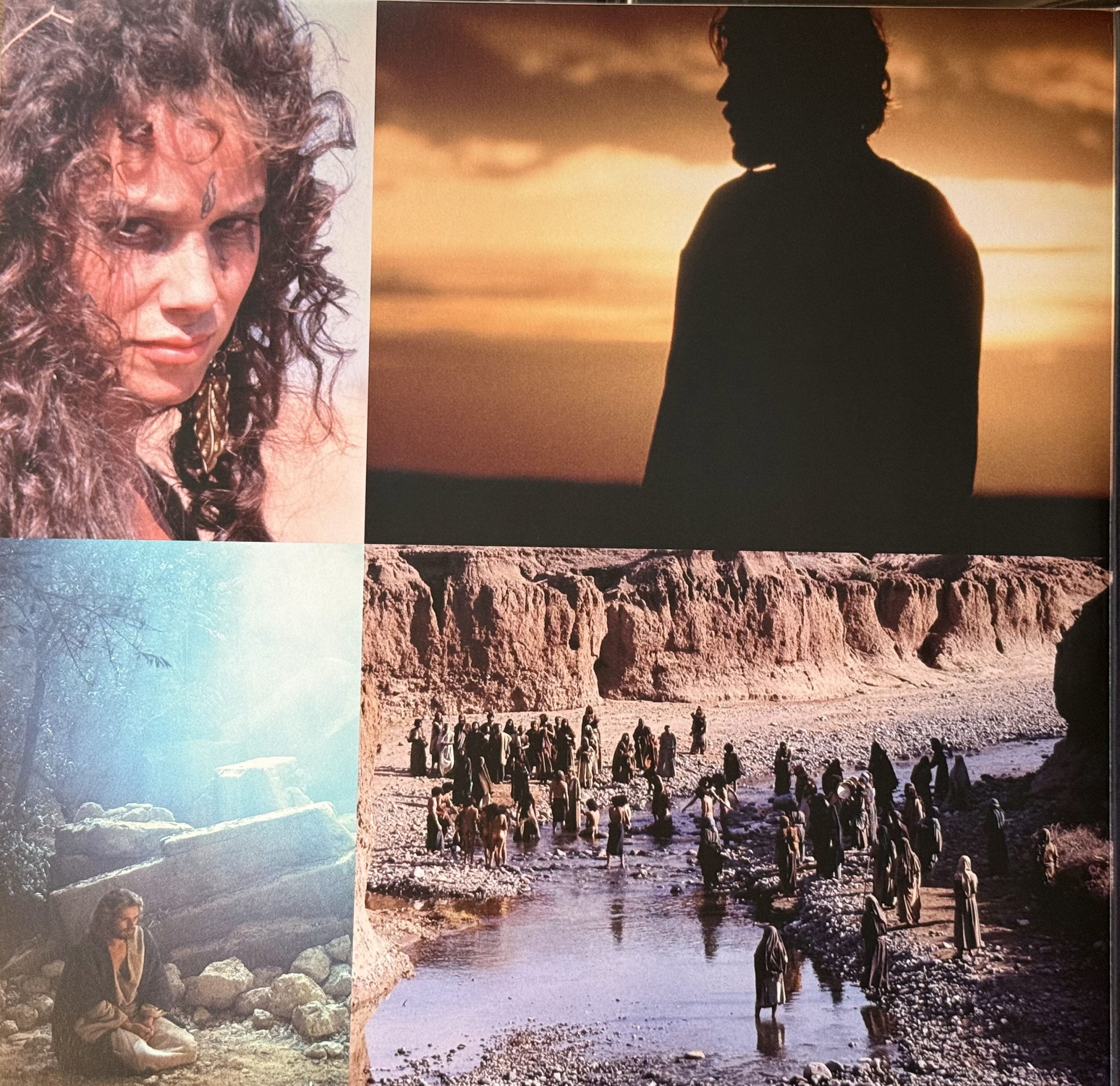
We’ve written extensively about Nusrat Fateh Ali Khan’s “Shamas-Ud-Doha Bader-Ud-Doja,” from his first Real World album Shahen-Shah; it opens this compilation in edited form, running just a touch over five minutes and fading out in the middle reprise of the verse. It leads into “Call to Prayer,” by Baaba Maal. Like Youssou N’Dour, Maal, who appeared on the Passion track “Of These, Hope (Reprise),” is an incredible vocalist from Senegal; unlike N’Dour, he is a griot, deeply steeped in the traditions of the Pulaar people, who were among the earliest African peoples to embrace Islam. Here he performs a traditional call to prayer as improvised over accompaniment from Lakshminarayana (L.) Shankar and a low drone; the work appeared in the movie The Last Temptation of Christ during its depiction of the Last Supper.
Shankar performs the next track, “Sankarabaranam Pancha Nadai Pallavi,” with his group the Epidemics, consisting of Zakir Hussain on tabla, Viku Vinayakram on ghatam, and British composer and musician Caroline Morgan on tanbura. Here, as in most of his 1980s work, Shankar plays the double violin, also known as the LSD (L. Shankar Double Violin), an electric string instrument of his own design that covers a wide chromatic range. The music here is a traditional southern Indian Carnatic raga.
Turkish master of the ney flute Kudsi Erguner performs the track “Ulvi,” a brief solo work in the Mevlevi Sufi tradition. If you suspect, based on the brief excerpt here, that a longer selection of ney music would be both hypnotic and slightly soporific, you would be correct, at least judging from the excellent German CD of his work I found in college. But this track is delightful and mysterious to listen to, and about as understated an expression of Sufi spirituality as Nusrat’s qawwali is extroverted.
Master Egyptian percussionist Hossam Ramzy multitracks the tabla, dufi, doholla, and tambourine on “Fallahi,” alongside the mazhar tambourine played by Joseph Alexander, building a tight polyrhythmic pattern that is both dance-worthy and trance-inducing. This is followed by two excerpts from earlier compilations, a “Sabahiya” or traditional morning nuptial serenade from an anthology, The Folk Music of Egypt, produced by Tiberiu Alexandra and credited to “Banga (Tanta-Suaag),” and a dervishlike “Tejbeit” by unknown Egyptian musicians, taken from an Ocora Records compilation with overdubbed percussion by Hossam Ramzy and tin whistle by Richard Evans. Here you can feel the slightly frantic atmosphere of the bar in which the original was recorded.
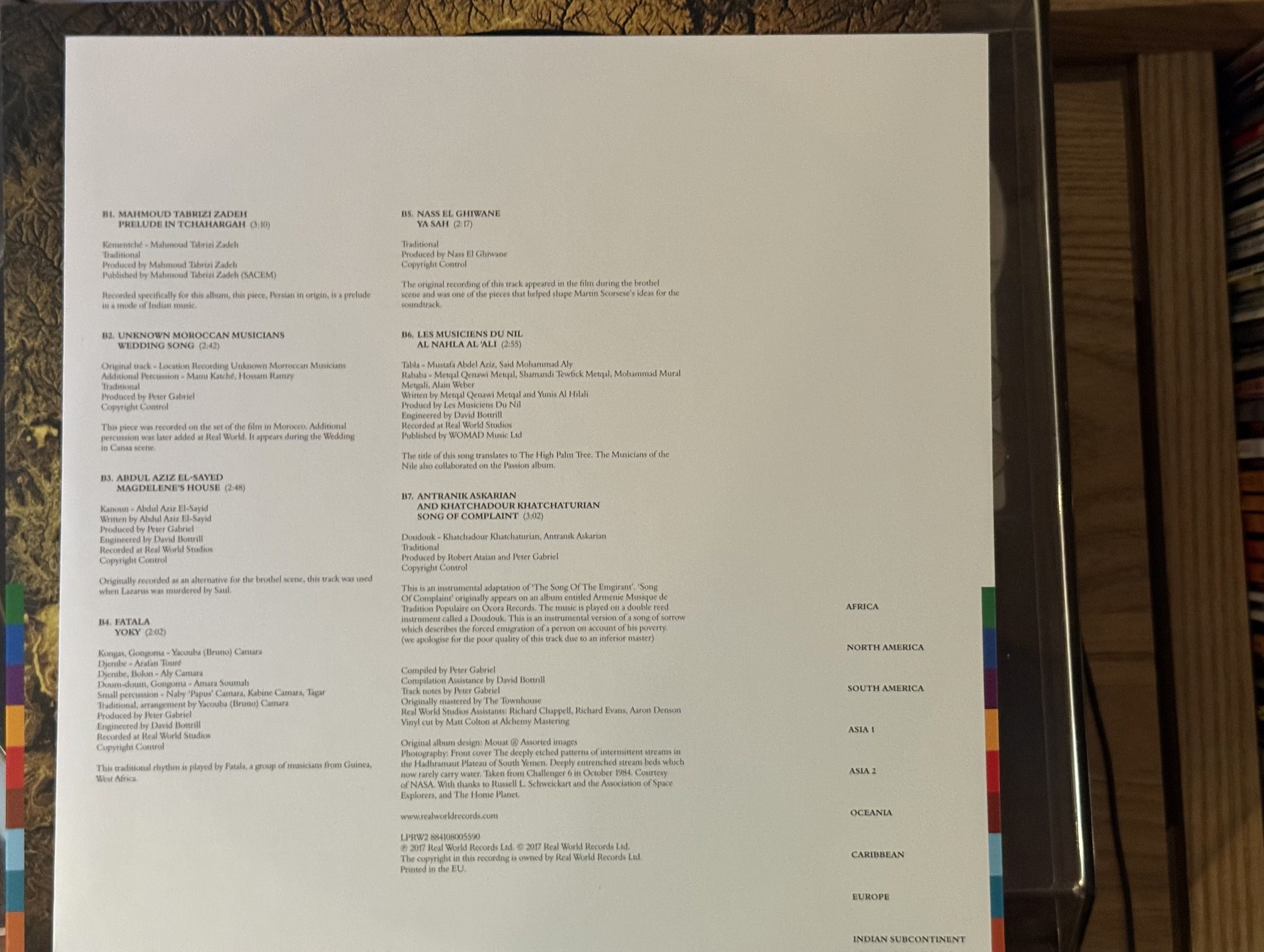
“Prelude in Tchahargah,” recorded by Mahmoud Tabrizi Zadeh on the kementché with tabla accompaniment, is a traditional Persian piece that displays some of the underlying affinities between Persian and Indian music. There’s very much a hybrid of dance and spiritual focus here, particularly in the unaccompanied improvisation that ends the work.
“Wedding Song” is a location recording of unknown Moroccan musicians from the set of the film, with percussion added by Ramzy and Manu Katché, that soundtracks the film’s recreation of the Wedding at Cana. It’s appropriately celebratory and hypnotic, with a repeated ten-bar call and response phrase.
“Magdalene’s House” gives us a listen to a musician whose work did not appear on Passion but did appear on the soundtrack of the movie. Abdul Aziz El-Sayed plays unaccompanied kanoun, a large zither-like instrument that allows the player to sound microtones. Here he plays flourishes and rapid runs in octaves along a modal scale, mostly sticking to a recognizable western mode but here and there throwing in some unusual tones for emphasis. The effect is spellbinding; one regrets the track’s short length, as it seems to end just as he finds a theme that could have made a magnificent Bach fugue.
An all-percussion track from the Guinean drum and dance troupe Fatala, “Yoky,” follows. Led by Yacouba (Bruno) Camara on congas and the gongoma drum (made from saw blades attached to a calabash gourd), the ensemble adds a pair of djembes and more gongoma for a hypnotic polyrhythm. Sadly, the ensemble only seems to have recorded one full album, a self-titled release in 1988.
“Ya Sah” is a trancelike number from Moroccan ensemble Nass El Ghiwane, which uses a Western banjo to produce an unusually disorienting cross-cultural effect — just as you think you’re in a foreign place entirely, suddenly the ring of the banjo places the sound squarely in an Appalachian string band tradition. Another number that doesn’t appear in Passion but does appear in the soundtrack, Gabriel says that its sound, which appears in a brothel scene in the movie, was one of the influences on his and Scorcese’s decision about the sound world of the movie.
Les Musiciens du Nil, who appeared on the Passion album in the track “Wall of Breath,” here play a more traditional Egyptian sound on “Al Nahla Al’Ali,” which features percussion and microtonal melodies in a rondo-like dance form that gradually accelerates into a crescendo then slows to a coda, leading to the slow “Song of Complaint” which is played on the Armenian doudouk by Antranik Askarian and Khatchadour Khatchaturian. Askarian appeared on the original recording on the Ocora Records label that was sampled for the opening track of Passion, “The Feeling Begins.” Without the massive drum hit, the traditional Armenian tune is a meditative reverie that completes the transition to another sound world.
As a “thank you” to the musicians whose work was incorporated into the Passion soundtrack, Passion – Sources can be read as a magnificent gesture. That it also functions as a sort of sampler for the mission of Gabriel’s new Real World label, opening ears to new sounds and new artists, is an intended second mission. As a seventeen-year-old listener newly moving beyond the relatively constrained sound worlds of my upbringing, it was revelatory. We’ll continue to explore the sounds of the world through the lens of Real World in the future. But over the next few weeks we’ll check in on some of Peter’s other collaborators as they make music through the end of the 1980s.
You can listen to this week’s album here:
BONUS: Here’s a live performance, with vocals, from Les Musiciens du Nil which gives you an idea of the traditional instrumentation used.
BONUS BONUS: Here’s a 1983 broadcast of Nass El Ghiwane in concert in Paris, playing for a very enthusiastic dancing crowd.
BONUS BONUS BONUS: Baaba Maal has had a long and fruitful career. Here’s his band from an astonishing 2024 performance that combines traditional and modern instrumentation to bring the crowd into a rhythmic trance:
BONUS x4: Kudsi Erguner has also had a long and vital career. Here’s a performance from 2013 that showcases the hypnotic power of the ney flute:
The Senegalese superstar’s major label debut blends a deep groove with modern technology and that incredible voice into a compelling, if uneven, listen.
Album of the Week, June 20, 2026
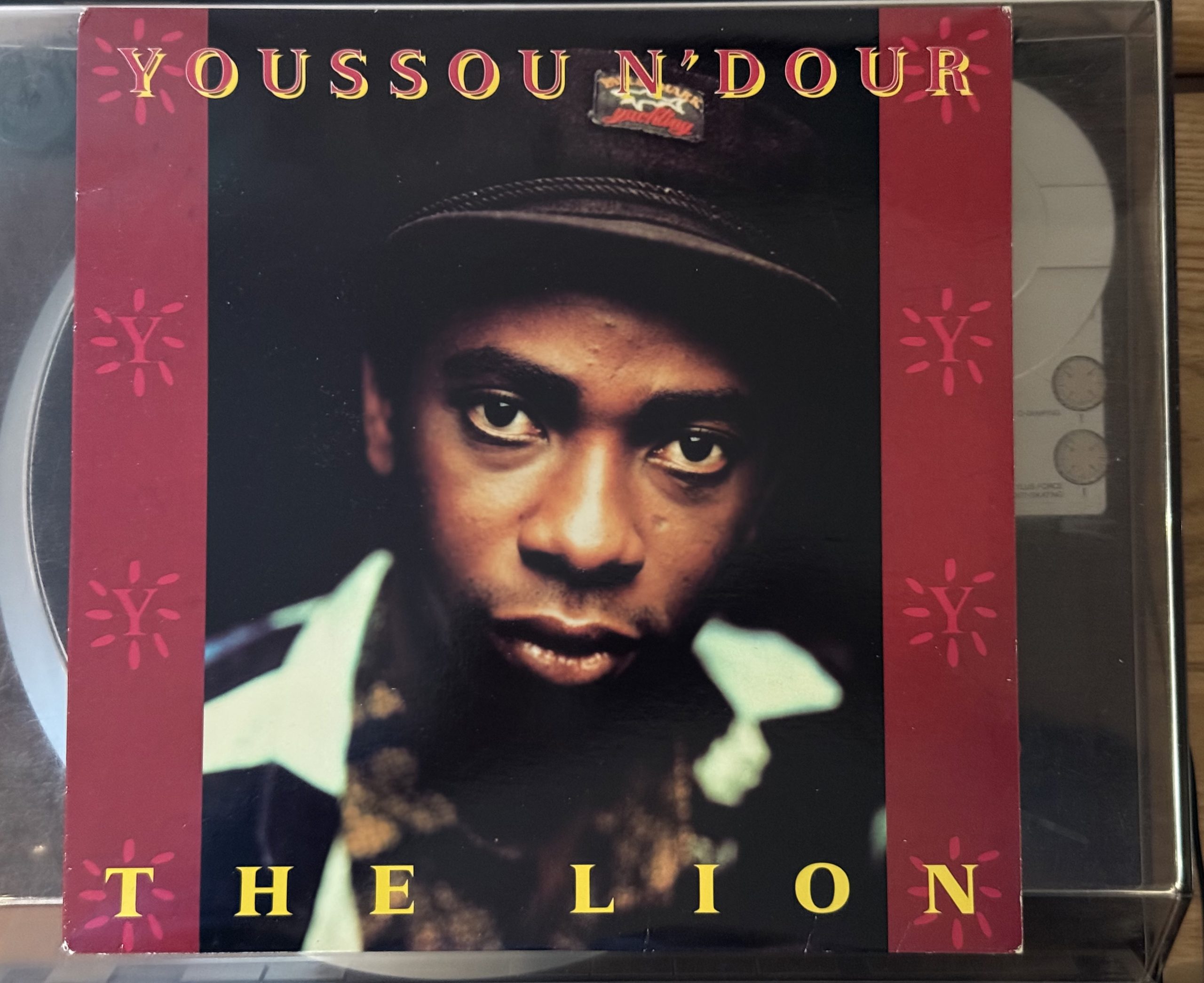
We’ve met Senegalese superstar Youssou N’Dour in the context of his work with Peter Gabriel; he might still be best known for his incandescent vocal on “In Your Eyes,” and we’ve heard his contributions to Peter’s all-star project Passion. But even before this global success Youssou was, by any measure, a star. It just took the world a while to catch up with him.
Youssou was born in 1958 in the Senegalese capital city of Dakar. He was already performing at age 12, and made many appearances with the Star Band, the house band of the most popular nightclub in Dakar at the time, the Miami Club. A number of bands eventually spun off the Star Band, including Orchestra Baobab and Étoile de Dakar; Youssou was a breakout star in the latter. The band fused traditional Senegalese music with Latin dance music, jazz and soul influences to form the mbalax style, which rapidly became the leading musical form in Senegal, Mauritania and Gambia due to its spread via inexpensive, accessible cassettes.
Étoile de Dakar was short lived due to tensions inside the group and split in two in 1981; Youssou’s half, Super Étoile de Dakar, featured guitarist Jimi Mbaye, bassist Habib Faye, and talking drum (tama) player Assane Thiam. The band recorded eight albums on local labels from 1982 to 1988. You can find a few of them on streaming services; Immigrésand Nelson Mandelaare especially worth a listen. But following the release of So in 1986, and the ensuing world tour, it was clear that Youssou had the makings of international stardom. He signed to Virgin Records, which was now distributing Peter Gabriel’s records in the UK, and brought the members of Super Étoile de Dakar along into the studio as his backing band.
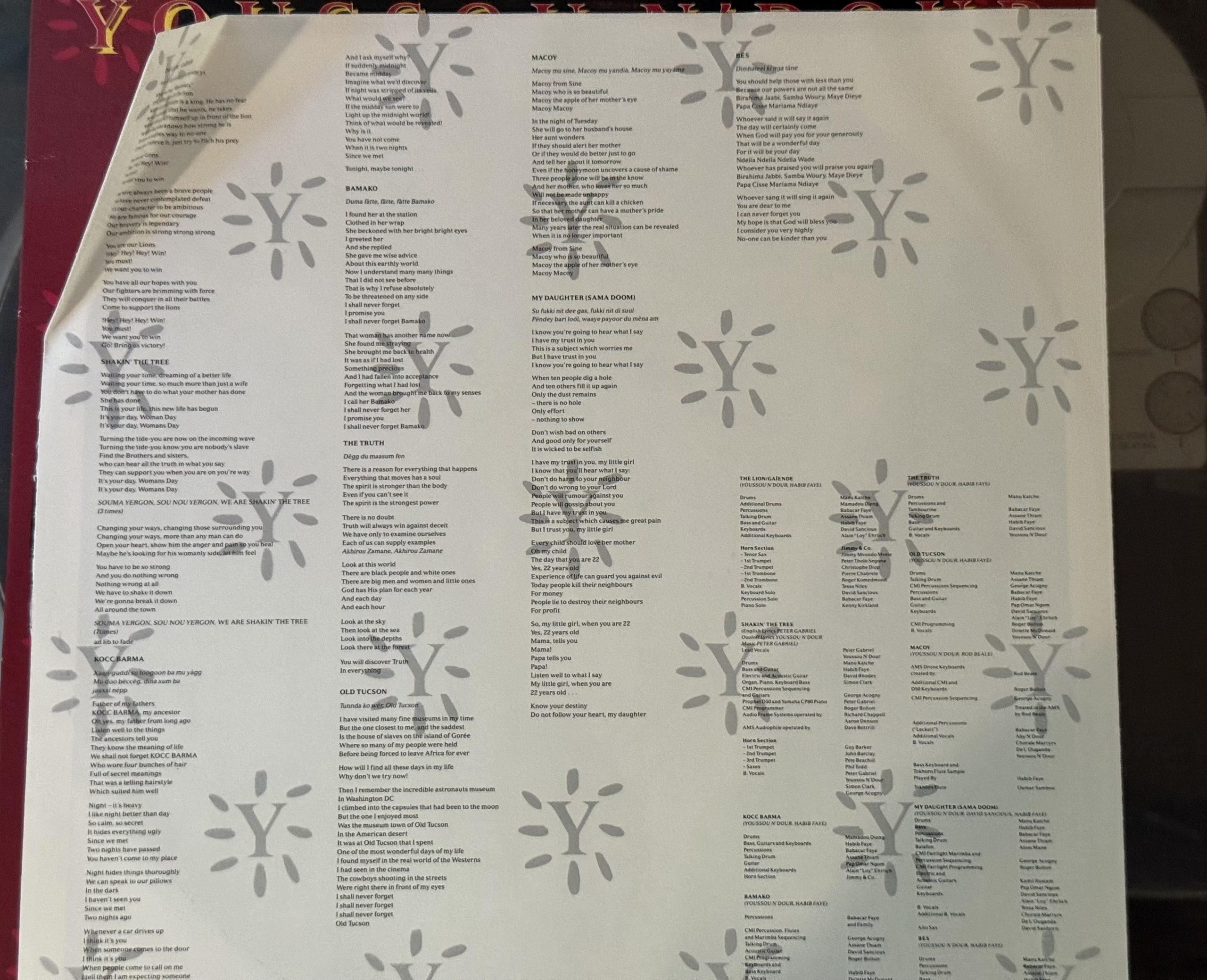
“The Lion (Gaïende)” starts us off with a bang. The band is tight as Youssou sings a song about the bravery of his people, in Wolof, that the liner notes translate in part as “We have always been a brave people/We have never contemplated defeat/It is our character to be ambitious… You are our Lions / Hey! Hey! Win! Win! / You must! / We want you to win.” Youssou is in fine voice here, moving quickly through the verse into an insistent chorus, in which he sings a second line that soars over the band. The bridge is noteworthy for some brilliantly fast keyboard work, which turns out to have been contributed by Kenny Kirkland. The lead track seems to fulfill all the promise of this debut, with sizzle and style that sacrifices none of the energy of the earlier Super Étoile recordings but adds a broader soundstage.
“Shakin’ the Tree” gives the people what they want—another Youssou/Peter Gabriel collaboration. This one is better thought of as Peter Gabriel’s band with Peter and Youssou trading lead vocals; of the players in Youssou’s band, only Habib Faye appears, joining Manu Katché, David Rhodes, and a horn section (Phil Todd, Guy Barker, John Barclay, Pete Beachill) made up of British jazz musicians. It helps that the song is a pretty strong Peter Gabriel composition, more optimistic—almost sunny—than the material on either of his two preceding albums. It also helps that it has two strong male voices singing about the strength of women, which you wouldn’t think would be groundbreaking but in 1989 was fairly revolutionary. And those horns! I remember reading a music mag article about Passion in which it talked about Peter sweating the stereo phase of the horns, trying to get the imaging just right in the mix, and you can definitely hear it here. About the only thing worth kvetching about is the vocal on the first verse, where, for the only time on record, Youssou sounds a little tentative as he sings the English lyrics. That may be why Peter chose to re-record the lead vocals with a higher melody when he put the song on his first greatest hits compilation a year later.
“Kocc Barma” is a more traditional mbalax number, featuring more of the Super Étoile sound including a non-British horn section and alternating sections of call-and-response and funky chorus. You can really hear the contributions of Habib Faye on bass and Assane Thiam on talking drum here; together they build an irresistible groove. This song was the headliner of one of Youssou’s last Super Étoile cassette releases, and it gives us a great high-definition picture of how mbalax could play on the world stage.
“Bamako” is more synth- and guitar-forward—that’s David Sancious on acoustic guitar, and African producer George Acogny’s keyboards and production. The percussion is forward in the mix but is largely relegated to straight-ahead timekeeping, with few of the talking drum flourishes from “Kocc Barma” until the very end. Instead we get stabs of strings and washes of heavily reverbed Youssou vocals, with backing vocals from Dolette McDonald. Not a bad thing at all.
“The Truth” builds atop a slap bass foundation with a strong Youssou chorus. Another inspirational lyric, the song begins (in translation) “There is a reason for everything that happens/Everything that moves has a soul.” About the only thing to complain about are the swathes of very 1980s keyboards, but then again, by 1989, synths are inevitable. Still, one wonders what this would sound like with the horn section.
Side two opens with “Old Tucson,” a puzzling song that features Youssou singing in English about three museums: the Maison des Esclaves (House of Slaves) on Gorée Island off the coast of Senegal; the Air and Space Museum, and Old Tucson, a kind of Disneyfied view of the old West where cowboys walk the streets. The groove is strong under the story, but it’s not clear where this shaggy dog story is going to end up. Is the point to marvel at the fruit that sprang from the poisoned beginnings, or just a travelogue? Whatever it is, Youssou will never forget, as he assures us in the final chorus. (This is another one that ended up on the Super Étoile Kocc Barma cassette.)
“Macoy” answers the question: what would it sound like if we had gotten more Youssou on Peter Gabriel’s Passion? The track is built around loops and samples sequenced on the Fairlight and features improvised vocals from Youssou and from his sister Aby N’Dour, along with backing vocals from the Chorale Martyrs de’Ougande. The translated lyrics in the liner notes don’t illuminate so much as deepen the mystery: who is Macoy from Sine? Why should there be shame in her going to her husband’s house? Why must she go after midnight?
“My Daughter (Sama Doom)” builds a groove out of a three-measure phrase and marimba samples on the Fairlight, but here it feels more organic thanks to the capable drumming of Manu Katché, who adds a little straight-ahead drive to the groove laid down by Faye and Thiam. Another soaring chorus adds emotional heft to this song of advice from Youssou to his daughter.
“Bés” closes out the album with another wash of synthesizers. It’s tempting to blame the major-label producers for the preponderance of synthesizers here, but the 1987 version on the Kocc Barma cassette has even more synth sound, albeit on less expensive hardware. It also has a stronger percussive drive than this version; though the album version features Thiam and Katché, it’s David Sancious’s keyboards that carry the overall sound. The lyric here is an inspirational message: “You should help those with less than you/Because our powers are not all the same.” He calls out a series of Senegalese politicians and innovators, charging them with a plea for generosity.
Coming on the heels of Nusrat Fateh Ali Khan’s Shahen-Shah, The Lion can be frustrating for the intrusion of synths, for the way that songs like “Old Tucson” and “Macoy” pose questions with no satisfying answers. At the same time, the album has some flat-out bangers, to say nothing of furthering the truly wonderful collaboration between Youssou and Peter Gabriel. And even better albums lay ahead; we’ll hear one of those in a few weeks. Next week we’ll hear more from some of the musicians who contributed to the success of Gabriel’s Passion.
You can listen to this week’s album here:
BONUS: Here’s a live performance of “Macoy” from Tokyo:
BONUS BONUS: Youssou was playing some of this material in the sets on the So tour where he opened for Peter Gabriel, including the legendary 1987 Athens performance. It’s a treat to watch the band perform “Kocc Barma” in high definition, even if this version omits the brass section:
Nusrat’s first Western album is an ideal representation of the sacred and secular art of qawwali singing.
Album of the Week, June 13, 2026
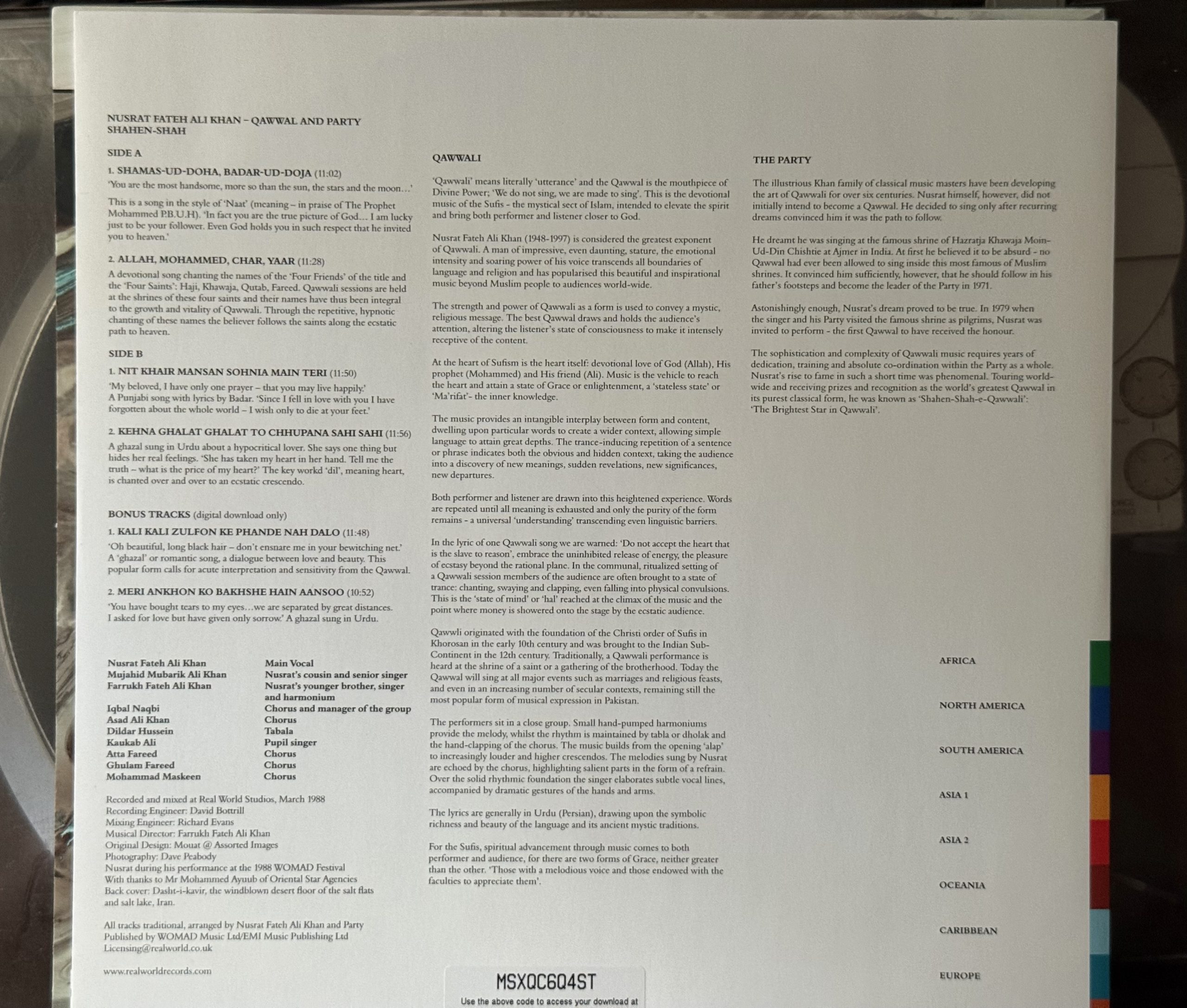
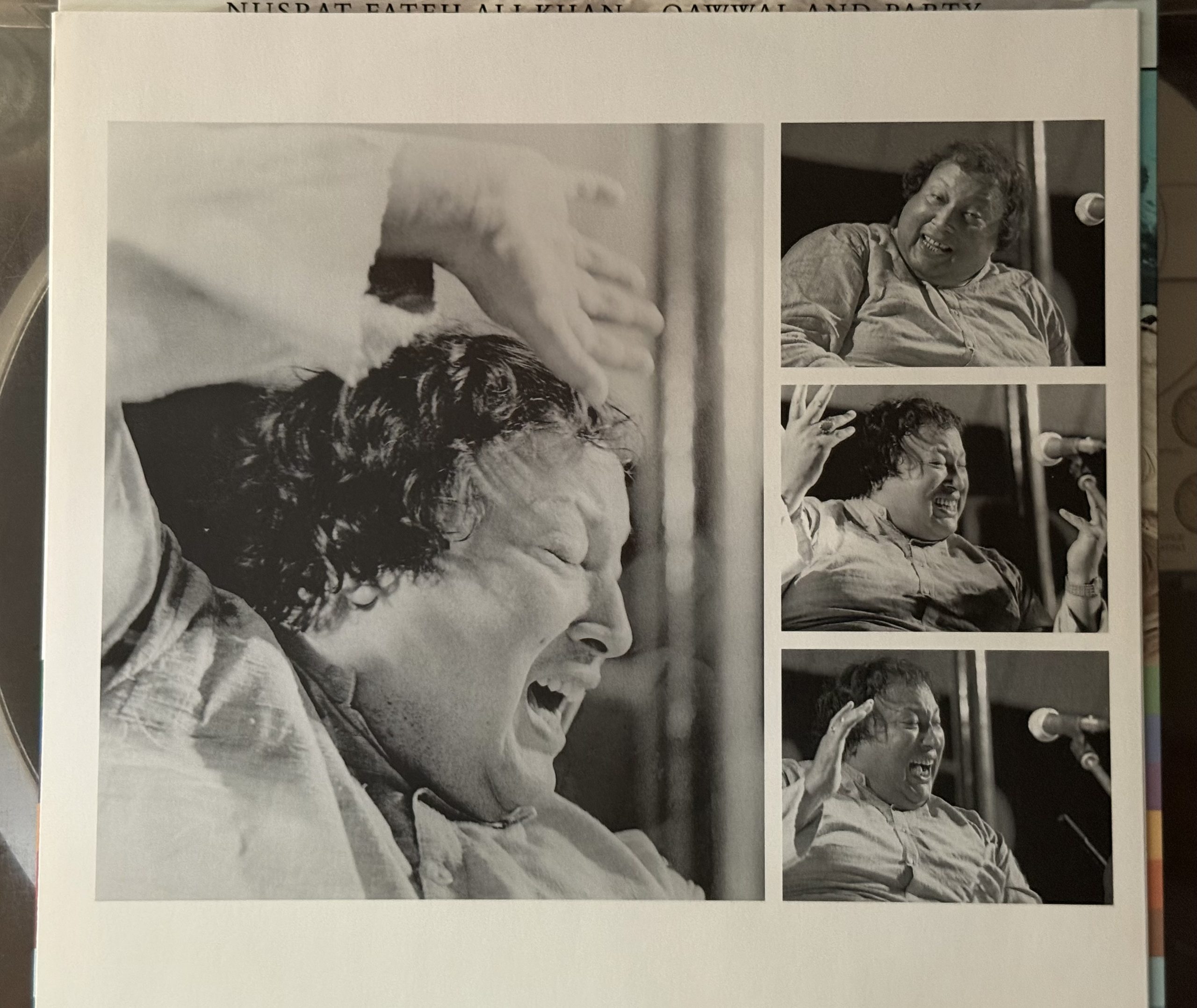
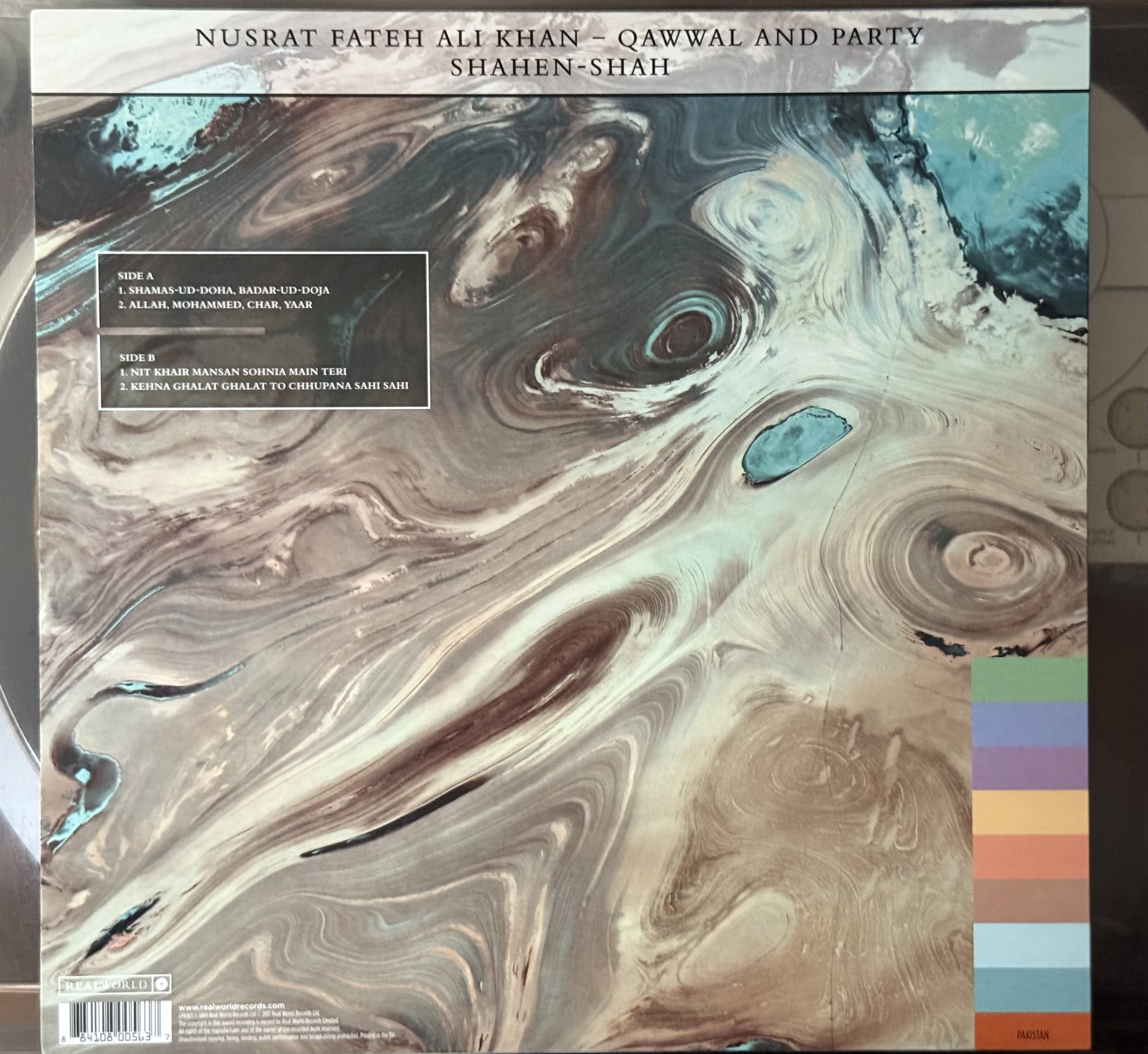
When it came time for Nusrat Fateh Ali Khan to record his first album for Peter Gabriel’s nascent Real World Records, he could have Westernized his sound—after all, he had just spent time in the studio with Gabriel on the Passion project. Instead, he and his party produced an album that was as accurate a representation of qawwali tradition that had ever been released, opening the door for Westerners to discover the tradition.
Nusrat was not new to being recorded; prior to 1989 and this session he had already released some twenty-eight albums, a few for EMI but most for small local labels, or for the French world music label Ocora. But listeners noted that “studio-recorded Nusrat [could] often feel rushed, as if the party was singing qawwali for the sake of the recording rather than for the sake of religious praise.” No such limitation existed here; this was full-throttle qawwali, with the group providing authentic examples of devotional songs as well as ghazals (romantic songs).
Part of the secret of the recording was the timing. The original Real World recordings were not limited by the running times of vinyl; by 1989 most releases were CD-first, and a project containing six tracks each stretching more than ten minutes was no longer out of the question. Unfortunately this led to some choices when releasing these recordings on vinyl, mostly at the time for the European market which continued to demand vinyl releases through the early 1990s. Today’s record is the 2017 reissue of the 1989 European vinyl release, and it omits two tracks, “Meri Ankhon Ko Bakhshe Hain Aansoo” and “Kali Kali Zulfon Ke Phande Nah Dalo.” The latter is probably my favorite Nusrat track of all time, so I was irked to find it omitted from this release; we’re going to talk about it in the bonus tracks.
“Shamas-Ud-Doha, Badar-Ud-Doja” opens with the instrumentalists: harmonium playing the melody of the hymn in praise to Mohammed, hand claps. Then Nusrat leads the party in a gathering tone, wordlessly outlining the tonic, the third and the fourth in an introductory vocalese before singing a rhythmic verse that loosely follows the main tune, followed by everyone entering on the chorus. Nusrat lets us know how it’s going to go when, at the end of the second chorus repetition, he easily rips a vocal improvisation an octave up. At the end of the fourth chorus, he lays down a series of 32nd-note runs. The other singers in the party contribute too; one of them adds a run around the fifth, another at the octave, and there are numerous places where Nusrat improvises in the middle range while one of the other singers provides a high obbligato above. (This record features vocals from Nusrat’s cousin Mujahid Mubarak Ali Khan and his brother Farrukh, as well as his pupil Kaukab Ali, as well as other singers in a chorus; the youngest pupil heard on Live at WOMAD 1985, Rahat, is not heard here.) About halfway through, Nusrat engages in some stepwise sangam improvisation and some rhythmic improvised vocal syllables, which are closely followed by the tabla and harmonium. The closing series of runs where Nusrat rips a series of 32nd-note patterns up the scale are simply awe inspiring.
“Allah, Mohammed, Char, Yaar” is a devotional chant to God, the Prophet, and the “four friends”—four Sufi saints whose graves are the site of pilgrimages and qawwali sessions. It’s also gnarly as hell. The melody syncopates from the second note and recovers the non-syncopated beat with three eighth notes, and those off-beats in the middle have me leaning forward into the beat all the way. It’s in the raga marwa, something like the Locrian western mode, meaning that it sits unstably between a major and minor feeling, and also meaning that the qawwal singer can explore both tonalities in the solo, a fact of which Nusrat takes full advantage. There is less for the party to do in this song, aside from some high obbligato late in the song; mostly they groove on the chant. And there’s a lot to groove on; Nusrat’s sense of the beat is impeccable, and he’ll seemingly fly off at random only to have an improvisation circle right back to the tonic at the start of the chant again, over and over again.
“Nit Khair Mansan Sohnia Main Teri” is a Punjabi love song: “My beloved, I have only one prayer, that you may live happily…Since I fell in love with you, I have forgotten about the whole world; I wish only to die at your feet.” You can hear a little more of the traditional raga sound in this one, as Nusrat and the party sing the introduction and then get to the chorus. Here you can hear the roles of the other singers in the party, as one specializes in singing descending wordless lines in a thin clear voice from the octave while another, with a stronger voice, provides more of a high tenor line above the proceedings. Nusrat’s incredibly resonant and vibrato-rich instrument essays rhythmic running lines throughout. This one is trancelike, perhaps because of the raga foundation combined with the relentless major key feeling.
Another love song, in this case a ghazal in Urdu, “Kehna Ghalat Ghalat To Chhupana Sahi Sahi” is a song of complaint about a lover who says one thing and does another. Even here Nusrat steps into moments of ecstatic crescendo; rather than sounding angry or exasperated this too is a moment to celebrate the musical world of qawwali. The extended series of solos on the syllable dil (heart) are a magnificent punctuation of the overall arc of the song. At the end of the song, we get the only decelerando in the whole album as the party slows to the final repetitions of the love song.
With his first album for Real World, it was clear why Nusrat Fateh Ali Khan had chosen this title: “Shahen-shah” means brightest star, and this was clearly a performance of a leading light in the qawwali tradition. The record opened the door for Western listeners to immerse themselves in an entirely new cultural sound world. Some, like Jeff Buckley, were awestruck by Nusrat’s vocal ability and sought to learn from him. Some heard exotic sounds and sought ways to bring them into Western music; we’ll hear examples of that later. And some took it as a cue to explore more varieties of non-European music. We’ll hear from another great musician who opened some of these same doors next time.
You can listen to the full version of this week’s album, including the tracks that didn’t make the LP version, here:
BONUS: Let’s talk about “Kali Kali Zulfon Ke Phande Nah Dalo.” I have always liked the track a lot; it appears on a mix I made just out of college and was likely one of the tracks I played the afternoon I met my wife (though it was Tuvan throat singing that was blasting from my stereo when I actually opened the door and met her). The tune of this Urdu love song is stated in the harmonium, which gets its own elaborate improvisation until Nusrat and the party join with sustained gathering tones. When Nusrat starts the chorus, we get an initial statement, a repetition tagged with an octave high emphatic tone, a third with a high obbligato, a fourth with Nusrat ripping a descending vocal line from the third above the octave. Then the party alternates singing the chorus statement with more obbligato from the other singers and elaborate improvisations from Nusrat. Starting about three minutes in he starts to essay some call-and-response verses. I learned a lot as a college just sitting and listening to all the ways he interrupted the flow of the chorus with solos, how his vocal lines reinforced or altered the tonality, and especially how he played with the meter of the lines. The stretch from around 5:45 to 6:20 is a masterclass in how to fluidly slip in and out of metrical alignment with the groove, particularly the triple sets of triplets which shift out of and into phase flawlessly. I can still put it on and listen to it all these years later, and discover something I’ve never heard before.
BONUS BONUS: Here’s “Nit Khair Mansan Sohnia Main Teri” live from the 1988 WOMAD festival, about the time that Nusrat was headed into the newly constructed Real World studio to record this album.
Happy Blogaversary to me! 2001 seems like a long time ago. I had tired of just reading about blogging and decided to try out some of the tools, some months before. But that summer I got into a habit of posting regularly, starting June 11, 2001. Partly inspired by the new ways of thinking I was learning in my classes on product design and business strategy at MIT, partly reflecting the changes in my life at the time, and partly looking to connect during what was a pretty lonely summer, the blog took off and started to be a real thing.
Over the last year I’ve mostly just written. Lots of music writing, a few cocktails and other posts. I haven’t updated the design of the blog in years; it’s interesting to look back at the one truly hand-rolled theme I ever made, which was buggy but had its own charm. I’m not going to go back to wrestling with CSS any time soon, but I miss certain things about the look and feel (mostly the small caps).
I also miss having the time to write more. Things don’t seem to be slowing down much as I age. But I suppose that’s better than the alternative. And really, no matter how much has changed, there are some important things that are true: I love music and writing, I love cooking and food, I love being here on this earth. All those are good things, and I look forward to continuing to write about them and share my thoughts with you for many years to come.
I’ll leave with another plug for a happy musical interlude that I published last month; I find I’m liking it more and more as the summer goes on. (You can listen to all my recent playlists on my Soundcloud.)
A landmark collaboration with a seemingly inexhaustible parade of master musicians creates one of the strongest offerings in Gabriel’s catalog.
Album of the Week, June 6, 2026
Peter Gabriel spent the months following So touring the world; the concert film Live in Athens gives a good idea of what that experience was like. But he was still writing music, and the next thing that came from him was a one-two punch: a soundtrack album to the most controversial film of the late 1980s, and a brand new record label to release it. And Peter being Peter, he released the album in June 1989, almost a full nine months after the theatrical release of the film that inspired it.
The energy that today animates reactionary groups like the Promise Keepers and Christian Nationalist groups was alive and well in the 1980s, in the form of groups like the Moral Majority, TV evangelist fans, and other similar gatherings of extremists. They weren’t happy with Martin Scorsese’s film (though few formed an opinion informed by actually having seen it), which dared to imagine that Jesus might have been human enough to have been tempted by the possibility of family life into abandoning his mission; the idea that Jesus might have in particular entertained sexual thoughts was particularly threatening.1 Some of those who felt so threatened lost the plot badly enough that they firebombed cinemas and made death threats against Scorsese. Plus ça change, plus c’est la même chose…
Gabriel seems to have escaped the threats, possibly because his album came out so much later than the movie’s release and the height of the controversy. Though a version of the music appears in the film, he kept working on it, trying to find the right sounds and textures, through March of 1989. And, thanks to his ongoing work with WOMAD and his previous collaborations, he had the right musicians to work with, many of whom would go on to release albums of their own on his new label, Real World Records. The list was long and included Egyptian percussionist Hossam Ramzy; Indian violinist L. Shankar; Senegalese vocalists Baaba Maal and Youssou N’Dour; Pakistani qawwali singer Nusrat Fateh Ali Khan; Senegalese drummer Doudou N’Daiye Rose; percussionists and string players Massamba Diop, Mahmoud Tabrizi Zadeh, and Fatala; Turkish ney flute master Kudsi Erguner; Brazilian percussionist Djalma Corrêa; Americans Jon Hassell, David Sancious, Billy Cobham, Nathan East and Manny Elias; and Peter’s long-term collaborators David Rhodes and David Bottrill.
All that said, the most notable music performance on the first track is a sample. “The Feeling Begins” opens with a traditional Armenian melody played on doudouks by Vatche Housepian and Antranik Askarian, from a collection of traditional Armenian music released on Ocora Records years before. The doudouk melody forms the backbone of the arrangement, but the massive percussion attack from Manny Elias with Hossam Ramzy is also fairly magnificent and provides our first clue that we’re in for a genre-bending ride throughout the album. As the doudouk melody comes to an end, the drums roar in a crescendo, using the same trick that Peter so memorably deployed in “The Rhythm of the Heat.”
One thing I discovered as a teenager listening to this album (I bought it the first summer I ever lived for myself, during a monthlong science Governor’s School experience at Virginia Tech, so I listened to it a lot) was that I was less engaged by the tracks that featured fewer live instruments. “Gethsemane” is one of those tracks, constructed by Gabriel from samples of flute and voices. But it’s appropriately ominous and ghostly, and does the job of foreshadowing that it’s meant to do.
It’s followed by one of the more spectacular sequences on the album. “Of These, Hope” opens with a fanfare of sorts on the arghul, an ancient reed instrument that here contributes a swirl of crowd noise over an insistent talking drum courtesy of Massamba Diop. Peter has said of So that the groove was the thing that made that album so special; “Of These, Hope” is a classical composition with groove. It also has strong textural interest thanks to the arghul, and from the combination of drone, flute whistle, talking drum, guitar and synths. This leads into “Lazarus Raised” without break via an anticipatory shiver of synths as another doudouk sample — this time an uncredited Kurdish player from a UNESCO collection — gives us a mysterious melody signifying the expression of power leading to the raising of Lazarus from the dead. Peter’s flute whistle leads us into “Of These, Hope (Reprise),” which plays like a further elaboration of the melody. It misses the shock and awe of the arghul chorus from the first repetition, but gains a different sort of shock and awe thanks to the presence of Baaba Maal, a Senegalese vocalist whose speciality was the traditional music of the Pulaar-speaking peoples of the Futa Tooro region of Senegal.
“In Doubt” is another synth-forward groove, given depth by the uncanny sound of the kementché, an Iranian bowed string instrument here played by Mahmoud Tabrizi Zadeh. Peter doesn’t let this groove build for very long before a bigger one takes over , a massive percussion onslaught from Doudou N’Daiye Rose and Fatala signals the arrival of “A Different Drum.” I can almost hear Peter telling Geffen Records, “This is the single.” Between the strong rhythmic intensity, the insistently repetitive melodic theme, the wordless chorus, and above all the presence of the spectacular voice of Youssou N’Dour, this is one of the most accessible and memorable tracks on the album. It has the feeling of one of Peter’s songs-in-progress that never received a proper lyric, but the feeling is there, a stirringly heroic track.
What did get life as an independent single, somewhat surprisingly, is the next track,“Zaar.” A complex track built around a slowed- and pitched-down drum sample, the band, here featuring Hossam Ramzy on percussion, Mahmoud Tabrizi Zadeh‘s kementché, wordless vocals, and an intense series of interjections from L. Shankar’s violin, constructs a striking mood piece whose free interchange of musical ideas and sounds seems to sum up the whole project. “Zaar” was the track Peter chose to represent this project on his first greatest hits album, which would be released two years later, and it feels like a universe of its own.
“Troubled” is built around a mean groove built out of layered drums and percussion, all played by the great Billy Cobham. After we heard him on Champions and on a whole slew of CTI albums, Cobham joined John McLaughlin’s legendary jazz-world-fusion project Mahavishnu Orchestra, and it’s that polyrhythmic intensity that he brings here over a backing of snarling synths and a wordless vocals chorus loop. “Open” breathes more freely, a duet between Peter on the Prophet and Akai S900 and vocals, and L. Shankar’s violin and vocals. It suspends time and, with the echoes of ragas in Shankar’s improvisation, lends an unexpected emotional resonance to the simple melody Concluding the trio of pieces, “Before Night Falls” is a three-way collaboration between Hossam Ramzy, Shankar, and the great Turkish Sufi ney flute legend Kudsi Erguner, with added depth courtesy of one of engineer David Bottrill’s legendary drones. The plaintive melody and fade-out lend the feeling of a sunset over the gates of a desert city.
We leave groove behind for more traditional composition with “With This Love,” a haunting melody played by Robin Canter on the cor Anglais. The melody is gorgeous but the layers of synths detract somewhat from the emotional power of the work. The theme bookends a trio of pieces dealing with the actual crucifixion of Christ, starting with “Sandstorm,” in which Hossam Ramzy, Mahmoud Tabrizi Zadeh, Manu Katché and Shankar build an atmospheric groove over a location recording of Moroccan percussion and vocals. The synths add a blurriness to the overall effect, so when the Moroccan musicians cut through it’s startling and intense.
“Stigmata” is a joint improvisation by Mahmoud Tabrizi Zadeh, Shankar and Gabriel. The instrumental texture is deep and mysterious, but ultimately the tension ebbs away into the fade-out before “Passion.” The redoubtable Shankar, Jon Hassel, and Peter’s Fairlight are the supporting players here for the astonishing vocal improvisations of Youssou N’Dour and Nusrat Fateh Ali Khan, here signifying the suffering of Christ on the cross. Here there is no ebbing of intensity; Nusrat masterfully builds suspense through his sangam improvisation, as Youssou’s interjections cut through to intensify the emotional impact. A devastatingly pure high melody from choirboy Julian Wilkins2 punctuates the rising emotional tide. At the end, everything cuts away but Youssou’s cries and Djalma Corrêa’s percussion.
The choral reprise of “With This Love” is introduced by the cor Anglais melody, but Gabriel wisely leaves the Wells Cathedral Boys Choir (recorded by Richard Evans) totally unaccompanied as they perform a heartwrenching four-part arrangement of the melody. The acoustic of the performance space can be heard—there’s an audible footfall or noise at one point that sounds a bit as though someone has stepped onto an echoing stone floor in one of the transepts and been hastily waved away—adding to the overall timeless resonance of the moment. It’s one of the most stunningly beautiful musical expressions on an album full of remarkable sounds. It’s also one of the most fraught; originally intended to accompany the scene where a devil in the form of a little girl tells Christ that he doesn’t have to suffer, removes the nails from his body, and leads him off the cross, it was nixed from the final film. Scorsese pointed out that the use of a Christian religious signifier like a boys’ choir would further underscore the blasphemy of the moment and pour fuel on the outrage that was already mounting even before the film was released.
“Wall of Breath” leads us into uncertain territory as Christ is tempted to abandon his destiny, with Kudsi Erguner, Shankar, and the Musicians du Nil building an atmosphere based around a shifting tonality. “The Promise of Shadows” takes us to a dark place with Billy Cobham’s drums and a rising chorus contributing to the feeling that something isn’t right. Despite the title, “Disturbed” seems to lead us into a brighter moment, as Shankar’s violin introduces an intense percussion groove built up from Hossam Ramzy’s tabla, African percussion from Fatala, and looped percussion from Mustafa Abdel Aziz and Said Mohammad Aly. Peter’s Prophet and Fairlight provide a simple melodic line to anchor the groove as the percussion fades out.
“It Is Accomplished” is signaled by a fanfare on the arghul followed by an uncanny shimmer of a vocal yell (uncredited on the album, the original location recording has surfaced which is amazing to listen to on its own. You can hear it in one of my Exfiltration Radio mixes). A triumphant melody built around a simple descending four-note pattern gains depth from Billy Cobham’s drumming, David Rhodes’ guitar, and David Sancious’s Hammond organ as the music celebrates Christ overcoming his last temptation and fulfilling his mission. “Bread and Wine” builds a new melody from the echoes of the old, creating something new in remembrance courtesy of a tin whistle performance by Richard Evans.
I cannot overstate the role this album played in furthering my personal musical development and encouraging me to listen to the world with open ears. And Passion marks a significant moment in Peter’s career, as a culmination of his work with WOMAD during the 1980s and a seamless blending of his explorations of synth textures with collaborative compositions from some of the finest non-Western musicians of the moment. It earned a Grammy Award for Best New Age Album3, and helped to further popularize “world music” as a genre in its own right.
It also helped create a vehicle to fuel the demand; as the first release on Gabriel’s new Real World label, it included advertisements for a series of individual recordings from many of the musicians on the record, plus more of Gabriel’s WOMAD collaborators. Real World is still going strong and has reissued many of those pivotal early recordings, some appearing on vinyl for the first time; we’ll check in on those, among other things, starting next week.
You can listen to this week’s album here:
BONUS: This 2021 performance by the Francesco Albano Open Ensemble of the Passion score is impressive. With all the layers in the original recording, it’s hard to imagine someone pulling off one of the songs live; to do the entire thing in a single concert is kind of mind-blowing.
BONUS BONUS: Speaking of live performances, Peter performed “Of These, Hope” live at the 1988 WOMAD Festival in St. Austell, with Nusrat Fateh Ali Khan and Youssou N’Dour. Sadly there’s no video but the audio in this bootleg clip isn’t half bad:
Footnotes
It’s a good thing he didn’t imagine himself dancing. ↩︎
Wilkins is now the conductor of the City of Birmingham Symphony Orchestra’s Youth Chorus. ↩︎
Proof positive that this was something new, as the album bears as much resemblance to “New Age” music as it does to Metal Machine Music. ↩︎
A soundtrack of a concert film of a performance art show, with wild technological magic under its skin.
Album of the Week, May 30, 2026
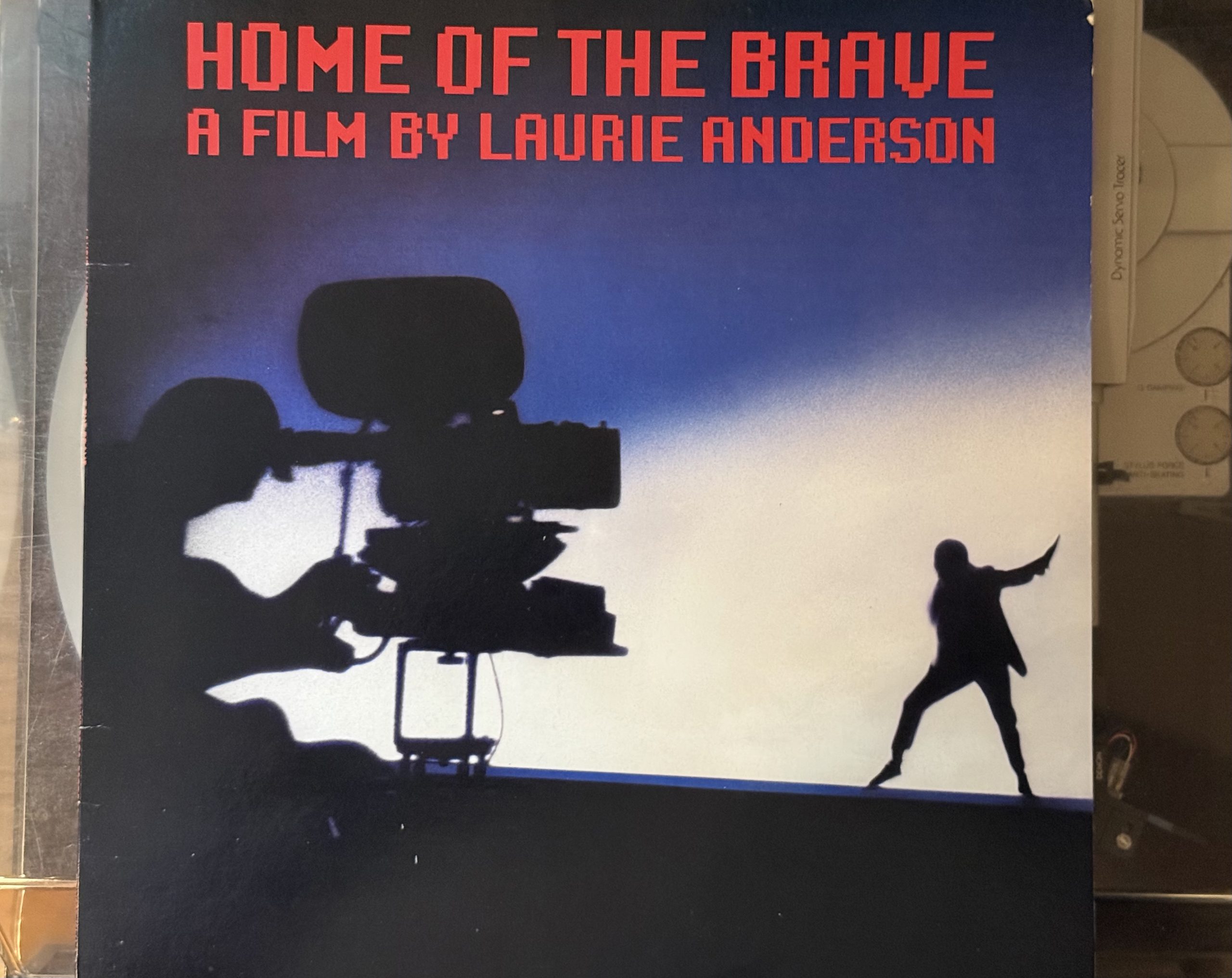
Following Mister Heartbreak, Laurie Anderson continued to develop and tour shows based around her unique combination of performance art and music, as well as technology. In 1986 that led to an unexpected place: a theatrical release of a movie capturing the touring show that she mounted in support of the 1982 album. The movie flopped, grossing only $1.25 million at the box office, but it spawned a video release and a soundtrack, which provide a fascinating picture of how her art evolved alongside the technology she used to produce it.
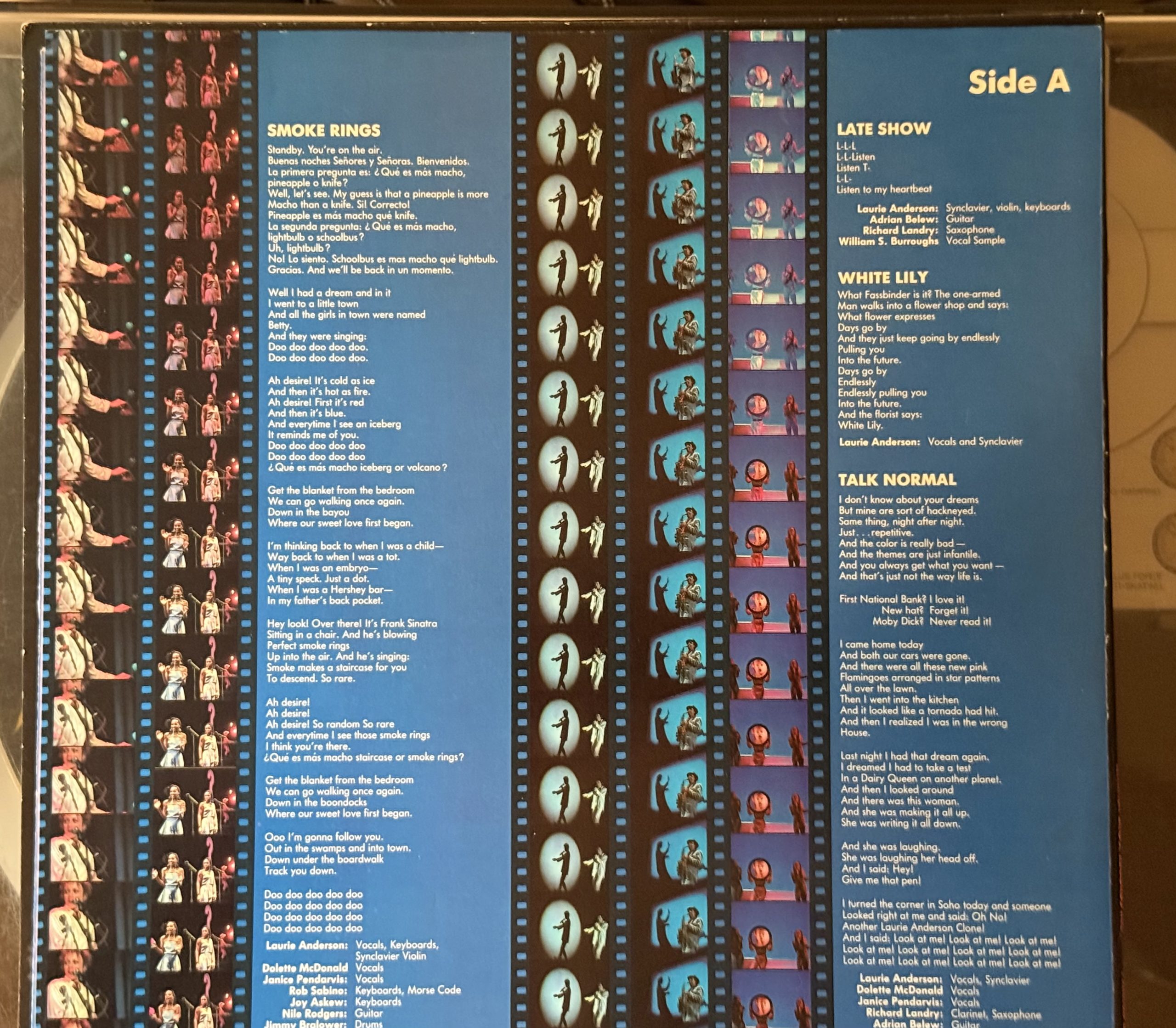
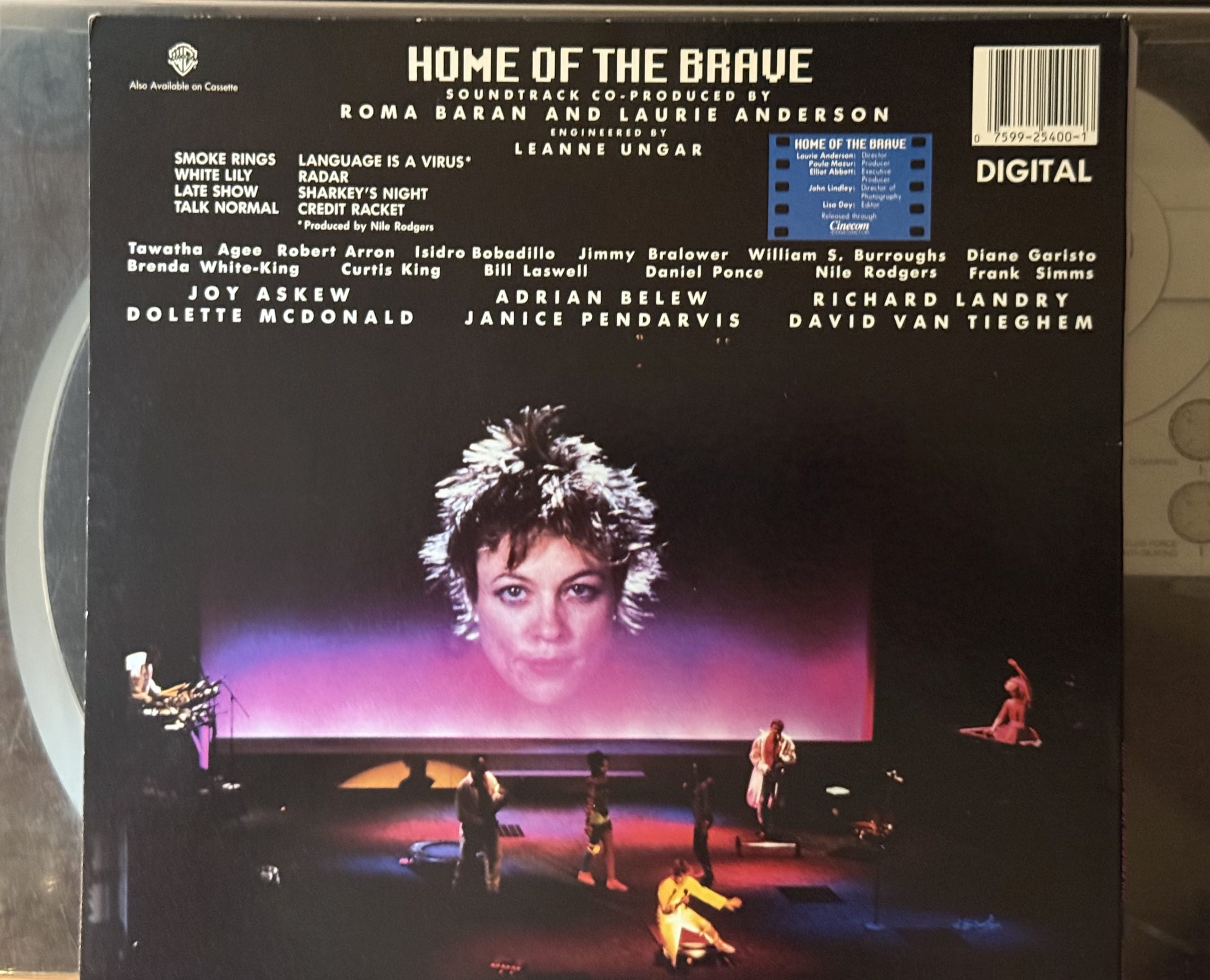
The tour featured a subset of the musicians who had contributed to Mister Heartbreak, including Adrian Belew on guitar, David Van Tieghem on percussion, and William S. Burroughs as himself (he appears on stage only in a brief nonspeaking role); they were joined by keyboardist Joy Askew and backing vocalists Dolette McDonald and Janice Pendarvis, fresh from performing with Sting on his Dream of the Blue Turtles tour. Five of the soundtrack’s eight tracks were drawn directly from the performance captured in the film; the other three were recorded in the studio and featured additional musicians including Bill Laswell, Nile Rodgers, and others. Only “Sharkey’s Night” repeats from Mister Heartbreak, here in a greatly extended form; the rest of the songs are new.
“Smoke Rings” starts with a descending synth line slightly reminiscent of “From the Air,” but quickly veers into surrealist territory with a Spanish game show establishing what is more macho. This idea, while promising, is quickly abandoned for a dream about “a little town… and all the girls in town were named Betty.” As she moves past the humor of the opening image, though, we get to the song’s serious core: “Ah, desire! It’s cold as ice and then it’s hot as fire… And every time I see an iceberg it reminds me of you.” The music itself is driven by a pulsing drum + synth groove and punctuated by the gorgeous backing vocals of McDonald and Pendarvis and the high reverberating sampled soprano note, as well as the sounds of dense beasts from Belew’s guitar. It’s a dizzying introduction to the album.
After this we get a quiet moment, driven by a skittering synthesizer line, in which Laurie asks “What Fassbinder film is it? The one-armed man walks into a flower shop and says: What flower expresses Days go by / and they just keep going by endlessly / pulling you into the future… and the florist says, ‘White Lily.’” As gnomic moments, this one is high on the list of Anderson’s most quotable aphorisms, but it’s married to a texture that’s mostly throwaway.
The same can’t be said for “Late Show,” a hypnotic 9/8 riff over which Laurie plays an electric violin, first with a conventional bow and then with something very different. She had been experimenting with the idea of a “tape bow,” a violin bow in which a length of recorded tape replaces the hair of the bow and passes over a magnetic pickup on the violin to play fragments of the recorded sound, since the late 1970s. Here, this instrument acts instead as a MIDI controller, playing back a sample of William S. Burroughs’ voice at different speeds and timbres as he intones “Listen to my heart beat.” You kind of have to see it to believe it.
“Talk Normal,” one of the tracks recorded in the studio. is a scene of pure chaos, with a doo-wop backing vocal behind different improvisations: a wild saxophone line, screeching Adrian Belew guitar noises played on a guitar with a flexible neck, and a set of odd stories from Laurie, including my favorite: “I turned the corner in Soho today and someone / Looked right at me and said: / Oh No! Another Laurie Anderson clone!” I like the idea that there is an alternate reality version of the 1980s in which the streets of the world were full of Laurie Anderson lookalikes — at least elsewhere than in SoHo. The version in the movie is even more extended and surreal, with jugglers, weightlifters, and a giant projected head of Laurie behind the stage. (There’s an image of that on the back of the album cover.)
“Language is a Virus” is another studio recording, this one produced by Nile Rodgers, who also contributes guitar, keyboards and Synclavier to the track. The track riffs off William Burroughs’ line “Language is a virus from outer space,” and Laurie plays with the disconnect between words and intentions throughout: “I was talking to a friend/And I was saying: I wanted you / And I was looking for you / But I couldn’t find you. I couldn’t find you / And he said: Hey! / Are you talking to me? / Or are you just practicing / For one of those performances of yours?” But the stories here feel a little flip, a little forced, as though the words have been squeezed to fit the pop song format. (Though I do confess to quoting the last stanza to myself whenever visiting a tourist attraction: “And there was a beautiful view / that nobody could see / Cause everybody on the island / Was saying Look at me! Look at me!”)
“Radar” is a brief snippet of wordless song against a crashing synth chord; if Laurie didn’t have another piece called the “Difficult Listening Hour,” the first minute of this would be a contender. But a synth melody punctuated by birdsongs provides an achingly beautiful bridge into “Sharkey’s Night,” here performed by Anderson using the Voice of Authority1 filter. This version loses the unforgettable William S. Burroughs “Paging Mr. Sharkey, white courtesy telephone please” tag from the original, but remixes in the vocal harmonies from “Talk Normal,” a bit that sounds a lot like a Prince song, an extended saxophone solo from Richard Landry, and a riff on World War III accompanied by an Adrian Belew guitar freakout that will upset your dog. Anderson gives us a backslapping moment with the “Big Boys in room 1003” who are “talking Big B, little O, little M, silent B” and then moments later asking “Hey, what’s that big noise from the sky? … It’s just those angels walking / They’re clomping around again / Wearing those big clumsy shoes we got for them.” Sharkey’s closing “ah, ah, ah, you’ve already paid for this / listen to my heart beat” feels at the end more like a threat, an implied standoff with the bomb as the payoff.
The song ends in a haze of klaxons, segueing into “Credit Racket,” an instrumental that harmonizes its guitar and synth parts from the sound of the sirens; the same track played over the closing credits of the film.
For me, part of the wonder of revisiting Laurie’s work is the ways in which her art, though undeniably limited by the technology available at the time, embraced those limitations (for example, the use of the Mac bitmapped system font Chicago as the title type for the record).2 As Anderson’s art evolved, the technology got more integrated into the work and the musical parts stepped forward more, leaving questions: was she a performance artist who sang or a singer who told stories? Her next album would deepen that confusion in strange and interesting ways. But first we’ll hear from another artist exploring the collision between technology and music with a completely different outcome.
You can listen to this week’s album here:
BONUS: The full concert film is available on YouTube, somehow. Watch it for Laurie’s tape bow, the waltz between her and Burroughs, the drum dance, the “¿Que es mas macho?” game show, and more:
Footnotes
Years later, Lou Reed, who married Laurie in 2008, named the persona that she adopted with the Voice of Authority filter “Fenway Bergamot.” ↩︎
Peter’s singles provide a good excuse to linger in the world of “So” a little longer.
Album of the Week, May 23, 2026
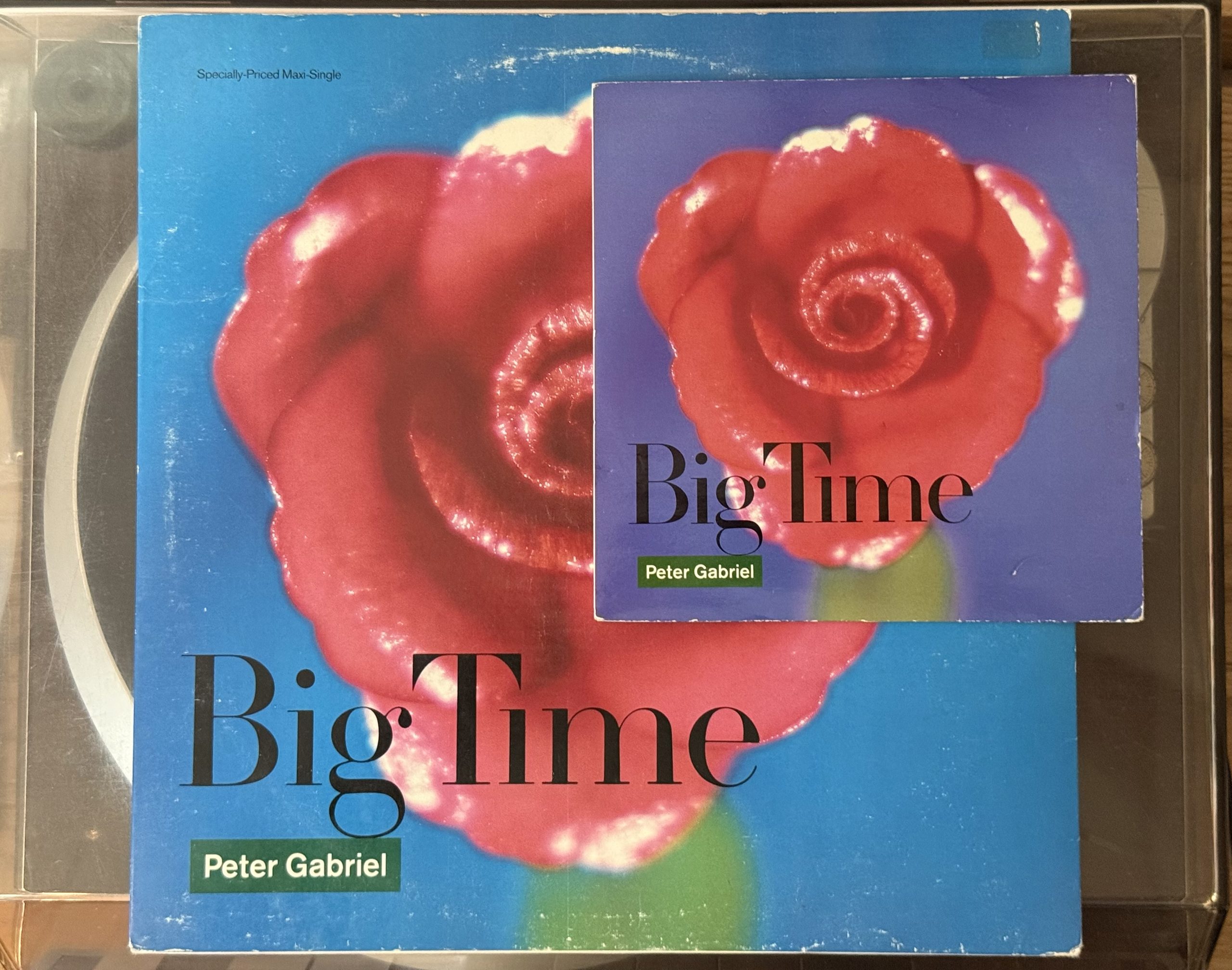
The album cycle for Peter Gabriel’s So went on for quite a while. The first single, “Sledgehammer,” hit the streets on April 14, 1986, about a month before the album was released. There followed “In Your Eyes” in August, “Don’t Give Up” in October, “Big Time” in March 1987 and “Red Rain” in June.1 That’s a lot of releases, and by extension a lot of opportunities for B-sides.
I love B-sides.2 They’re a glimpse of what else was happening when the album was recorded (or, sometimes, some other album, as we’ll see today). Sometimes they illustrate where else a song could go. And sometimes they’re just dance mixes. And the great thing about there being huge markets for pop music in both the US and the UK is that sometimes you got completely different B-sides!
If the above discursion and the picture have led you to think that I’m using these facts to just talk about a bunch of Peter Gabriel rarities, you would be correct. I’m going to pull from three different releases of “Big Time”: the 12″ US single, the 7″ UK release, and the CD maxi-single, which is the one that I first owned back in the day. (Shhh.)
The 12″ opens with “Big Time (dance mix),” which is what it says on the tin. It’s mixed by Tom Lord-Alge, a recording engineer who had previously crossed paths with Peter on “No More Apartheid” on the Sun City compilation, and who had also engineered or mixed for the Force MDs, Jeff Beck, Southside Johnny and the Asbury Jukes, David Johansen, Sly Fox, Steve Winwood’s Back in the High Life, OMD’s “If You Leave,” and Billy Crystal’s “You Look Marvelous.” This cavalcade of 1980s sounds perhaps explains the low-end drum machine and handclaps that get spliced onto the beginning of the track. I do love the way that he pulls out and isolates Tony Levin (and Jerry Marotta)’s bass line at the beginning though, as well as letting us hear the nasty (in a good way) David Rhodes guitar riff without vocals over it. The verses are largely untouched—a little extra echo here, an extra-80s guitar in the texture there—but the chorus gets a spacey reinforcement on the backing vocals that’s almost dublike. This is kicked into high gear after the second verse, where it’s just backing vocals, drum machine, and Peter going “huh!” for about 30 seconds. As dance mixes go it’s relatively harmless but also fairly unimaginative.
“In Your Eyes (special mix)” is an entirely different story. Produced by Bill Laswell and mixed by Jason Corsaro, the mix shuffles the key bits of the original recording, but also adds an entirely new opening featuring Peter singing over a low synth note, chiming thirds and fourths, and a hi-hat heartbeat: “Accepting all I’ve done and said / I want to stand and stare again / Til there’s nothing left out / All that remains there in your eyes.” The intro is punctuated by a brilliant vocal run by Youssou N’Dour, then the brilliant Ronnie Bright bass vocal. Youssou sings a bit in Wolof: “Sa bet chi lamp, chi tangaay, sa bet maangi ci biir,” meaning “Your eyes are lit, your eyes are bright, it’s in your eyes.” And then, when we think we’re going to get the verse, there’s instead an extended meditation with talking drums and synths, with more incredible Wolof vocals from Youssou and some vocalese from Peter. The chorus finally joins with even more Youssou vocals atop it. There’s an extended reverbful talking drum break, reminding us that Laswell has always been the king of dub. Somehow the complete absence of the verse pulls me into a trance listening to this mix—or maybe that’s just Youssou. This is a masterful mix and still holds up incredibly well, which is why it featured on one of my playlists years later. The twelve-inch single finishes with the album version of “We Do What We’re Told.”
The UK 7″ single, on the other hand, has a single B-side, “Curtains.” The composition here is reminiscent of Peter’s work on Birdy, but with more space around the edges. There’s an extended bit that is just a heartbeat of a talking drum with a tiny whoosh of a cymbal brush, and a panoply of synth textures giving the effect of opening doors, echoing caverns, distant bells, all leading to Peter’s vocals: “Oh, draw the blinds / we can shut out the night.” This is the most erotically direct of his love songs to this point, but even here love is filled with ambiguity and tinged with regret: “And there are lions on our curtains / They lick their wounds / They lick their doubt.” It’s a stunning miniature of a song, and I can only imagine what might have gone through the heads of the casual buyers of the single in 1987 when they flipped it over and listened to it.
“Curtains” also appears on the Big Time CD maxi-single, alongside the album version of “No Self Control.” It’s rounded out by “Across the River,” which was used as a mood-setting opener for the original 1982 WOMAD festival and which was recorded in the studio for the WOMAD benefit Music and Rhythm. It begins as an improvisation by Shankar and Peter, joined by David Rhodes, and then a thundering drum part from Stewart Copeland enters. I’ve always been captivated by the combinations of sounds, particularly the low notes from Shankar’s instrument (not a traditional Western violin), and have long wondered what a full album of collective improvisation from a group like this might have sounded like.
The relatively long period of time between Security and So, combined with Peter’s collaborations in WOMAD and with others, combined to make the experience of following the various offshoots from the album a rich musical journey. We’re going to continue following some of those connections for … well, for a while. Next week we’ll pick back up with one of those collaborators and listen to a unique live album.
BONUS: Peter brought “Across the River” back for his “Secret World Live” tour in the 1990s, with Shankar:
BONUS BONUS: A version of “Curtains” with extended vocals appears in the video game Myst IV, though I’m unsure if these were newly recorded or just an alternate take. Here’s a playthrough video showing the song in context:
Footnotes
Making this the only Peter Gabriel album with a singles-to-non-singles ratio of greater than 2 to 1, regardless of whether you count the LP track listing with eight tracks or the CD with nine. ↩︎
I don’t know if I have to spell this out after four years of writing about vinyl records, but just in case: songs played on the radio used to come on 7″ vinyl records that were played at a faster speed (45RPM rather than 33 1/3). The faster playback speed meant the grooves could be cut deeper for better dynamic range. The records had two sides: the A-side, aka the actual single, and the B-side, which was usually whatever the artist or the label felt like putting on there. ↩︎
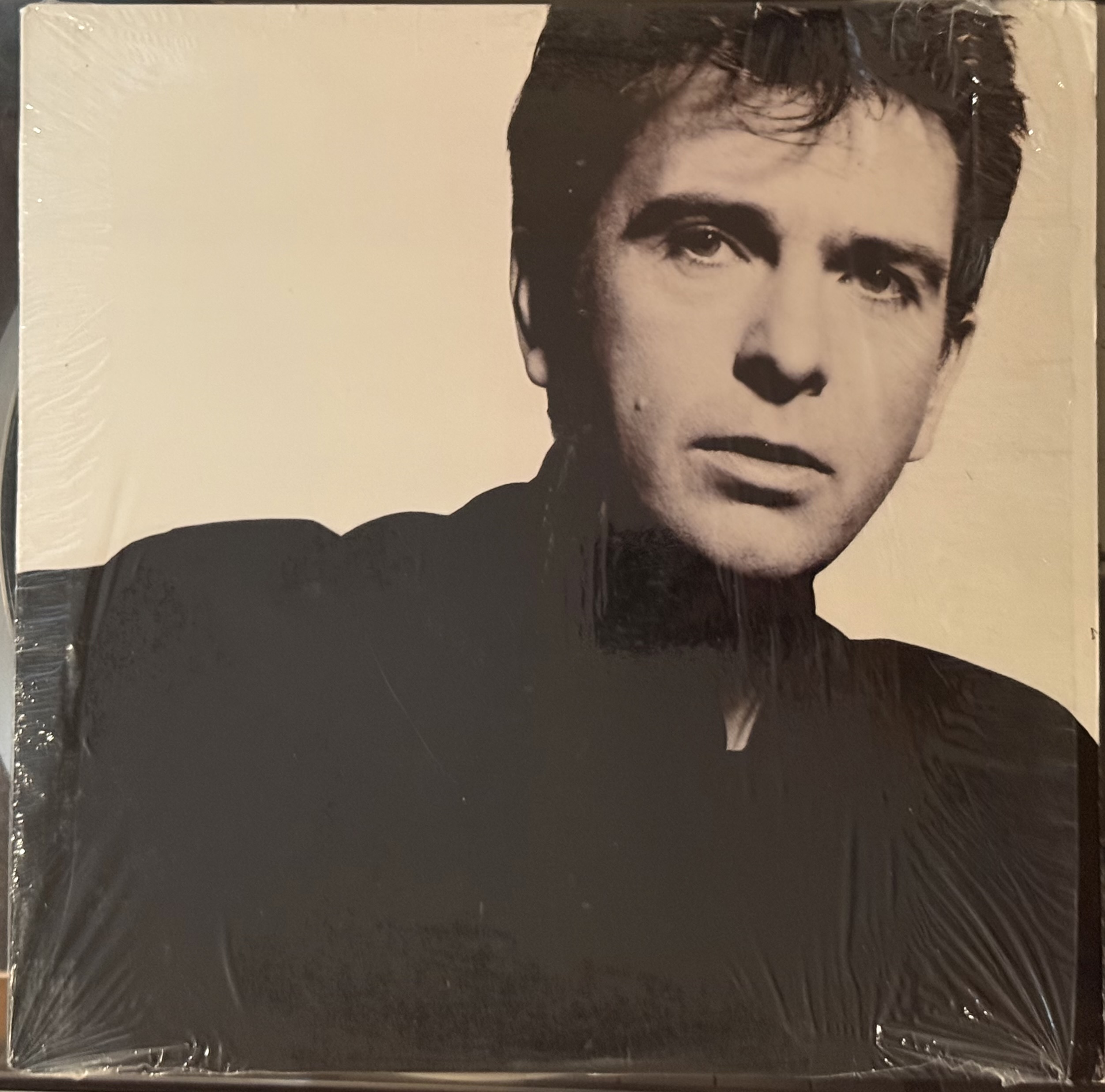
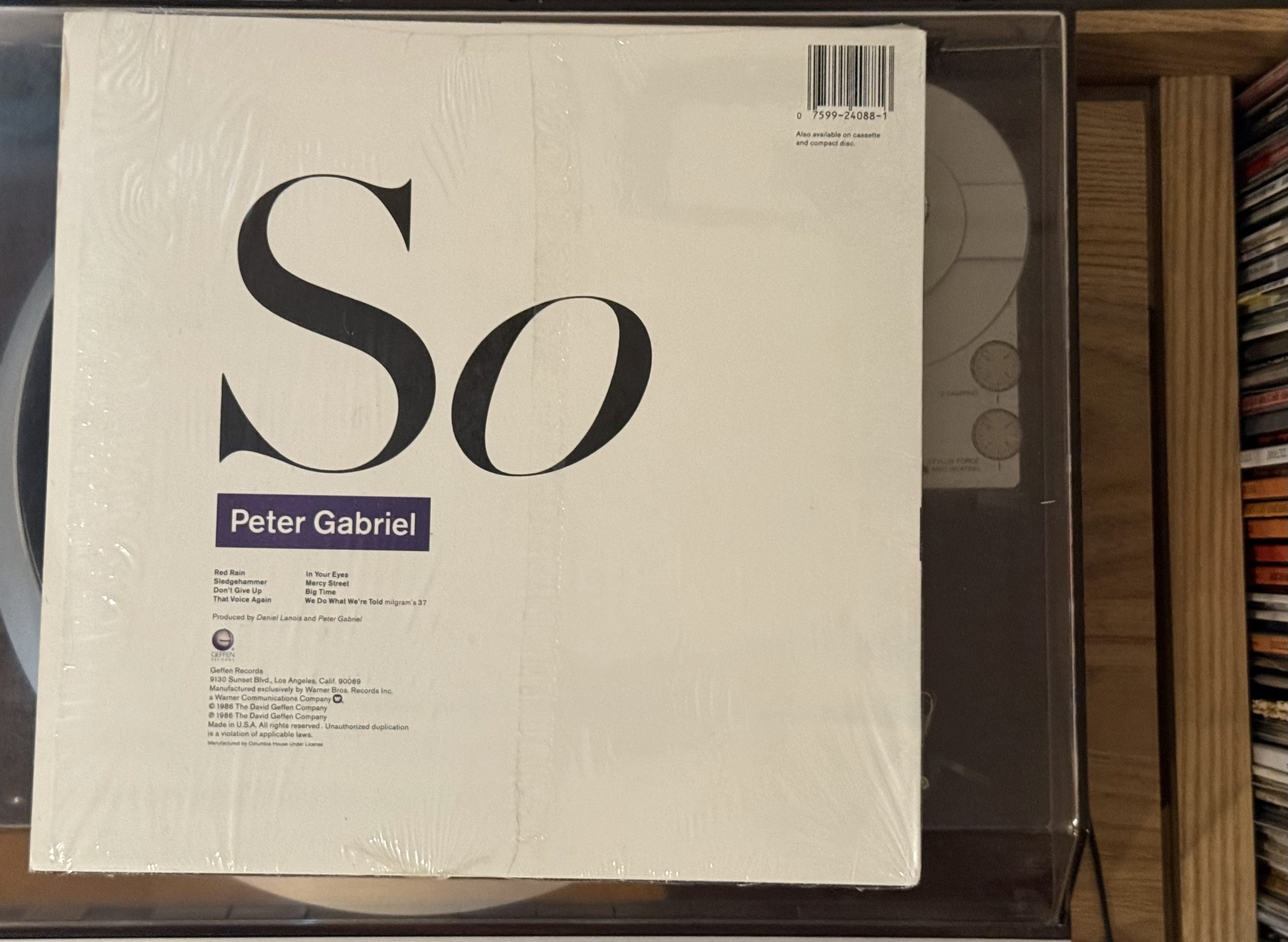
The bestselling 1986 album seamlessly melds art and pop and marks Peter’s transition to a top tier star.
Album of the Week, May 16, 2026
It’s a challenge to approach an album like So. Easily Peter Gabriel’s most popular album, arguably one of the most talked about and best albums of the 1980s, and it’s not like it’s obscure. But, like the songs themselves, the album is made of layers upon layers, and that’s where our tale begins.
In fact, let’s begin at the beginning. Following the 1982 release of Security and the subsequent tour, you’d be forgiven for thinking that Peter took some time off, save for the soundtrack to Alan Paton’s film Birdy. In fact, he was recording the whole time. The years 1983–1985 were surprisingly fertile given that there was no official album released. In fact, there’s a rich batch of soundtrack appearances from this period, as well as non-album studio tracks: “Walk Through the Fire” (from Against All Odds),1 the studio version of “I Go Swimming,” “Across the River” (a collaboration with Indian violinist L. Shankar and Stewart Copeland), his song “No More Apartheid” from the 1985 Sun City compilation, and of course “Out Out,” Peter’s contribution to the Gremlins soundtrack.2 Unfortunately, around this time Peter’s long-term UK label, Charisma, was being acquired by Virgin Records. Ultimately the acquisition settled out and Charisma/Virgin continued to release Peter’s albums in the UK while Geffen handled releases in the rest of the world, but in the dust of the acquisition some of the wind went out of the sails of a new album.
But his creative juices were still flowing. So in February of 1985 Peter retreated to the recording studio at Ashcombe House, where he had recorded since 1978, and began laying down tracks. He considered working with a number of producers for the album, including Bill Laswell (whom he had crossed paths with in the making of the Laurie Anderson collaboration “Excellent Birds”) and Nile Rodgers, but ultimately decided to stick with Daniel Lanois, his collaborator from Birdy. It would prove a fruitful choice; not only was Lanois an expert in producing the combination of organic and atmospheric sounds that Peter was striving to produce, but he was also surprisingly adept at forcing the famously digressive Peter to finish work. My favorite anecdote: at one point Lanois resorted to locking Peter inside the studio so that he would finish a vocal. Peter wrote the core tracks of the songs with Lanois and guitarist David Rhodes from sketches that he produced using the Prophet-5 polyphonic synthesizer or his Yamaha piano, along with a Linn drum machine. Using this method, Peter built songs up from melodic ideas with nonsense vocal syllables to fully fledged songs, having the trio improvise with his rough demos in their headphones, bouncing the trio recordings into the headphones to bring in the larger band, and so on.
The larger band was built around familiar collaborators—Tony Levin, Jerry Marotta—and French drummer Manu Katché (who would follow this session with Sting’s …Nothing Like the Sun). A host of others would make appearances on the album, most on one or two tracks: Chris Hughes, fresh off producing Tears for Fears’ Songs from the Big Chair; Copeland; Shankar; trumpeter Wayne Jackson from the Stax Records backing band the Bar-Keys; saxophonist Mark Rivera from Billy Joel’s band; pianist Richard Tee, whom we’ve previously seen playing with Hubert Laws and Ron Carter on CTI Records; and guest vocalists Laurie Anderson, Kate Bush, and Youssou N’Dour. The last was a superstar in his native Senegal, but was yet to break out in the consciousness of the broader world; that was about to change.
“Red Rain” opens the album on a massive note, with an indelible riff on the hi-hat from Stewart Copeland and an echo of a keyboard line, then a massive chord through which Tony Levin’s indelible bass snakes. Peter’s apocalyptic lyrics sing of a dream of a rain that covers all those around, imagery that dates back to some of his earliest writings; in fact, the image is the one of the last remnants of the Mozo mythology that had previously informed “Down the Dolce Vita,” “Here Comes the Flood,” and “On the Air.” But Mozo aside, the song also features some deeply personal writing. His marriage to Jill Moore was falling apart—strained by his touring, she was unfaithful, and the resulting divorce sent Peter into a deep depression and to six years of therapy. It’s hard not to read lines like “I come to you, defenses down / with the trust of a child” and “Red rain is coming down all over me / I’m begging you” knowing this context without thinking of metaphors for accusations and retribution.
From the sublime to … “Sledgehammer,” easily Gabriel’s most-remembered song, thanks in no small measure to its innovative Claymation video and unsubtle but good-natured phallic imagery, as well as to the horn section, a first for a Gabriel album. Peter has explicitly called out the song as an homage to Stax-Volt soul singles, an early source of musical inspiration for him, to the point that he asked Wayne Jackson, who as a member of the Mar-Keys played behind Peter’s hero Otis Redding, to assemble the horns for the track, which included Rivera and trombonist Don Mikkelsen, who had played with Ann-Margret and in Louie Bellson’s band. There’s what sounds like a Hammond B-3 organ on the track, which is actually played on Peter’s Prophet-5 synthesizer, and a weird synthetic flute sound, which Peter plays on the E-mu Emulator II, a sampling synthesizer beloved by acts as diverse as Stevie Wonder, Belgian electronic band Front 242, Depeche Mode, and the Pet Shop Boys. The track is tremendous fun, thanks in no small part to its bouncy rhythm section courtesy Levin and Katché, who was literally getting on a bus to the airport when Peter encouraged him to stick around and help re-record the track from its original foundation, which had featured drummer Chester Thompson.
“Don’t Give Up” is another complete stylistic pivot, a hard-luck song constructed in response to Dorothea Lange photographs of starving farmers from the American Depression. It was built around a rhythmic part that Peter transferred from tuned drums to a Tony Levin bassline; Tony achieved a more muted sound by the expedient of placing a diaper that he had packed in his gig bag for his two-month-old child beneath the strings. The track is moving enough, but when the chorus comes and Kate Bush sings “Don’t give up, you still have … friends,” it enters spine-tingling territory. The song changes lives; both Elton John and the late Matthew Perry at different times credited the bridge’s lyric “Rest your head, you worry too much / It’s gonna be all right / When times get rough, you can fall back on us” with encouraging them in sobriety. And Richard Tee’s gospel piano on the second bridge similarly elevates the song to a different place. It was always conceived as a man-woman duet, though originally Peter had Dolly Parton in mind; now it’s hard to imagine the song without Kate’s contributions. This is particularly true with the video, which features Peter and Kate embracing each other and singing the song for the entire video as the sun rises and falls in the background. Though Peter asked Jill’s permission before embarking on the shoot, the video ultimately did not help their marriage.
“That Voice Again” has its origins in Peter’s efforts to write the soundtrack for Martin Scorcese’s The Last Temptation of Christ, believe it or not. Originally the lyrics were written about judgment and Christ’s commandment “Let him who is without sin cast the first stone,” but over several rewrites it became about the inner judgmental voice that “either helps or defeats us.” It is also the very last Mozo song, with the judgmental voice somehow fitting into Peter’s alchemical narrative. Twelve-string guitar from Lanois (the first time that instrument appeared on a Gabriel album since “Solsbury Hill”) and an elaborate drum part from Katché fill out the arrangement.
“In Your Eyes” is a pure love ballad, a form that Peter rarely essayed prior to So. It has several key features in the arrangement: Richard Tee’s piano, a soaring pre-chorus (that “I reach out from the inside” segueing into the wordless vocal bridge always hits me right in the feels), and Youssou N’Dour. That a previously-unknown-to-Westerners Senegalese vocalist would be the secret weapon of this track would seem unusual, especially given the Who’s Who of backup singers also appearing on the track—which included Simple Minds’ Jim Kerr, The Call’s Michael Been, and doo-wop singer Ronnie Bright, who performed the bass vocals on the classic song “Mr. Bass Man.” But that’s only if you don’t reckon with Youssou’s voice; a soaring, resonant instrument with bright edges that spans multiple octaves with heldentenor intensity and is comfortable in Wolof, French and English. More than any other track on the album, the arrangement for “In Your Eyes” is fluid, and live versions and remixes play with the running order of the song; we’ll hear an example of that another time. As a listener who fell in love with the album in 1986, the song sits at Number 5 in the running order for me, but Peter originally intended it to end the album; the limitations of the vinyl format, which made reproducing the low bass tones in the inner grooves a challenge, switched it to start Side Two.
“Mercy Street” is another of the songs on the albums about which I have difficulty being objective. The song introduced me to the writings of Anne Sexton, whose poetry (particularly 45 Mercy Street and The Awful Rowing Toward God) inspired the song. The song is built around a track by Brazilian percussionist Djalma Corrêa, who provided surdo, congas and triangle in a traditional Brazilian forró rhythm. (A different set of track by Corrêa provided the basis for “Don’t Break This Rhythm”, which became the b-side to “Sledgehammer.”) The arrangement, though uncluttered on the album, was painstakingly constructed, with piano parts from Richard Tee added and then removed, a Fairlight CMI-based melody played by Peter by hand instead of sequenced for a more human feeling, and double-tracked vocals, with the lower octave achieved by having Peter stay up all night at the studio and doing a single take at 7am when he was at his most fatigued. All this is in support of a jewel of a song, with bits of Sexton’s poetry turned into a stream-of-consciousness lyric full of confessional details, anchored around the desperate search for home: “Dreaming of Mercy Street / Wear your inside out / Looking for mercy / In your daddy’s arms again.” The final coda lends finality to the searching and despair in the song as Peter turns to images from Sexton’s posthumous book: “Anne with her father is out in the boat / Riding the water, riding the waves / On the sea.” A slightly extended version of the track was used for the official video.
“Big Time” is the other “overtly commercial” track on the album. The horn section from “Sledgehammer” returns over a rhythm track that was notoriously difficult to record; Tony Levin’s bass part was achieved by having Tony finger the notes on the fretboard while Jerry Marotta hit the strings with his drumsticks to achieve a percussion effect, while Stewart Copeland’s ingenious hits and fills didn’t exactly line up with the drum machine, so engineer Kevin Killen sampled his track and created the percussion from the samples. Former Ikette P. P. Arnold led the backing singers, and Peter’s Prophet-5 faux-Hammond organ returned. Where the phallic imagery in “Sledgehammer” is playful, here it’s sardonic, as Peter dismantles the consumerist mentality of the 1980s and ties it to the drive to overcompensate, a point brought home by the closing lyric: “Look at my circumstance / And the bulge in my big, big, big, big, big, big, big, big, big, big, big, big, big, big, big.”
The transition into “We Do What We’re Told (Milgram’s 37)” is abrupt and icy. The song, reminiscent of “Lead a Normal Life,” is mostly constructed around Peter’s synthesizers, with David Rhodes’ guitar and L. Shankar’s violin contributing to the texture over a beat from Jerry Marotta; many of the sounds, including Peter’s vocals, were processed through the Fairlight for extra texture. Peter wrote the lyrics as an attempt to process the results of Stanley Milgram’s experiments in authoritarian behavior, in which 37 of 40 participants continued to administer higher and higher levels of electric shocks to unseen subjects when encouraged to do so by their peers. The repeated “We do what we’re told” lyric repeats like a mantra, expressing the impulse to conformity that drove the awful behavior of the participants. Some listeners found this song the only part of So to their tastes; however one felt, it’s undeniably a direct link to the themes and preoccupations of 1980’s Peter Gabriel 3 (Melt), and in fact the song originated in those sessions.
“This is the Picture (Excellent Birds),” which appears on modern LP versions of the album but not the original, is a re-think of Peter’s 1984 collaboration with Laurie Anderson from Mister Heartbreak, with the groove (including an added talking drum from Manu Katché) brought to the fore and some elements (like Laurie’s idiosyncratic synth line) removed. My poor mother could never get Peter’s word choice in the song; hearing it in my childhood home as I was listening, she asked me not to listen to it again as the line about “bitches of evil” made her uncomfortable. (This was, of course, a mondegreen for “I see pictures of people.”)
It’s hard to overstate how huge So was. Quintuple platinum album sales, Number One on the UK album chart and Number Two on the US, a number one Billboard Top 200 spot (“Sledgehammer”) and nine MTV Video Music Awards (also “Sledgehammer”), number one on Billboard’s Album Rock chart (“In Your Eyes”), top 10 singles in the UK (“Don’t Give Up”) and US (“Big Time”), and number 3 on the Mainstream Rock chart (“Red Rain”). It launched Youssou N’Dour to worldwide fame, further raised the profile of Kate Bush, and most of all completed the transformation of Peter Gabriel from a niche artist for fans of progressive and experimental rock, to a pop artist with serious artistic and experimental bona fides. Because of the album’s long gestation and long singles cycle, many interesting tracks were released alongside as b-sides; we’ll linger in this album’s shadow a bit next week to listen to some of those.
You can listen to this week’s album here, in the original 1986 track order but including “This is the Picture (Excellent Birds)” in its spot on the original CD running order. This is controversial. Ever since 2002, Peter has preferred a revised running order that puts “In Your Eyes” last on side two.
BONUS: Peter’s So sessions sprawled across many months and there were a few songs that were recorded that never made it to the album, or even as a b-side. When the 25th anniversary of the album was released as a box set in 2011, Peter polished up a few of these songs. “Courage” is pretty great! It was released as a 12″ 45 single in the box set, with “Sagrada” and an alternative mix of “Don’t Give Up” as b-sides.
BONUS BONUS: There are a lot of live performances of these songs; they essentially form the core of Peter’s touring repertoire for the rest of his career. But the ones featuring the original performers, such as this 1987 live version of “Don’t Give Up” with Kate Bush, are special. Even if it is an audio-only cleaned-up bootleg:
BONUS BONUS BONUS: “In Your Eyes” was made newly famous through its use in the John Cusack/Ione Skye movie Say Anything, in a scene that is engraved in the hearts of otherwise-cynical GenX kids everywhere:
BONUS X4: The version of “Mercy Street” that was performed in Peter’s 1987 concert in Athens, Greece has always pierced me to the heart, with Peter singing from curled and crouched positions to echo the anguish of the lyrics:
Footnotes
I know that I probably just put the Phil Collins title song from that movie into your head. You’re welcome. ↩︎
We’ll talk about some of Peter’s other soundtrack work another time. ↩︎
An hour of sunny, dreamy happy music for late spring/summerish afternoons.
It’s spring here in New England which means that the days are finally warm enough for flowers to open and we can finally turn the heat off. Just in time for summer to come along in two weeks!
This set of Exfiltration Radio started when I found a song I had been looking for ever since I was living in Seattle that first summer of 2001 and listening to KEXP. There was a happy, sunny track that I kept hearing, perfect for the warm-but-not-hot, breezy summer days, but it literally took me over twenty years to track it down to a 2001 album by Swedish producers Koop, with guest vocals by Yukimi Nagano. There was also a burgeoning playlist of songs from that summer that I never committed to the blog or to Art of the Mix; unfortunately it was wiped out when I had to rebuild my iTunes library file one year, but a few of the tracks came from there.
And a few are definitely out of left field. I find OMD’s “Genetic Engineering” to be a happy, bouncy song; not all will agree. And The Blue Nile’s “Tomorrow Morning” appeared in the playlist yesterday, after listening to Peace at Last for the first time in many years.
Youth – Langston Hughes (The Voice of Langston Hughes)
I Feel – The Sundays (Blind)
The Lifting – R.E.M. (Reveal)
Dreams – The Cranberries (Everybody Else Is Doing It, So Why Can’t We? (The Complete Sessions 1991-1993))
Kiss Me – Sixpence None the Richer (Sixpence None the Richer (Deluxe Anniversary Edition))
Summer Sun – Koop (Waltz for Koop)
Genetic Engineering (312MM Version) – Orchestral Manoeuvres In the Dark (Dazzle Ships)
Sweetness And Light – Lush (Ciao! 1989-1996)
Alison – Slowdive (Souvlaki)
Temptation [7″ Version] – New Order (Movement [Collector’s Edition])
Lost Outside The Tunnel – Aztec Camera (1981 – Cassette)
Today is the Day – Yo La Tengo (Summer Sun)
The Big Sky – Kate Bush (Hounds of Love)
Tomorrow Morning – The Blue Nile (Peace at Last (Deluxe Version))
Um Canto De Afoxé Para O Bloco Do Ilê (Ilê Ayê) – Caetano Veloso (Brazil Classics 1: Beleza Tropical)
We have taken control as to bring you this special show and we will return it to you as soon as you are exfiltrated.
It’s time for a new Exfiltration Radio, and this time out we’re going deep into the wonderfully weird world of Thelonious Monk. This show is an hour of Monk compositions, played by a variety of his bands and also covered by other artists.
We open with a portion of a story Charles Lloyd tells about Monk in the late 1960s, here excerpted from the Billy Taylor radio show ca. 1999. That leads into Monk’s ensemble playing “Well, You Needn’t,” from Monk’s Music, which I wrote about a few years ago. Still fantastic for the sound of the ensemble, which included both Coleman Hawkins and John Coltrane as well as Gigi Gryce, Art Blakey, Wilbur Ware, and Ray Copeland.
The earliest of the recordings on this set, “Bemsha Swing” dates from Monk’s first album for Prestige Records, 1954’s Thelonious Monk Trio, with Max Roach and Gary Mapp. It’s the earliest performance of this tune as well, and it’s interesting to see some of the places that Monk takes the melody, as well as to hear his joyous vocalizations as he plays. This is followed by a later live track, “Bye-Ya” from the 1963 Copenhagen live session recently issued as Mønk. This is Monk’s great swinging quartet with Charlie Rouse, John Ore and Frankie Dunlop. From “Bye-Ya” we go back to Monk’s Music for his “Ruby, My Dear,” here played with Ware, Blakey, and Hawkins, whose solo on this one is a thing of beauty.
The second half of the mix features notable performances of Monk’s music by other artists, starting with another run at “Bemsha Swing,” this time by Keith Jarrett’s great standards trio with Gary Peacock and Jack DeJohnette, on the live album The Cure. I love what Jarrett (as far as we know, at most a very distant relation!) does with Monk’s melody, turning the rhythm into a boogying, churning perpetual motion machine. The performance also features Jarrett’s own vocalizing, which is an acquired taste, so be forewarned.
Following this, there’s a spectacular take on Monk’s composition “Ask Me Now” by a group led by McCoy Tyner and featuring Joe Henderson on tenor, Ron Carter, and Al Foster on drums, live in performance from 1991. The extended solos by Henderson at the beginning and end of the track are worth the price of admission by themselves.
This is in turn followed by a take on “Blue Monk” with scat vocals by Kurt Elling and piano by Christian Sands. There are a number of essays of Monk’s tunes with lyrics out there, including another version of “Blue Monk” by the great Abbey Lincoln and a gorgeous “Round Midnight” by Samara Joy. But I like this version, part of a session laid down and released digitally in a single day, for the spontaneity and joy that the two players have with the work; as Elling says after one spectacular solo by Sands, “That’s the happiest that piano has been all day.” A brief tag of Monk’s “Epistrophy,” from a recently issued performance in Paris in 1966, brings the set to a close.
It’s hard to fit all the great things about a composer and performer like Monk in a single hour, so I focused on tunes that featured great playing by the entire ensemble. You can easily get lost in Monk’s world; this set provides a happy introduction.
Do not attempt to adjust your set…
“Well, every night, Monk would drink the orange juice” – Charles Lloyd (Exfiltration Radio: the bumpers)
Well, You Needn’t – Thelonious Monk (Monk’s Music)
Bemsha Swing – Thelonious Monk Trio (The Thelonious Monk Trio (Rudy Van Gelder Remaster))
Bye-Ya – Thelonious Monk (Mønk (Live, 1963))
Ruby, My Dear – Thelonious Monk (Monk’s Music)
Bemsha Swing – Keith Jarrett, Gary Peacock, Jack DeJohnette (The Cure)
Ask Me Now – McCoy Tyner (New York Reunion)
Blue Monk – Kurt Elling, Christian Sands (Wildflowers Vol. 3)
Epistrophy – Thelonious Monk (Live in Paris (1966))
On taking control of an artistic career and creating an unparalleled work of genius.
Album of the Week, May 9, 2026
We come at last to Kate Bush, whom we’ve heard as a backing vocalist on Peter Gabriel 3, but whose own body of solo work was already substantial by this time. At age 27 she was already on her fifth album, and having had a reasonably high level of success with the first four was able to record it with considerable artistic freedom. What she produced has few peers in pop music history: a record with both hits and a conceptual suite, self-produced, that seamlessly blends new wave influences with progressive rock and traditional music sounds, and still manages to sound new today.
Kate Bush grew up in Kent, with both parents harboring amateur musical talents. She taught herself piano at age 11 and was writing songs in grammar school. In the early 1970s she recorded a demo tape which found its way into the hands of Pink Floyd guitarist David Gilmour via a mutual friend. Gilmour sponsored a more professional demo recording; this led to Kate being signed to a recording contract with EMI at age 16. EMI, fearing Bush was too young, kept her on retainer for two years during which she studied interpretive dance with David Bowie’s dance instructor and finished her secondary education.
Her first album, The Kick Inside, was recorded when she was 19 years old and yielded a Number One UK single, “Wuthering Heights.”1 She set a Guinness World Record as the first woman artist to have written every track on a million-selling debut album. But she wanted more artistic control than she was able to exercise on The Kick Inside or her second album Lionheart. Starting with her third album, Never for Ever, she began co-producing her work, bringing a diversity of sounds to the songs and featuring heavy use of synthesizers for the first time, in particular the Fairlight CMI to which she had been introduced while working with Gabriel. This album and the follow-up, The Dreaming, were much more experimental, and the fourth album in particular was received with puzzlement. Undeterred, but noting the high price of studio time, she built her own private studio, allowing her to work at her own pace.
Much of the fifth album was written and performed by Kate on the Fairlight, the Linn drum machine, and piano, but there were a small host of other musicians present, including her longtime bass player and then-partner Del Palmer, bassist Eberhard Weber, percussionist Morris Pert (also on PG3), session guitarist Alan Murphy (Level 42, Mike and the Mechanics), bouzouki and bodhran player Dónal Lunny (Planxty, The Bothy Band), whistle and fiddle player John Sheahan (the Dubliners), Uillean piper Liam O’Flynn (Planxty), the Richard Hickox Singers, and her brother Paddy, who had played on all her prior albums, on balalaika, didgeridoo, violins, and vocals.
“Running Up That Hill” is by this point the best known song on the album, after its second life in Stranger Things. But it’s still a mesmerizing track, with the rhythmic drums (session player Steve Elliott and a healthy dose of Linn) underpinning Del Palmer’s bass and that synth vocal line playing the hook, all before Kate even sings her first lyric. But it is precisely the lyrics and Kate’s voice that are the heart of the song as she sings about the failure to communicate and the desperate wish for empathy: “If I only could, I’d make a deal with God/and I’d get him to swap our places.” Kate’s early albums had her vocals in her high soprano, which was mesmerizing but which could also be harsh depending on her choice of vowel production; here she embraces her lower register as a grounding and a dramatic accent (as on the famous “Yeah, yeah, yo” backing vocals, themselves an iconic hook).2
“Hounds of Love” is a more joyous song, somehow, as Kate sings about being afraid to fall in love over a woofing chorus: “I’ve always been a coward / And I don’t know what’s good for me / Oh here I go… Take my shoes off and throw them in the lake / And I’ll be / Two steps on the water.” The song is almost entirely Kate’s, with only the two drummers (Elliott and Charlie Morgan, who appeared on Wham!’s On the Edge of Heaven and Paul McCartney’s Flowers In the Dirt and who later played with Elton John for thirteen years—and a single cellist credited as joining her on the track. The melody is in a major key but relentlessly descends in thirds and fourths, giving a feeling of giddy instability. It’s a blast.
“The Big Sky” is another disorientingly happy song, with an edge on it, as Kate’s ragged vocal expresses her excitement at the clouds in the big sky while simultaneously accusing her past lover: “You never understood me/ You never really tried.” A chorus rises behind her as she proclaims, “This cloud/Says ‘Noah / Come on, build me an Ark / And if you’re coming, jump / ’Cause we’re leaving with the big sky.’” The ending chorus—“Rolling over like a great big cloud / Walking out in the big sky”—is as close to a gospel moment as Kate’s songs come, and her ecstatic melisma over it is one of her biggest highs.
“Cloudbusting” seems to flow out of “Mother” naturally, but it’s an entirely different song, closer to “Running Up That Hill” in concept and writing. Indeed, the chorus “Every time it rains you’re here in my head/Like the Sun coming out” could be a continuation of the “Running Up That Hill” chorus, only here powered by a churning string section instead of the synthesizer. The song itself carries immense longing in the chorus, “I just know that something good is going to happen,” with only the chugging low strings hinting that there’s tragedy ahead. The song is based on the memoir of Peter Reich about his father Wilhelm’s experiments with attempting to tap “orgone energy” to create rain, but you don’t need to know that story3 to feel the hopeless sadness mixed with the sense that this time it just might work.
The seven songs on Side Two form a complete song cycle which is titled “The Ninth Wave” in the liner notes. “And Dream of Sheep” opens the cycle with Kate’s character in the water, kept afloat by a life vest, “Little light will guide them to me / My face is all lit up.” She tries to keep herself awake, to keep from drowning in the ocean, but she fails to keep her eyes open and enters a dream state, pulled under by her hallucinations.
We get those dreams in “Under Ice,” and they’re frozen; she skates over a frozen body of water, only to see “There’s something moving under/Under the ice… Something / Someone help them / It’s me…” With the realization that the narrator is watching herself drown she comes to herself, and the track hard cuts to “Waking the Witch,” where the narrator hallucinates voices telling her to wake up, alternating with an accusatory judge accusing her of witchcraft, fragmented voices spinning past in a vortex of sound, and even the sound of rescuers: “Can you not see that little light over there?” followed later by the sound of helicopters arriving and a voice yelling at her to “get out of the water.” There are layers upon layers in the sound; it replicates the disorientation of near-death convincingly.
She’s out of the water but not out of the woods. “Watching You Without Me” finds her at her house watching her lover but unable to interact with him; meanwhile he seems utterly unaware of anything that’s happened to her. The track is a ballad tempo, an ordinary major key loop that seems frozen in time, with only a prominent bass melody pushing at the edges to signal the narrator’s distress. There’s a section that appears to have been recorded backwards and played forward; the sound of seagulls drifts in, cutting through the hallucination, as “Jig Of Life” confronts the narrator with her future self, who insists that she bring herself back to life for the sake of her future and her children. As the emotional energy peaks, suddenly we’re in a jig, led by the violin and accompanied by the skirling of the Uillean pipes. Coming out of the jig, the narrator tries to unfragment her memory: “I put this moment here/I put this moment over here.” The song ends with Kate’s older brother John Carder Bush reciting a dramatic poem about her being one with the water.
The hallucinating victim seems in danger of losing all contact with life in “Hello Earth,” which seems to reprise the melodies of “And Dream of Sheep,” “Running Up That Hill” and “Cloudbusting” all at once. A men’s chorus anchored by deep bass voices (possibly pitch shifted) makes us wonder: has she died? The full chorus accuses her of being the “murderer” from “Waking the Witch” as Kate’s character asks “Why did I go?” The bass chorus returns again; is she being sung to rest? But there’s a beep as of a hospital machine, and through the whooshing sounds we hear a German voice: “Deeper, deeper… Somewhere there is a light.”
“The Morning Fog” returns to the “Hounds of Love” melody, this time tempered by gentle guitar melodies and played down a step, as the drowning victim gratefully regains her life: “Do you know/I love you better now/…I’ll kiss the ground/I’ll tell my mother/I’ll tell my father/I’ll tell my loved ones/I’ll tell my brothers/How much I love them.” At the end of the cycle, we’ve come full circle, only instead of seeking to bring empathy to her lover, she is filled with a desire to live and love in the present instead, changed by her near-death experience.
Hounds of Love is like that, a circular, endlessly self-referential album, full of depths and supporting many interpretations. (There are Kate fans who argue that “The Ninth Wave”’s drowning victim dies and is reborn, or that the drowning is symbolic of ego death and investigating the subconscious, or that Kate is the Ophelia to her own Hamlet).4 However you interpret it, the album is first rate, with a philosophically deep second side, a first side full of absolute killer songs, and an everything-goes approach to production. The album hit Number 1 in the UK in 1986, and when “Running Up That Hill” soundtracked an episode of the fourth season of Stranger Things in 2022, it rocketed up the UK charts, giving Kate her second career Number One and going all the way to Number Three in the US. There’s hope for the world still.
And speaking of Number Ones, we’re going to be talking about a few of them next time.
You can listen to this week’s album here:
BONUS: Here’s Kate performing “Running Up That Hill (A Deal With God)” at The Secret Policeman’s Third Ball, with none other than David Gilmour backing her up:
BONUS BONUS: Here’s Kate performing “Hounds of Love” at the 1986 Brit Awards:
BONUS BONUS BONUS: Here’s a 1985 interview with Kate on the BBC’s “Old Grey Whistle Test.” She talks about the building of her new studio and the making of the album.
BONUS X4: Kate didn’t tour behind this album; she famously played very few live shows, and most of the “live” performances I’ve linked to (except the Secret Policeman show) have her lip-syncing. But as a performer she was still electric even when lip-syncing. This appearance on Wogan from 1985 was the first time anyone had ever heard the music from the album, and the whole thing is completely electrifying.
There was a memorable karaoke outing in San Francisco while I was there for the RSA Security Conference one year, where a young man sang “Running Up That Hill” in the original key, and the entire bar sang along on the “yeah, yeah, yo”s, about five years before the song made its Stranger Things comeback. This song is wired into GenX’s brain. ↩︎
Gathered posts from rec.arts.gaffa, the Kate Bush USENET newsgroup. This is what discourse on the Internet really used to be like, in the days before memes and shitposting. ↩︎