Hillary: Eleventh hour UVA session doesn’t help

diy Barack poster

Interesting choice of campaign destination for Hillary Clinton on Monday: she spent an hour with Larry Sabato’s PLAP 101 class at the University of Virginia (via the Tin Man). It appears, from last night’s election returns, that it didn’t help, since Obama swept Virginia (and Maryland, and DC) by a healthy margin.

What surprises me a little is the tone of the uncredited article in UVA Today, always the glossiest and least relevant of the on-Grounds publications. It reads like a campaign press release, gushing over how “poised and candid” she sounded.

I have to say I’m not surprised at all by the fact that the University Singers, rather than the Glee Club, got the nod to do the musical accompaniment, though. I can’t imagine a scenario in which this particular candidate would be OK with a men’s chorus accompanying her.

Oh, and the Barack Obama “Sweep” poster is courtesy the Do It Yourself Barack Obama Poster Site, which is based on this fantastic series of posters by Shepard “Andre the Giant has a Posse” Fairey.

The Good Old Song of … the Virginia Glee Club

Funny what you find when you dig through University archives. I was going through some old Virginia Glee Club photos tonight when I decided it would be a good idea to actually read the lists of names at the bottom. Some familiar names popped out (Ernest Mead, Harry Rogers Pratt), and then one (in an 1893 photo) that sounded familiar but I couldn’t place it. E.A. Craighill

Then it hit me. Here’s the guy credited with writing the lyrics to “The Good Old Song” between 1893 and 1895—in an 1893 Glee Club photo! The guy who wrote the freakin’ “Good Old Song” was in Club!!!!

Well, I was having trouble filling out the Notable Alumni section of the Glee Club article after Woodrow Wilson… now I’ve found Notable Alum #2.

Revised Glee Club record date: 1951

While doing some Wikipedia related research last night, I stumbled across something interesting. The record album Songs of the University of Virginia, which I’ve long thought was recorded in 1947 based on photographic evidence from the University archives, was apparently not released until 1951. How do I know this? From a 1951 Washington Post article, of all places.

If it seems funny that a Paper of Record would cover goings-on at the University, consider that the WaPo didn’t get that reputation until the time of Woodward and Bernstein. Prior to that, it was viewed as a sleepy society paper, and apparently not above covering the doings down Route 29.

Also interesting in the article was the following: confirmation of the 1871 founding date (the record was said to honor the eightieth anniversary of the founding of the Glee Club); identification of the Beta Chi chapter of Kappa Kappa Psi (the “national honorary band fraternity”) as the sponsor—an organization that, as far as I can tell, isn’t on Grounds any more; and identification of Thomas Jefferson Smith III of McRae, Georgia, as the co-chairman of the project (with Jack Hardy) and president of the Glee Club at that time. Plus, apparently, the Music Department was resident in Minor Hall then, rather than Old Cabell.

But the main point of the article for me was its claim regarding the aim of the project, which I reproduce here in its entirety:

Many songs which should be a part of University heritage have been lost, some because they were set to popular tunes of the times and died out when the tunes were forgotten, some because a college generation is a brief time in the life of the school. Words to these songs can be found in university publications, but no one sings them because the tunes have been lost.

The famous “wah-who-wah” [sic] of the University’s alma mater is an example of these lost songs. Once it was sung; then all the band music for it was lost. Now no one knows the music, and it has become a yell, used chiefly at football games.

So “Songs of the University of Virginia” will preserve songs which otherwise might be lost in future years. The album will help alumni of present and future to recreate the days of “purple shadows” on the lawn.

The irony, of course, is that the album itself faded almost completely into obscurity too. Note the part about wa-hoo-wa—they are referring to the song about which the “Good Old Song” was written (no, the “Good Old Song” is not self-referential!), which is lost.

Virginiana, Wikipediana

I’ve been expanding my Wikipedia footprint over the past few months. Starting on the Virginia Glee Club page, my contributions now span articles on a few University presidents, the Raven Society, the Virginia Gentlemen, and even the Seven Society. Yes, editing articles on Wikipedia is a gateway drug.

So I made it formal the other day and joined the WikiProject University of Virginia. I don’t know exactly what that means but I suspect I’ll find out soon enough.

I’d welcome help from other University alumni or interested parties regarding any of these topics. For instance, there is damned little about the VGs online to use as reference material for discussion of this 50+ year old a cappella group, and I know they’re more notable than the Hullabahoos, who have a kick-ass article.

Glee Club nostalgia trip

Courtesy fellow VMHLB the Tin Man, the other version of the Twelve Days of Christmas, the audience participation version performed by the Virginia Glee Club. Some of the traditions seem to have gone away: there is no “Hens Suck Eggs” chant from the Four Calling Birds, for instance, and the traditional bum-rush of the conductor followed by champagne toast has been replaced by a skit that’s not really visible in the video. But you get some of the spirit of the occasion. And I was excited to see that it happened in Old Cabell Hall; there were some dire predictions about what was going to happen with hall availability this year that appear not to have come fully to fruition.

Enjoy:

Back in reach, 23-21 in the third quarter: “From Rugby Road to Vinegar Hill”

Well, that took a while, but what a series of plays by Virginia! And that was one time that “run it up the middle,” that old George Welsh standby, paid off for the team.

The song for this touchdown is a colorful one, and the 1947 Glee Club omits most of the colorful verses, but you can Google for some of the more fun ones. Can you imagine a student group today cutting a record with the chorus, “I think we need another drink”?

From Rugby Road to Vinegar Hill, Virginia Glee Club and the UVA Band – Download 4.6 MB MP3

Virginia gets on the board, 10-7 in the first quarter: “Hike, Virginia”

First UVA score of the game with just a few minutes left to go in the first quarter. Here’s another track from that 1947 album in honor of UVA getting on the board: “Hike, Virginia” is another fight song, and it looks like Virginia could use the encouragement.

Hike, Virginia, Virginia Glee Club and UVA Band (1947) – Download 1.5 MB MP3

Virginia vs. Virginia Tech, with a soundtrack

I need to watch the UVA–Virginia Tech game. Nice that ESPN is already giving the Cavs no respect; we’ll see how it goes. I’m afraid to make a prediction, though; I’ve been wrong too many times before this season.

In honor of the game, here’s a little team spirit from 1947. This is ripped from that LP reissue of the 1947 Virginia Glee Club/University of Virginia Band album, and it’s an MP3 of the 1912 fight song that the Glee Club was still performing when I was there. I’ll post another song each time we get some points on the board.

Yell Song, Virginia Glee Club and UVA Band (1947) – Download 1.8 MB MP3

Update: The downloads have been temporarily pulled to reduce my bandwidth consumption. Sorry, folks.

Mothman is married

I had a great weekend, hanging out in DC at my good friend Jim Heaney’s wedding. Jim, known to many as the Mothman, was a fellow Suspicious Cheeselord/housemate/Glee Club alum and remains a good friend. I had a fabulous time meeting Rebecca’s family and reconnecting with friends—Doyle, Vick, Cheeselords, it was good to see all of you again.

In particular, I received the welcome news that the next Cheeselords recording, of unrecorded works of Jean Mouton, will be coming out soon. Having heard the group on Saturday, I can only say that (perhaps fortunately) it’s a completely different sound than when I was there, and I can’t wait to hear how it goes.

And, yes, all survived the hike on Saturday morning. Definitely the only wedding I’ve ever been to where the groom requested a bachelor hike in lieu of a party. Despite my fears of dropping from cardiac arrest, I had a lot of fun. Jim and Rebecca, I can’t wait to hang out with you guys again soon; you throw a heckuva party.

Missing the Glee Club … for the Glee Club

The Virginia Glee Club will be in Cambridge on November 3, singing with the Wellesley College Choir (repeating a pairing that was done back in 1991 when I was a first year). Unfortunately, I won’t be in the audience at the First Congregational Church to see the group, because (in one of those weird coincidences) another Glee Club member is getting married that day. Yep, Jim Heaney, the Mothman himself, will be tying the knot in DC, and I’ll be there doing whatever a groomsman does (it will actually be my first time participating in the ceremony from that perspective). Should be a reunion of many kinds, as the Suspicious Cheese Lords will be in attendance as well.

Songs of the University of Virginia: Liner Notes and Discography

Finally I have a few moments to sit down and transcribe the liner notes from the 1947 edition of the Virginia Glee Club’s album Songs of the University of Virginia.

From Rugby Road to Vinegar Hill, from Cabell Hall to Scott Stadium or Lambeth Field, and back again to the Gymnasium (Fayerweather or Memorial, depending on your vintage!), music and song have always played a lively part in the social life of men of the University of Virginia. Practiced or impromptu, spirited or merely spiritous (or both), music is a part of every Virginia man’s memories of the University. It has always been so.

“Music is the favorite passion of my soul,” wrote Thomas Jefferson, who founded the University in 1819, designed its unique buildings, and drew up its original curriculum—a curriculum which included a plan for a professor of music and reserved a room in the Rotunda for teaching it. Mr. Jefferson was himself a proficient violinist and the collector of an outstanding musical library, and from his University’s opening in 1825 instrumental music and singing were favorite student pastimes. That they were sometimes rowdy and off-key is attested by a faculty ruling of 1831 which prohibited the playing of musical instruments after two in the morning and on Sundays! As early as 1832 there was an informal band composed entirely of students, and by 1835 faculty resolutions were deploring occasional “disorderly singing” amont the young gentlemen.

But there has been all through the years much serious music, too. The Claribel Club, a serenading socety, was started in 1874 and seems to be the first formal musical organization. The Glee, Banjo, and Mandoline Club, organized in 1893, was another of the forerunners of today’s large and well-trained Glee Club and Band. The range of the Glee Club’s repertoire is wide and ambitious and the University Band does far more than furnish colorful backgrounds for athletic events, for its concert programs offer music of a high order.

These two competent and highly-trained University organizations have joined their talents in this album to offer students, alumni, and friends of the University a selection of representative Virginia songs of the present and the recent past. These versions, however, make no claim to be definitive, either in words or melodies. Students and alumni alike may prefer, from sentiment or long familiarity, other versions of some of them.

In this album the Band and the Glee Club have tried to reflect in song the essential spirit of the University in its lighter moods, to evoke again the happy memory of University days (and nights) which, despite the tide of years, still “cheers our hearts and warms our blood.”

The University of Virginia Band is directed by M. Donald MacInnis, the University Glee Club by Stephen D. Tuttle. The music has been arranged by M. D. MacInnis, J. E. Berdahl and S. D. Tuttle with the assistance of members of both organizations.

Glee Club record on 78s

Quick followup to my post about the 1947 Virginia Glee Club album Songs of the University of Virginia: yesterday I scored a copy of the original release. As I surmised, it was originally released on 3 78RPM records in an “album,” or book containing the records in three separate sleeves.

The good news is that the album has liner notes, which I will be transcribing at some point not too far from now. The bad news is that the liner notes don’t clarify either the recording release date (still estimated at 1947 based on the UVA library photo evidence) or the copyright of the record. They also muddy the waters about the origin of the Glee Club, dating it to the 1892 formation of the Glee, Banjo and Madrigal Club rather than to the formation of the original Glee Club in 1871. But it’s more information than we had before, so that’s cool.

Kickoff

prints00886.jpg

So, as I posted on my Facebook account last night, I remember when UVA used to beat other football teams 23–3, not get beaten by that amount. Sigh.

Other traditions: in times past, the first concert of the Virginia Glee Club’s season was called the Kickoff Concert, and the program featured traditional university songs as well as the Glee Club’s normal classical repertoire. Now? Apparently, the Virginia Choral Showcase is the order of the day instead. Sensible in that it makes sure that there isn’t a glut of choral concerts competing for audience, but I bet it limits the groups’ ability to perform bigger works for that first concert. It also eliminates one crucial opportunity for working with visiting choirs.

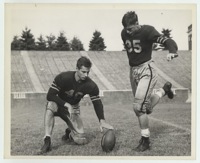
But then, maybe I’m just biased. Fifteen years ago, I was just getting started as the Vice President of the Glee Club, a position whose chief responsibility then was concert publicity, which for us largely meant posters. So I learned how to design posters. I inherited a big cardboard portfolio of posters with designs that had been used and reused for many years. Most were hand drawn; all had some level of nostalgic meaning. I thought that the posters didn’t stand out, and that they didn’t project the kind of image that director John Liepold and I thought the group should claim: professional, an important part of the University, fun. The first poster of the year was for the Kickoff Concert. So to replace the hand-drawn image in use for several years prior, I went searching in Special Collections at Alderman Library for old pictures of the football team.

And I found the shot attached to this post, an actual football kick (albeit in practice). I surrounded it with sans serif typography—Franklin Gothic Condensed, letterspaced, a favorite— in homage to a famous Elvis Presley poster of about the same vintage as the photo. It was great. We used it for two seasons while I was there. Then the group moved on to other images and eventually stopped doing Kickoff Concerts.

I found the image again recently while working on a Wikipedia article. It hit me again the same way it did back then, an immediate punch. And I thought about change, and how the immediacy of an image can fool you into thinking that things don’t change. But of course they do, and you can change with them or stay out of the way.