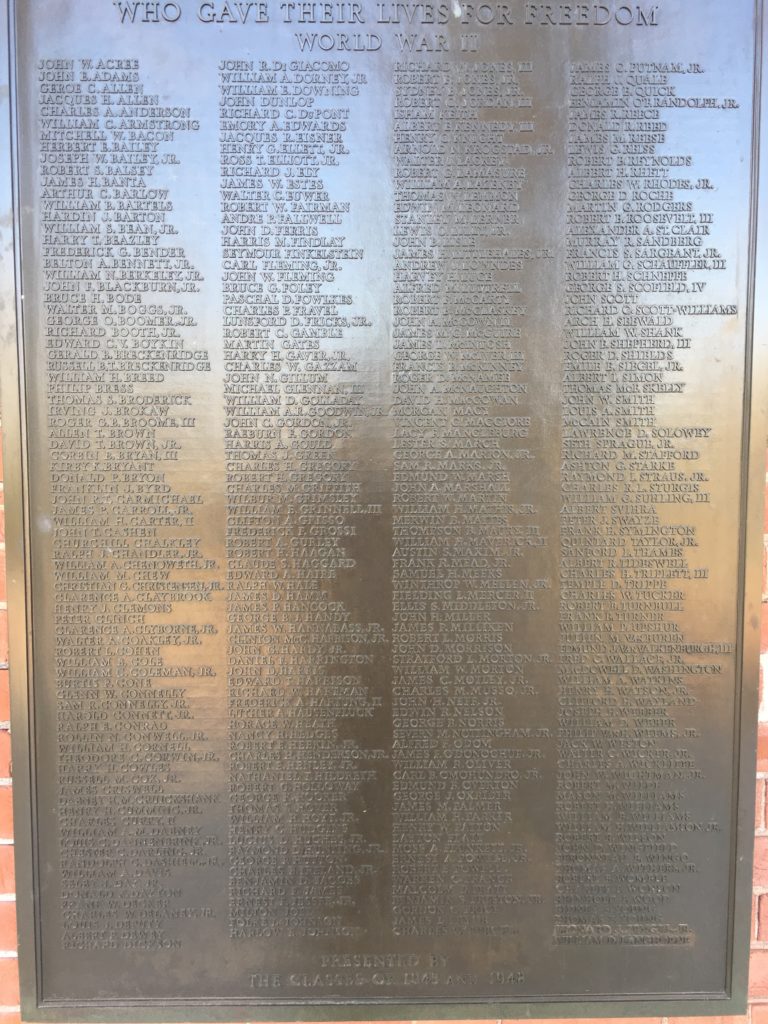
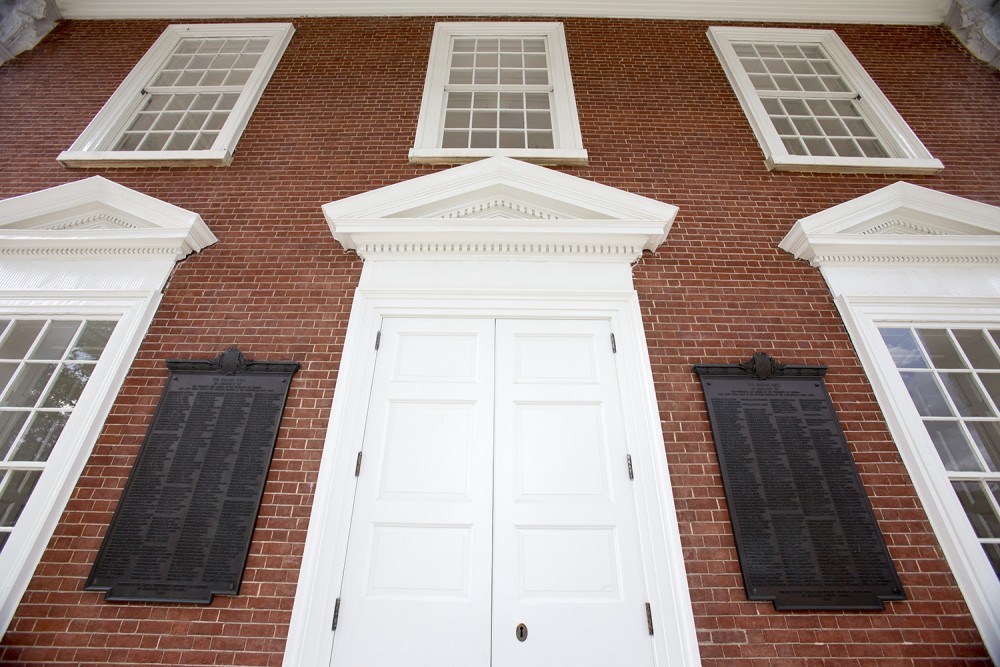
Rotunda memorial tablet for UVA students killed in World War II. Photo courtesy Andrew Breen
As part of my ongoing work on the history of the Virginia Glee Club, I started researching the lives of Club members who became casualties of World War II. With some help from fellow fossil Andrew Breen, who thoughtfully photographed the Rotunda memorial tablet for me, I’ve been able to fill in a few additional names of Glee Club alums who gave their lives in service. This work is ongoing; I have no doubt I’ll find more than the seven I’ve found thus far.
The variety of ways in which young men gave their lives to save their country during this war is both inspiring and daunting. I’ll post more information as I get it.
The actions over the weekend are a direct outcome from the events that happened in Charlottesville over August 11–13, in which torch bearing neo-Nazis marched through Grounds shouting anti-Semitic slogans. Passing up into Grounds from the Bookstore and presumably passing the student center at Newcomb Hall on their way up the Lawn, they came around the Rotunda, which bore these plaques on its south side, and surrounded a group of 25 counter-protesting students at Moses Ezekiel’s statue of Thomas Jefferson. They jeered and chanted at the students, and then they threw kerosene and lit torches at them.
Tyler Magill, who was in the Glee Club with me in the early 1990s and who I count as a friend, had joined the students by this time. He was struck by a torch on the side of his neck, which eventually led, a few days later, to his suffering a stroke.
More horrors happened over the weekend, including 20 year old James Alex Fields driving his car through a crowd of protesters, deliberately murdering Heather Heyer and injuring many others.
I have been trying to write my feelings about what happened that horrific weekend for over a month, and have not been able to. Among other reasons, it feels as though once I started I wouldn’t be able to stop.
But part of it is that today’s liberal Charlottesville sits atop a veritable Indian burial ground of undercurrents of racism and secession. This is, after all, the school where the Jefferson Society debated, on January 14th, 1860, whether a state had the right to secede from the Union (the conclusion was affirmative), and where the Washington Society decided in a November 1860 debate that the Southern States should secede; where students flew the flag of the Confederacy atop the Rotunda in February 1861. And it was also the school that was built with slave labor and that ran on the efforts of enslaved workers, and that was founded by a United States President who wrote “we hold these truths to be self-evident, that all men are created equal,” but who held both a peculiar definition of “all” and over 100 slaves.
So it is that Charlottesville seems a seat of that original sin of our country, and that our past is now coming home to roost.
The University’s actions to remove the names of those who fought to uphold slavery from its most central, symbolic building are a good start. I think the decision to display the memorials elsewhere is a good way to resolve the tension I have felt about removing public Confederate symbols. I don’t want us to forget our historic complicity in injustice and violence, but I also don’t want those reminders to continue their mission of oppression.
For every use of Facebook that is lamentable or just plain awful, there’s something like the Newport News group that I’m a member of. Filled with people whose memories of the Peninsula predate mine, it’s regularly full of surprises. None so big, though, as the pointer to a discussion forum on a Newport News High School site about World War II POW camps in my home town.
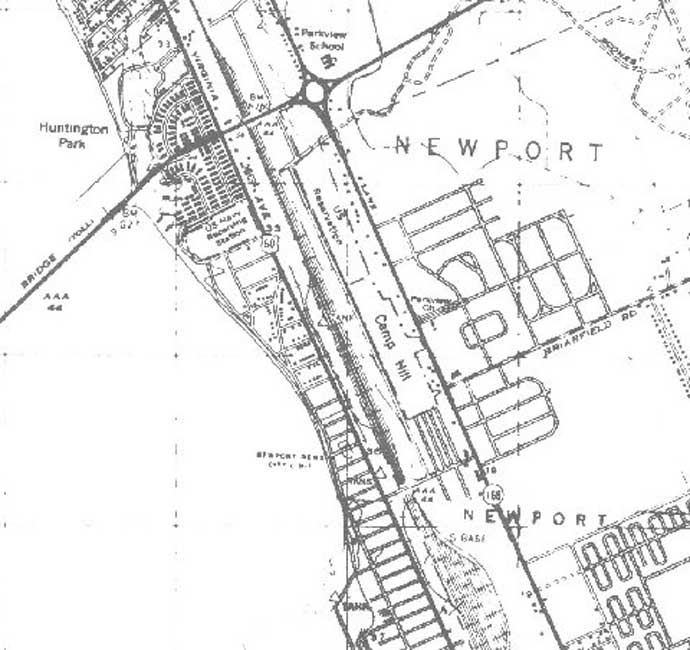
I think I had been vaguely aware that some prisoners of war had been housed in Newport News, particularly at Camp Patrick Henry (in my childhood Patrick Henry Airport, today known as Newport News/Williamsburg International Airport or “New Willie”). But I wasn’t aware of the scope: over 134,000 German and Italian POWs were housed in the camps at Camp Patrick Henry, Fort Eustis, a POW camp near the Port of Embarkation, Camp Hill, and other locations. According to one article, a major purpose of the camps was the “re-education” of former Nazis who were drafted into the German army unwillingly.
To my surprise, I also learned that there were enemy alien interment camps (like the ones in California that held a young George Takei) in New Market, Staunton, and Bath; these held German, Italian and Japanese natives.
History isn’t distant; sometimes it’s right where you’ve been all along.
More fools, we. As one digs deeper into the history of the house, one turns up a handful (only) of references to it in official University and Charlottesville publications. One of those identified a Miss Pattie J. Daffan as the proprietor of the Cabell House. Another publication placed her as the proprietor of a boarding house at 852 West Main Street, only a block from where the Cabell House was supposed to be. It seems pretty clear that this was the actual address of the Cabell House.
Why, one may ask, is this exciting? Well, partly because it’s important to know where to pay homage to our as-yet-unknown founding fathers. But also because the property between 9th and 10th on West Main Street is a Hampton Inn, but the property at 852 West Main Street is World of Beer (as well as apartments). Surely a World of Beer is a better location for our Glee Club than a motel.
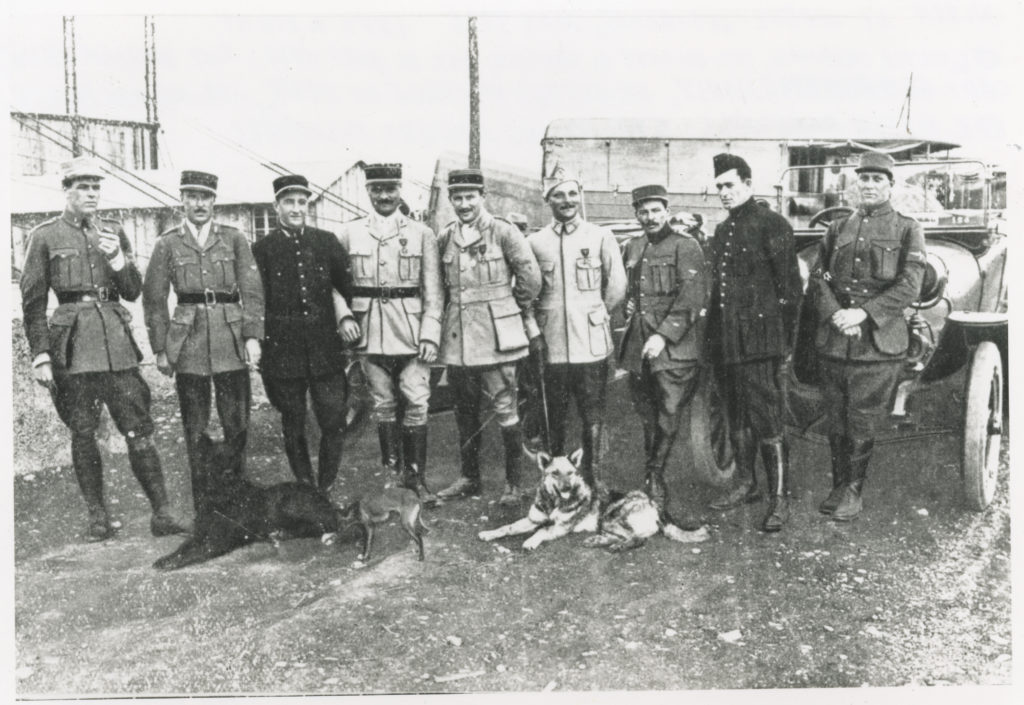
Some members of the fighter squadron N.124, “l’Escadrille Américaine,” in May 1916. Corporal James Rogers McConnell is at the right. (Courtesy Air Force Times)
First, McConnell was at once the last and first of his kind. First because he was the first UVA student to be killed in that awful war; last because he was the last American airman killed before the United States officially entered the war April 6, 1917, just 18 days after his death. He was also effectively the last American warrior-as-adventurer, in the model of Teddy Roosevelt or the other early 20th century military leaders who held greater fame in civilian life.
Indeed, his decision to head to France, and later join the Escadrille after serving as an ambulance driver, is best read through the lens of Roosevelt as a role model. As he is quoted in the introduction to his memoir Flying for France, “These Sand Hills will be here forever, but the war won’t; and so I’m going.” But later he was converted to the belief of the absolute rightness of the French cause, and so he entered his combat role.
He was last in another way too—probably the last prominent UVA student to partake so fully of UVA’s extracurricular offerings. As King of the Hot Feet he was part of the University’s tradition of revelry; as one of the earliest known members of the Seven Society he was a founder of the tradition of more sober and secretive organizations that focused on good works.
Cavalier Daily: Final report on Confederate memorials presented to city. Interesting tension between moving the statues of Robert E. Lee and Stonewall Jackson and recontextualizing them, with some unusual voices on both sides.
Interesting, too, to note the association of both statues within a historically segregated park and the donor of both statues and park, namely Paul McIntire, also a major donor to the University of Virginia.
Two streams of media combined for me in the last few days. I finished reading The Underground Railroad last week, and I found The Year of Jubiloon Dust to Digital. Both brought an immediacy to some of what I’ve been thinking and learning about my country and the South in the years before (and during) the Civil War.
Colson Whitehead preserves a lot of things that really happened in the Underground Railroad, such as concealing runaways in attics and under haybales in wagons, but mythologizes the motivating spirit by envisioning a vast, mysterious underground network of tunnels with real trains running beneath barns and sheds. When Cora the runaway slave asks in astonishment “Who built it?,” the reply comes “Who builds anything in this country?” “Who do you think made it? Who makes everything?”
The unspoken secret: We built it. We built everything in this country. As Whitehead’s messianic Lander says later in the book, “Black hands built the White House.” The secret Whitehead tells is that the Underground Railroad wasn’t made up of well meaning whites with their attics and trap doors; it was built by the slaves themselves who decided they would fight for their freedom.
The flip side of that self determination? “The Year of Jubilo.” This is a Civil War song, written in 1862 by Henry Clay Work as “Kingdom Coming,” and familiar to fans of Tex Avery by its inclusion as the tune whistled by the “Confederate wolf” in “The Three Little Pups.”
Knowing it’s a Civil War era tune doesn’t exactly prepare modern ears for the lyrics. Even without the dialect, lines like “Say, darkies, have you seen the massa with the moustache on his face” are jarring to modern ears. But listening closer, the inversion that the song depicts, with the master running away from the arrival of the “Lincoln gunboats” and pretending to be a runaway slave himself to await capture, while the slaves avail themselves of his wine, is a different facet of the Civil War experience and captures part of the feeling that the world was turning upside down.
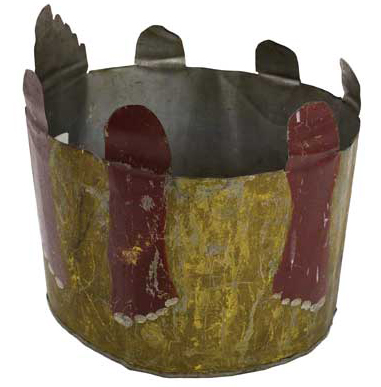
It made me think of some of the few artifacts that have surfaced from the University of Virginia’s secret societies. Most of them have left behind only their rings or ribbons, but a few other items of stranger affect survive, particularly from the Hot Feet.
My favorite is the crown of the Hot Feet, pictured above and worn by James Rogers McConnell, among others. Though the crown was updated by the time that Lewis Crenshaw wore it, it is still a fascinating reminder of this intersection between UVA mythology, folk art and the American tendency toward the borrowed ritual image. It would be fascinating to see if any of the other … intriguing artifacts pictured below from 1906, showing the coronation of Charles S. McVeigh outside the East Range, survive.
Today’s adventure into the musical past of the University of Virginia comes courtesy of my sense of curiosity. I had often seen the statement (starting with Virginius Dabney’s fine history of the University, Mr. Jefferson’s University) that “Virginia, Hail, All Hail” and “The Cavalier Song” were winners of a competition sponsored by the student newspaper, College Topics, for the best fight song and alma mater song. It occurred to me that I had repeated that claim in several places, including on Wikipedia, without actually checking the primary source.
I had a little downtime on Saturday and paged through copies of College Topics from early 1923—thanks, Google. What I found surprised and amused me a little.
Discovery one: The contest was not widely subscribed. On January 19, 1923, with twelve days left in the running, Topics ran the following article:
So apparently, even in this more musical time, students and alumni were not pounding down the door to provide original songs.
Discovery two: The competition was not specifically to find an alma mater song or fight song; it was more generally about getting more original songs written about the University and was open to both students and alumni.
Discovery three: The organizers weren’t wild about the winners! On February 16, in announcing the winners, they said the following: “The Committee desires to thank those who submitted songs and to congratulate the winners. It is hoped that the contest will stimulate the student body and alumni to greater effort to give Virginia a still better group of songs with original music.” This attitude may explain why “Virginia, Hail” was not more widely adopted outside the Glee Club. Also of note: neither of the second place winners were Glee Club members, while two of the three first place winners were associated with the Club.
Here’s the article from that day, minus the texts of the winning songs:
I still have one more piece of research to perform, since I haven’t seen the original announcement of the competition. Google News archives doesn’t have College Topics from December 1922, and I can’t find a copy of the December 1922 Alumni News on line either. But I’m a little closer to having good information than I was.
“Rooms beneath the student rooms on the East Lawn”: I couldn’t find a photograph, but the excellent rendering above shows how the sloping elevation of the ridge on which the Lawn is situated exposes access to a basement level beneath the student rooms on either side of Pavilion VI on the East Lawn. These are visible as you approach the Lawn via the alley between the gardens of Pavilions VI and VIII. I distinctly remember a conversation with other students (my memory is they were University Guides, but I could be mistaken) discussing the theory that these anonymous windowless doors were slave quarters, a theory which was dismissed at the time but which appears to be true.
“Even in the recent IATH project to create and render 3D models of the buildings, they appear to exist in a vacuum, without outbuildings”: I spoke hastily. The IATH project in question, the “Jefferson’s University: The Early Life” project, does include renderings of some pavilions in a standalone fashion. But as seen above, for some pavilions a more full representation is provided. Particularly noteworthy is the work that has been done on the Pavilion VI outbuildings, which provides renders and historical context for no fewer than five outbuildings, ranging from Gessner Harrison’s office to a privy to a smokehouse. Also see the page on the Crackerbox, which is described as a combination kitchen and slave residence.
UVA Today: Beneath the Mews. As I noted on Facebook, this article covers a plethora of my interests. University of Virginia archaeologists, working underneath the floor of an outbuilding to Pavilion III, have discovered traces of an original Jeffersonian serpentine wall below where slaves were once housed—and where Virginia Glee Club conductor Harry Rogers Pratt and his wife Agnes Rothery once lived.
Pavilion III, currently undergoing a minor renovation, is said to be one of the few pavilions not to have suffered substantial exterior structural additions or alterations from its Jeffersonian incarnation. Apparently this extends to its mews, which an official Historic American Buildings Survey notes was “constructed between 1829–1830 [and] … is visible over the north garden wall.”
Which means, of course, that the Mews was the outbuilding that was visible from the rear window of my Lawn room when I lived in 3 West in 1993-94.
The other thing that’s striking about this recent announcement is the matter-of-fact inclusion of the following statement, which would have been highly controversial even when I was a student:
“In its early years, [The Mews] served as a quarters for enslaved people, and may also have served before 1865 as a washhouse and apparently, a chicken house,” said Kirt von Daacke, co-chair of the President’s Commission on Slavery and the University. “The building is important because it is one of only a handful of extant structures where enslaved people lived and worked.”
So this fixture of the landscape was silently, unremarked-on, a remnant of the secret history of slavery at the University of Virginia. I say “secret” because it was absolutely never discussed when I was a student. The guides would deny that the rooms beneath the student rooms on the East Lawn housed slaves, when it was clear in retrospect that they must have. No one talked about the fact that much of the original Jeffersonian plant was built with slave labor. And yet it was all around us. If you want an example of how screwed up America’s relationship to reality and its own history is, that’s as good as any.
Aside: the photo at the top of the post is of the front façade of the Pavilion because apparently no one takes pictures of the rear garden. It is emblematic of the history of slavery at the University that this staggeringly well-photographed Jeffersonian residence has very few photographs published of its back gardens and outbuildings. Even in the recent IATH project to create and render 3D models of the buildings, they appear to exist in a vacuum, without outbuildings.
West Lawn (Pavilions I and III with student rooms), University of Virginia
UVA Today: Jeffersonian Roofs Restored Over Lawn Rooms. When I lived at 3 West Lawn, there were pitched slate roofs over all the student rooms on the Lawn at the University of Virginia. Turns out that those roofs post-dated Jefferson. His original idea? Flat roofs. And the design was ingenious: Cover a serrated wooden roof with decking. The rain water would run down through the decking and run out through the valleys of the wood roofs. Kind of like this:
= = = = = = = = = =
^^^^^^^^^^^^^^^^^^^
Unfortunately, Jefferson’s vision outstripped his engineering. The wood sub-roof leaked, damaging the roof over the colonnade walkway. So in the 1830s the flat roofs were covered over with pitched slate roofs.
What I find so fascinating about the story is the fact that Jefferson’s original roofs were preserved under the slate for 180 years. I also like this tidbit:
“All the single-leaf doors were replaced in the 1990s with new half-leaf doors,” Kutney said. “We’ve more recently found evidence that the single-leaf was the original Jefferson condition, so we’re going back to the single-leaf.”
When I was a student, I had a discussion with the late J. Murray Howard about the ongoing renovations of the Lawn, including his dismay that students damaged the paint of the doors on their Lawn rooms by hanging signs on them advertising various student activities. He didn’t appreciate my observation that the students who occupied the Lawn were the living embodiment of Jefferson’s vision just as much as the buildings, and that part of the vitality of that vision was the presence of advertising for the student groups who had gotten them to the Lawn in the first place. Howard was responsible for adding the half-leaf doors. It’s petty of me, but I like the reminder that even experts can be wrong.
Pitchfork: Blood and Echoes: The Story of Come Out, Steve Reich’s Civil Rights Era Masterpiece. One of Reich’s early experiments in tape loop composition, the composition treats the spoken testimony of 18-year-old Daniel Hamm, who was beaten by police for trying to protect Harlem school children from being injured by an overexcited patrolman.
Later unjustly incarcerated as one of the Harlem Nine, Hamm’s story lives in Reich’s composition. Beaten by six to 12 officers over the course of the night, they tried to refuse him medical treatment on the grounds that he wasn’t visibly bleeding. Hamm recalls that he reached down to a knotted bruise on his leg and “I had to, like, open the bruise up, and let some of the bruise blood come out to show them.” Reich loops this appalling statement via two tape players, one in each stereo channel, that drift slowly into and out of phase, into what has varyingly been described as a “raga,” a psychedelic experience, early minimalism, and media overload. To me, it speaks as a reminder that Black Lives Matter is responding to something that isn’t a new problem.
In a follow up to the post about the 1953 Virginia Spectator and its booklet of ersatz carols, here’s one titled “Advice to All Those Who Think That Being a Civil Engineer is the Greatest Form of Life, or Rudolph the Red-Nosed Wahoo.” Just goes to show that the fine art of taunting the toolies—er, I mean, engineering students—is not new.
A few lyric references:
Slide rule: Precursor of the computer and electric calculator. Ask your dad.
The men of Rugby Road: Then as now, the center of fraternity parties. Presumably “first base” referred to socializing with women at fraternity parties, rather than “getting to first base” WITH a fraternity member; but you never know.
Thornton Hall: UVA engineering building.
“Punch”: UVA humor magazine of the 1940s and 1950s, sometimes appearing in the pages of the Spectator.
Rudolph the red-nosed wahoo,
Was a scroungy first-year man.
Oh how his slide rule hung out,
And oh how his nostrils ran.
He never got to first base
With the men of Rugby Road.
He settled for the worst place:
And at Thornton Hall he glowed.
Then one dreary Christmas eve
F. Scott’s ghost appeared:
“Rudolph with your nose so drippy
Try to act a bit more Chippy.”
Now he’s an English major,
He’s no longer out to lunch,
Sipping his dry martini,
And reading his last week’s “Punch.”